2026-10-13
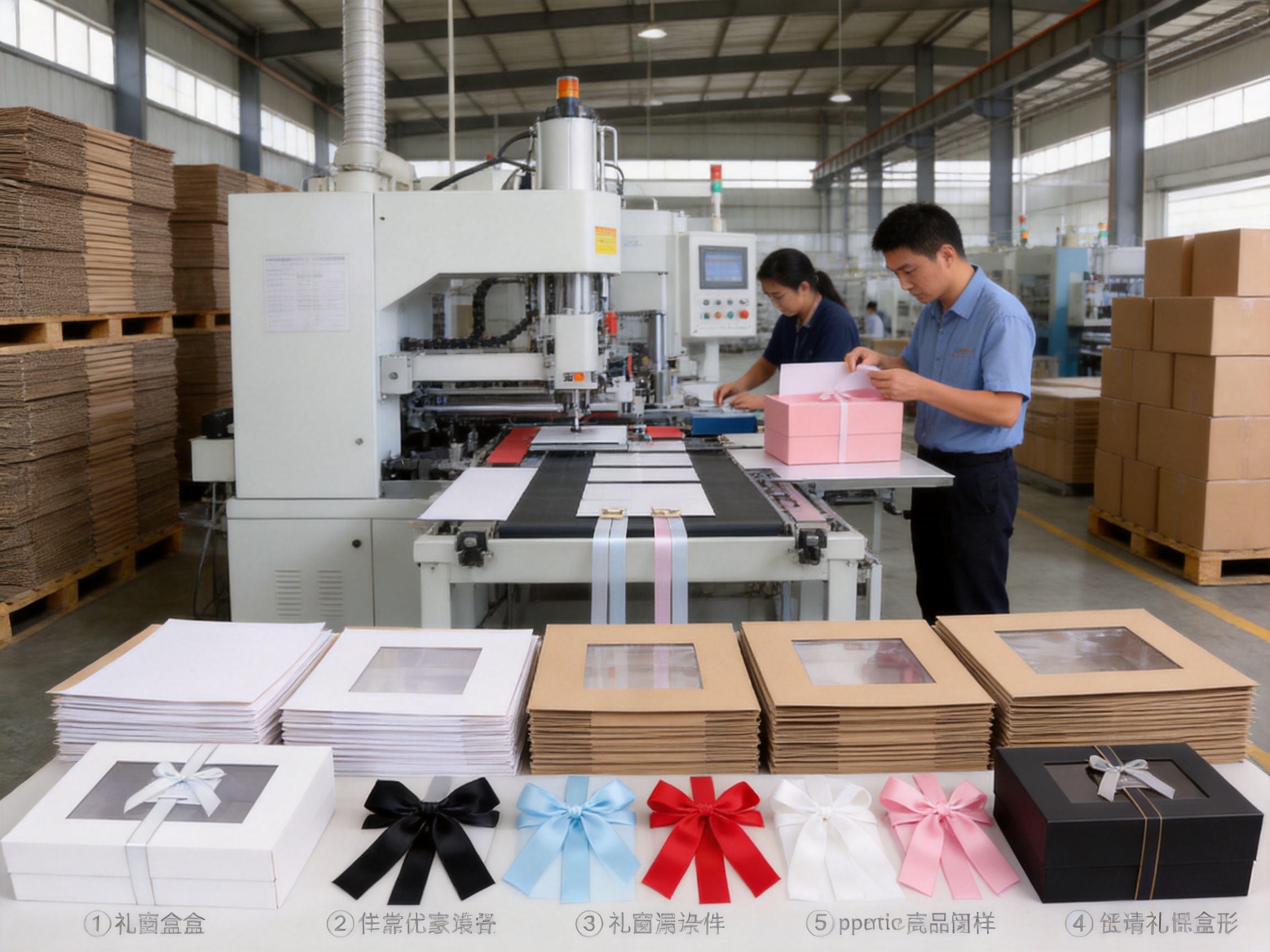
Packaging is often the first physical interaction a customer has with a product. Before a gift is opened, used, or shared, its box has already communicated messages about quality, care, value, and brand identity. For this reason, the choice of gift packaging can have a direct influence on purchasing decisions, customer satisfaction, and the overall memorability of a product. A well-designed box protects its contents while also creating anticipation and giving the recipient an attractive unboxing experience.
The transparent window recyclable paper folding gift box is designed to meet these requirements in a single packaging format. It combines a refined paperboard structure, a clear viewing window, a matte laminated surface, a satin ribbon, and a foldable construction. This combination creates a package that is visually elegant, practical to store, efficient to transport, and adaptable to many types of customization.
Unlike ordinary cartons that hide the product until the package is opened, this style of gift box presents the contents immediately through its transparent top window. The window can be particularly valuable for gift sets, stationery, accessories, wedding favors, cosmetics, small household products, and other items where appearance is an important part of the purchase decision. At the same time, the paper-based structure offers a more premium presentation than a basic plastic bag or plain shipping carton.
Produced by Zhejiang Shihao Gift Packaging Co., Ltd., the folding gift box is available in several standard sizes and can also be adjusted according to a customer’s requirements. The manufacturer supports custom colors, logos, festive graphics, thematic patterns, and finishing effects. With more than 15 years of experience in paper gift packaging, an in-house design team, certified production capabilities, and export experience across multiple international markets, the company is positioned to support both standard orders and customized packaging programs.
Gift packaging is no longer viewed only as an outer container. In many markets, packaging is part of the product experience. Consumers increasingly notice the material, structure, finish, opening method, and visual presentation of a box. A package that looks carefully designed can help a product appear more valuable, even when the contents are similar to competing products.
This is especially relevant to gifts. A gift is often purchased to express appreciation, celebration, congratulations, affection, or business recognition. The package therefore needs to support the emotional purpose of the purchase. A box that appears too plain, difficult to open, or poorly finished can weaken the impression created by the gift itself. In contrast, an attractive box can make the recipient feel that the sender has paid attention to detail.
The transparent window folding gift box addresses these expectations through several coordinated features. The window allows the buyer to inspect the product before purchase and allows the recipient to see the gift before opening it. The matte surface offers a soft and sophisticated appearance. The ribbon contributes a traditional gift-giving signal. The folding format reduces the space required for storage and transportation. Finally, customization options enable the same basic structure to serve different industries, seasons, campaigns, and brand identities.
For retailers, importers, wholesalers, and brand owners, these features can provide a balance between presentation and operational efficiency. A rigid box may offer a luxurious appearance but require significantly more warehouse space. A simple folding carton may be efficient but lack the visual impact expected from a premium gift. The folding structure described here is intended to bridge that gap by delivering a refined presentation without sacrificing flat-storage convenience.
The product is a paper folding gift box with a transparent window built into the lid. It is available under item numbers Z262, Z263, Z264, Z265, and Z266. These models represent different size options, allowing buyers to select a suitable format for different products or gift combinations.
The box is designed to be supplied in a folded or flat condition. This means that multiple units can be stored in a comparatively compact area before use. When the box is needed, the panels can be unfolded and secured through precisely designed folding lines and clasps. The assembled structure is intended to provide reliable support for the packaged contents while retaining the convenience associated with folding packaging.
The lid includes an embedded closure. This helps the top panel remain aligned with the body of the box and makes the package straightforward to open and close. A satin ribbon adds an additional securing element while also improving the visual presentation. Depending on the final design, the ribbon may be coordinated with the box color, printed artwork, seasonal theme, or brand identity.
The transparent window is positioned to give a clear view of the contents. This can be useful when the product itself contributes to the visual appeal of the package. For example, a gift set containing colorful stationery, small accessories, confectionery, wedding favors, or decorative items can be displayed without requiring the package to be opened in a retail environment.
The overall structure is deliberately simple and adaptable. A minimalist form can be used for modern retail packaging, while special printing, hot stamping, or decorative elements can transform the same construction into a festive, romantic, corporate, or luxury presentation.
The following table summarizes the principal information available for the standard models.
| Item | Available models: Z262, Z263, Z264, Z265, Z266 |
| Material concept | Paper-based folding gift box with transparent window |
| Surface finish | Matte lamination |
| Closure | Embedded lid closure with satin ribbon support |
| Color | Selection from the color bank or customized design |
| Minimum order quantity | 1,000 pieces |
| Available sizes | 20 × 18.2 × 8 cm; 28.2 × 20.2 × 9.2 cm; 33 × 25 × 12 cm; 33.5 × 26 × 15.5 cm; 39 × 28 × 17.8 cm |
| Design support | Professional suggestions, in-house design assistance, and customized artwork |
| Artwork formats | AI and CorelDRAW files |
| Sample lead time | Approximately 3–5 days |
| Customization methods | Logo printing, hot stamping, screen printing, festive elements, and thematic graphics |
The range of dimensions makes the product suitable for both compact and relatively large gift presentations. Buyers can select a standard size for faster development or work with the design team to adapt the dimensions to a particular item. Correct sizing is important because a box that is too large may allow excessive movement, while a box that is too small can damage the product or make the package difficult to close.
The minimum order quantity of 1,000 pieces is appropriate for retailers, wholesalers, promotional programs, event organizers, and brands preparing a coordinated packaging launch. It also gives buyers an opportunity to maintain consistent packaging across a product line or seasonal campaign.
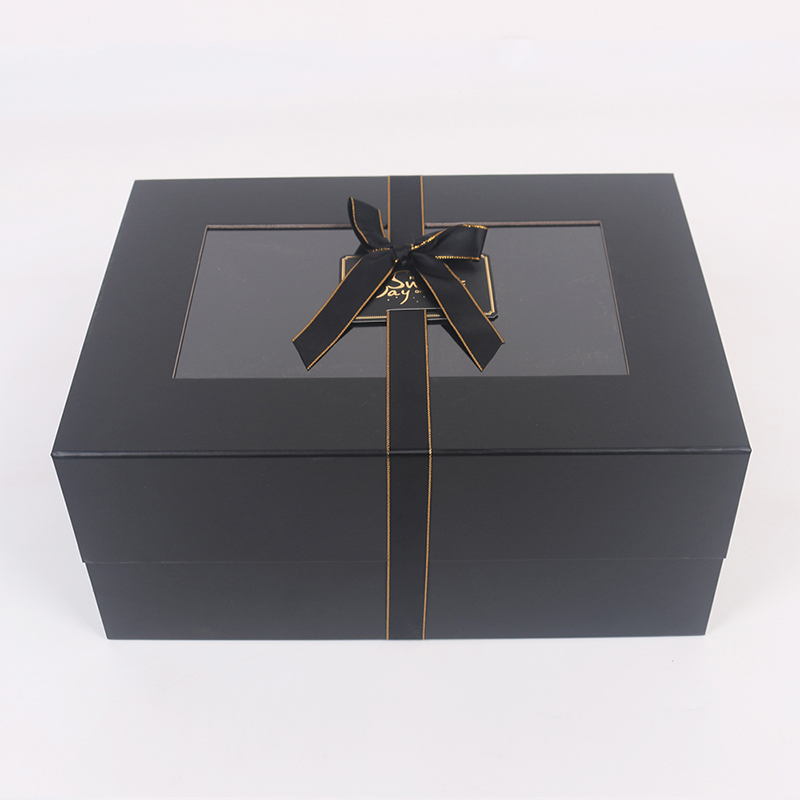
Transparent Window Recyclable Customizable Paper Folding Gift Box Packaging
One of the most noticeable features of the box is its matte laminated exterior. Matte lamination creates a smooth, low-gloss surface with a soft visual effect. Compared with a highly reflective gloss coating, the matte finish gives the package a more restrained and contemporary appearance. It can help colors appear calmer and allows typography, logos, and decorative graphics to remain visually balanced.
The surface also offers practical benefits. According to the product specifications, the matte finish is resistant to ordinary scratches and wear and is less likely to show fingerprints. These characteristics are valuable during handling, storage, retail display, and delivery. Gift packaging is often touched by multiple people before it reaches the final recipient, so a surface that maintains a clean appearance can contribute to perceived quality.
Matte lamination is particularly suitable for minimalist packaging. When the design uses a limited color palette, the surface texture becomes part of the visual identity. The slight frosted effect can make the box feel more tactile and substantial. It also creates a useful contrast with brighter elements such as a satin ribbon, metallic hot stamping, or the transparent window.
For brands that want a luxury appearance without an excessively ornate design, matte lamination offers a practical design foundation. It can support neutral colors, pastel shades, dark tones, seasonal color schemes, or customized brand colors. The result is packaging that looks polished while remaining suitable for a wide range of products.
The transparent window is one of the clearest advantages of this packaging format. Traditional gift boxes generally require the customer to open the package or rely on printed images to understand what is inside. A window provides immediate product visibility. This can reduce uncertainty at the point of purchase, particularly when the appearance, color, arrangement, or style of the product influences the buying decision.
For retailers, visible contents can improve shelf communication. A shopper can understand the package more quickly without reading extensive information. When several gift boxes are displayed together, the window can help differentiate products by showing the actual item rather than only a printed representation.
For gift recipients, the window creates anticipation. Seeing a carefully arranged gift through the lid can make the presentation feel more personal. It also allows the package to function as a display container after the initial purchase. In some applications, the recipient may keep the box for organizing small items, stationery, accessories, or keepsakes.
The window can also help support quality control during packing. Operators can inspect the arrangement of the contents without repeatedly opening the lid. This is useful for gift sets that contain several coordinated products, where correct positioning is important to the overall presentation.
From a marketing perspective, the window creates an opportunity to combine product display and branding. Logos, printed patterns, or messages can be positioned around the viewing area without obstructing the product. The design team can adjust the window proportions, printed panels, and internal arrangement so that the box communicates both the brand identity and the value of the contents.
A major operational advantage of this product is its foldable construction. Rigid gift boxes are often shipped in an assembled condition. While they may provide a premium appearance, their fixed volume can increase transportation costs and require more warehouse capacity. Folding boxes can be supplied in a flatter condition, allowing more units to be stored and transported within the same space.
Flat storage can be particularly valuable for seasonal businesses. Retailers may need to purchase packaging weeks or months before a holiday, wedding season, corporate event, or promotional campaign. A package that takes up less space can reduce the pressure on storage facilities and make it easier to organize inventory by size, color, or project.
Transportation efficiency can also influence the total environmental impact of packaging. When more flat-packed units can be loaded into a shipment, the number of transport movements or the amount of space used per unit may be reduced. The exact benefit depends on order volume, shipping method, and final assembly requirements, but the structural principle is clear: packaging that can be stored efficiently offers operational advantages beyond its appearance.
When unfolded, the box uses precise clasps to create a stable body. This is important because a folding box must balance two requirements: it should be easy to assemble, but it must also remain secure during handling. The clasp system supports the box panels and helps maintain the intended shape once the package is ready for use.
The design is therefore appropriate for businesses that value both presentation and efficiency. It can offer a more elevated appearance than a basic folding carton while avoiding some of the space-related limitations of fully rigid packaging.
The lid uses an embedded closure to improve the opening and closing experience. A closure should be intuitive for staff, retailers, and recipients. If it is too complicated, packing becomes slower and the gift may be damaged during opening. If it is too loose, the package may open unintentionally. An embedded closure provides a neat solution within the structure of the lid.
The satin ribbon adds another layer of security and decoration. Its smooth sheen contrasts naturally with the matte laminated paperboard. This contrast creates visual depth without requiring an overly complex design. The ribbon can be selected to complement the box color or customized theme. For example, a soft ribbon may suit wedding favors, while a darker or metallic-accented ribbon may be more appropriate for corporate or holiday gifts.
Ribbon details also influence the tactile experience. Opening a gift is a physical action, and the ribbon gives the recipient a familiar cue that the box has been intentionally prepared. It can turn a simple lid into a more ceremonial opening process. This quality makes the package suitable for occasions where the presentation is nearly as important as the product itself.
From a manufacturing perspective, the ribbon must be applied consistently so that the package remains visually aligned. The production process therefore requires attention to ribbon placement, tension, length, and coordination with the lid structure. Consistent assembly helps ensure that large quantities of boxes present a uniform appearance when displayed or distributed.
Customization is an important feature for companies that need packaging to reflect a specific identity or campaign. The standard box structure can be adapted through color selection, printed artwork, logos, decorative effects, and size adjustments. This gives buyers the flexibility to use one packaging concept for multiple markets or product categories.
Customers can select colors from the manufacturer’s color bank or submit a customized color requirement. Color selection can be coordinated with an existing brand system, product collection, wedding palette, holiday theme, or retail environment. Matte lamination can help create a consistent visual effect across different color choices.
Brand logos can be added to visible areas of the package, including the lid and side panels. A carefully positioned logo can reinforce recognition without overwhelming the product presentation. Businesses may choose a discreet logo for a premium minimalist design or a more prominent treatment for promotional packaging.
Hot stamping can be used to create metallic or special-effect details. It is suitable for logos, names, borders, short messages, and decorative patterns. Metallic accents can provide a strong contrast against the matte surface and can help communicate premium value. Gold, silver, and other effect options may be considered according to the design and intended market.
Screen printing can support bold graphics, solid-color details, and thematic artwork. It may be useful for festive packaging, event gifts, seasonal collections, and designs that require strong visual clarity. The production team can advise on artwork preparation, color coverage, and suitable positioning.
The box can be customized with holiday motifs, wedding elements, business messages, celebration graphics, or collection-specific patterns. This allows buyers to create packaging for occasions such as weddings, anniversaries, festivals, corporate events, product launches, and seasonal retail programs.
Customers may provide artwork files in AI or CorelDRAW formats. The manufacturer’s design team can also offer professional suggestions and help refine the layout. This is particularly useful when a buyer has a general concept but needs assistance with dimensions, print placement, color balance, or production feasibility.
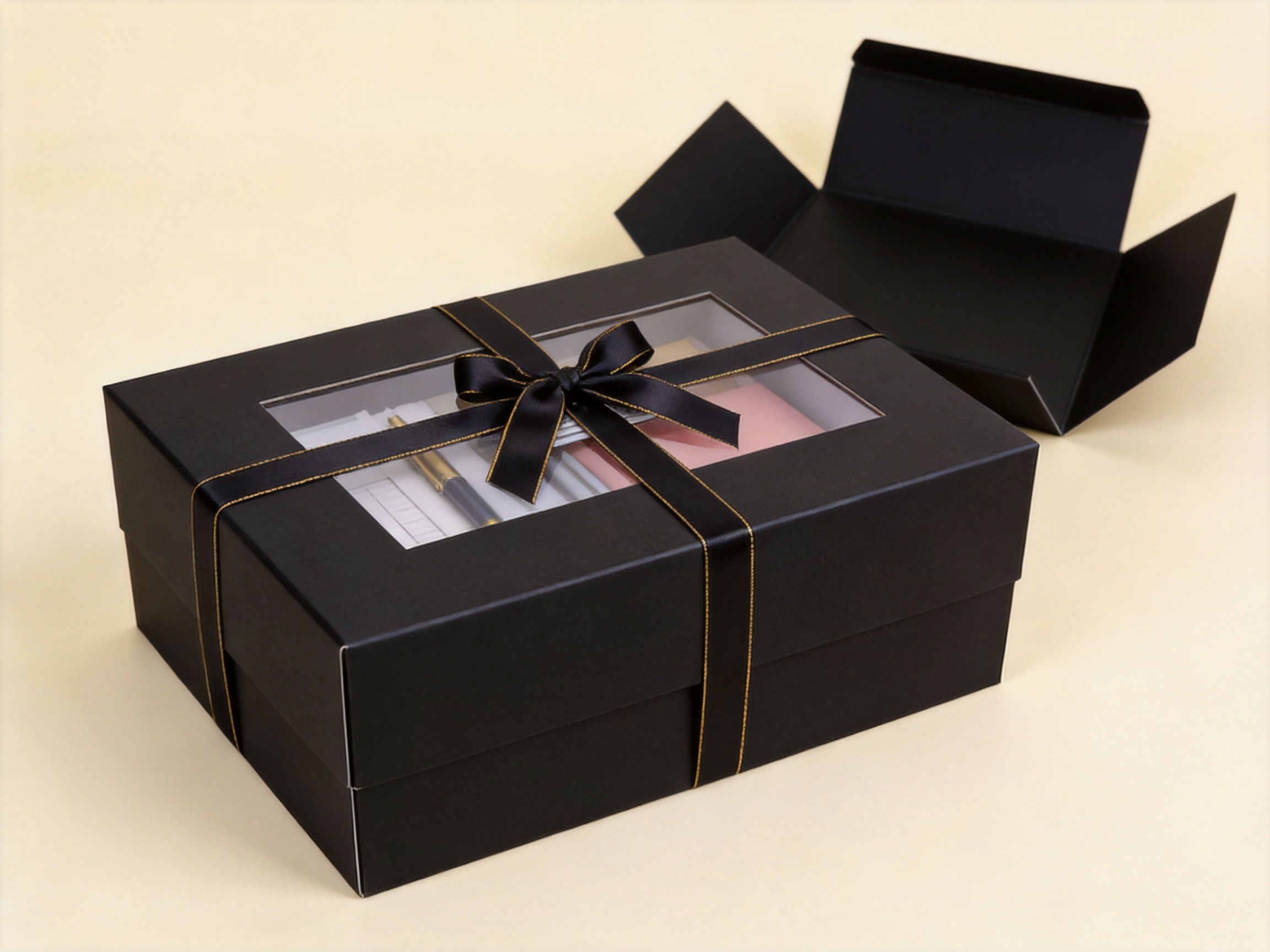
The folding gift box is adaptable because it combines a neutral structure with customizable visual elements. Its applications extend beyond one product category.
Wedding favors require packaging that feels personal and visually coordinated with the event. The transparent window can display a small favor, keepsake, confectionery item, or decorative accessory. The ribbon can be matched to the wedding colors, while names, dates, initials, or short messages can be printed or stamped on the lid.
Corporate gift packaging should appear professional and organized. A matte box with a restrained color palette and a discreet logo can support business gifting, client appreciation, employee recognition, and event distribution. The window allows the contents to be presented clearly, while the folding format helps simplify storage before a large event.
Seasonal packaging benefits from the ability to change graphics and colors without redesigning the entire structural concept. Holiday icons, festive patterns, seasonal messages, and coordinated ribbons can be added to create limited-edition packaging. The available sizes make it possible to package individual items or small curated gift sets.
The box can be used for stationery collections, writing instruments, small notebooks, craft products, desk accessories, and other compact items. The transparent window is useful when the arrangement and color of the stationery contribute to the product’s appeal. After the gift is opened, the box may continue to function as a storage container.
Small beauty products, personal accessories, lifestyle items, and curated care sets can benefit from a box that combines visibility with a premium finish. Brands can use hot stamping, screen printing, and coordinated colors to align the packaging with a broader visual identity.
Companies preparing promotional campaigns can customize the box with event names, campaign messages, sponsor logos, or thematic graphics. The folding format is useful when packaging must be prepared in advance and stored until the event date.
The manufacturer behind this product is an export-oriented company specializing in the production, research and development, and sales of paper gift packaging boxes. With more than 15 years of industry experience, the company has developed capabilities covering design support, structural development, printing, finishing, assembly, and order production.
The production facility covers approximately 20,000 square meters and employs around 300 people. This scale provides a foundation for handling different order requirements, from standard product programs to customized packaging projects. The company reports an average daily production capacity of approximately 5,000 sets of gift boxes, supporting the needs of wholesalers, retailers, importers, and brand owners.
Manufacturing capacity is valuable not only because it allows larger orders, but also because it can improve production planning. A structured manufacturing system helps coordinate raw materials, artwork approval, printing, finishing, assembly, inspection, and shipment. For customers working with fixed launch dates or seasonal deadlines, this type of organization can be an important consideration.
The company also maintains its own design team. This allows customers to receive professional recommendations during the development stage instead of relying only on basic production instructions. Design support can include choosing appropriate dimensions, balancing the window and printed areas, preparing artwork, selecting finishing options, and adapting a standard structure to a particular product.
The manufacturer has passed BSCI and FSC certifications. BSCI certification is associated with social compliance and responsible working conditions within the supply chain. FSC certification supports responsible forest-management practices for applicable paper materials. Buyers should confirm the scope and validity of certifications for a specific order, but these credentials provide useful evidence that the company recognizes social and environmental responsibilities in manufacturing.
A reliable custom packaging program normally begins with product analysis. The manufacturer needs to understand the size, weight, shape, fragility, and presentation requirements of the item that will be placed inside the box. This information helps determine the most suitable box dimensions, internal clearance, window position, closure arrangement, and paperboard structure.
The next stage is structural design. The folding pattern must be developed so that the panels open efficiently, the clasps hold securely, and the lid aligns correctly. The design team can evaluate how the box will be folded, packed, stored, and assembled. This stage is also where potential problems such as excessive movement, insufficient clearance, or weak folding points can be addressed.
Artwork preparation follows structural confirmation. Logos, graphics, text, color blocks, and decorative elements are positioned within the approved dieline. The transparent window must remain unobstructed, and important information should be placed where it can be seen clearly. AI and CorelDRAW files can be used to support professional artwork preparation.
After artwork approval, paperboard materials are printed and processed. Depending on the design, the package may receive screen printing, hot stamping, or other decorative treatment. Matte lamination is applied to create the intended low-gloss surface and support resistance to ordinary wear and fingerprints.
The window component is then integrated into the lid area. Its placement and clarity are important because the window is one of the primary selling features of the package. The box panels are cut and creased according to the approved structure. Accurate creasing helps the package fold along the intended lines and reduces the risk of misalignment during assembly.
Assembly includes the application of the satin ribbon and the formation of the folding structure. Quality checks should review the printed appearance, surface finish, window condition, ribbon placement, lid closure, dimensions, and overall stability. Samples are available in approximately three to five days, allowing customers to evaluate the physical result before confirming larger production quantities.
This sequence illustrates why custom packaging should be treated as an integrated manufacturing process rather than simply a printing order. Structural design, material selection, finishing, assembly, and quality control all contribute to the final customer experience.
The transparent window folding gift box offers several advantages when compared with common packaging alternatives.
A plain folding carton may be economical and easy to store, but it usually hides the product and may appear less distinctive. The transparent window improves visibility, while matte lamination and ribbon details create a more gift-oriented appearance. The folding construction preserves many of the logistical benefits of a standard carton while adding greater presentation value.
Rigid boxes often create a strong premium impression, but they generally occupy more space during storage and transportation. The folding box can provide an elegant appearance while being stored in a flatter condition. This can be beneficial for buyers managing warehouse capacity or shipping costs.
Plastic packaging can provide visibility, but it may not communicate the same warmth or traditional gift value as a paper-based box. A paper folding gift box can combine visibility through the window with a more tactile and decorative outer surface. The use of paper-based materials may also align more closely with sustainability goals, depending on the exact material composition and local recycling systems.
Generic stock boxes may be available quickly, but they offer limited control over dimensions, color, branding, and seasonal design. Customization allows businesses to create a package that fits the product and supports a particular market position. The manufacturer’s design team can help transform a standard concept into a more distinctive branded package.
Gift bags are convenient, but they may offer less product protection and less organized presentation. A folding box provides a defined shape, a secure lid, and a structured display. The window can show the contents while the box protects them more effectively than a soft bag in many retail and gifting situations.
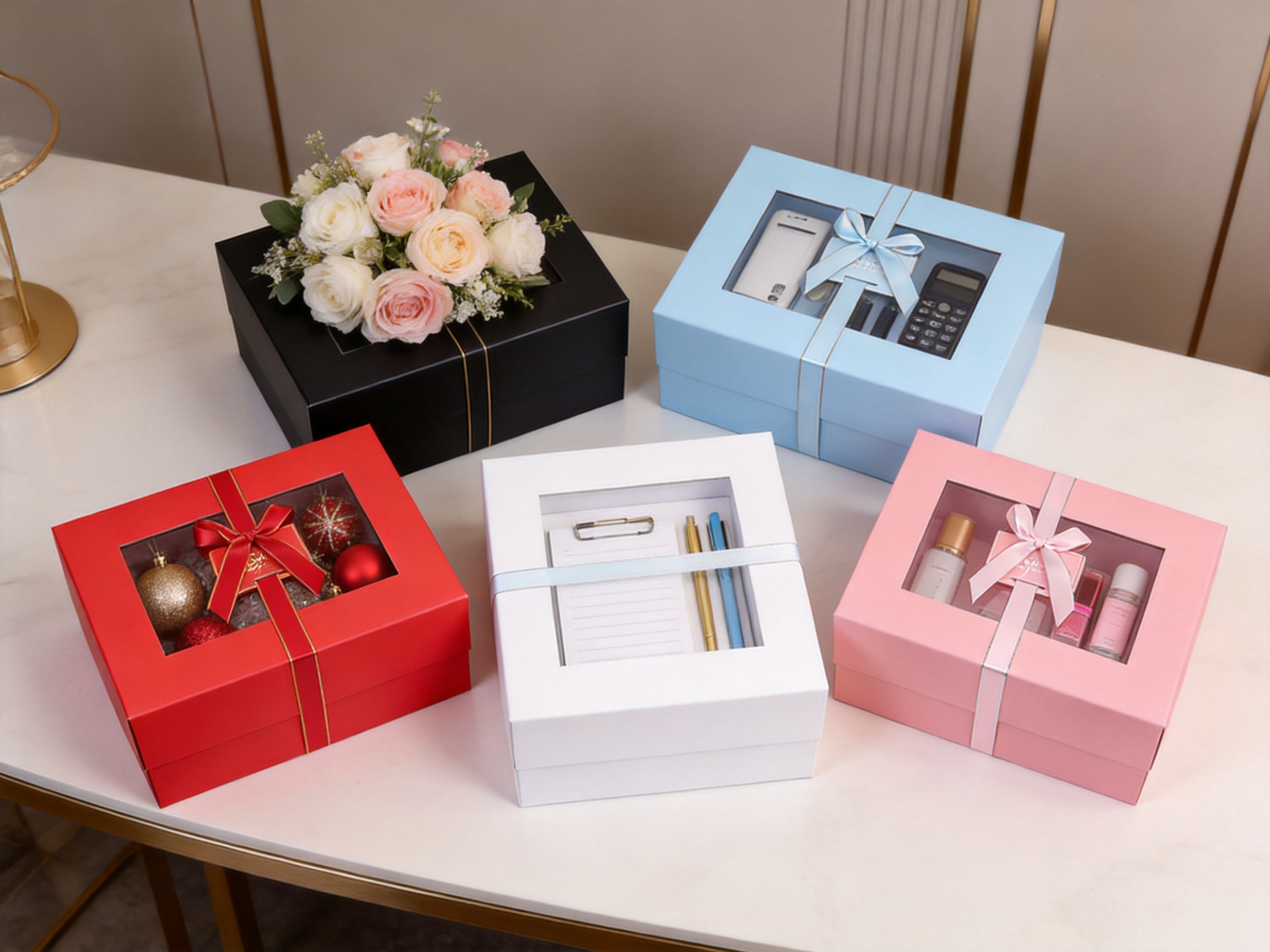
Environmental responsibility is becoming an increasingly important factor in packaging decisions. Buyers are examining not only whether packaging can be recycled, but also how much material is used, how efficiently it can be transported, and whether suppliers follow responsible sourcing and social practices.
This product is described as a recyclable paper folding gift box. Paper-based packaging can be compatible with established recycling systems, although recyclability depends on the complete material structure, coatings, window composition, local collection rules, and contamination levels. Buyers should confirm the exact specification and recycling guidance for their target market before making environmental claims.
The foldable structure supports resource efficiency by reducing the volume required for storage and transportation before assembly. Better space utilization can contribute to more efficient logistics. In addition, a box that remains useful after the gift has been opened may have a longer practical life. Recipients may reuse it for stationery, accessories, keepsakes, or small household items.
FSC certification is another relevant consideration for customers seeking responsibly sourced paper materials. The certification can help buyers assess whether applicable paper inputs come from controlled and responsibly managed sources. Certification details should be reviewed for the specific materials and order conditions.
Sustainable packaging does not depend on one feature alone. It is influenced by material selection, product protection, production efficiency, shipping volume, reuse potential, printing methods, and end-of-life handling. The folding gift box supports several of these considerations, but responsible communication requires buyers to evaluate the full packaging system.
The unboxing experience begins before the lid is opened. A recipient sees the color, texture, shape, window, ribbon, and printed message first. These details establish expectations. Matte lamination can suggest understated quality, while the satin ribbon signals that the item has been prepared as a gift rather than simply packed for shipment.
The transparent window can make the unboxing process more gradual. The recipient first sees the contents through the lid, then opens the embedded closure or ribbon, and finally removes the product. This sequence creates several visual and tactile stages. Such a process can be especially valuable for products promoted through social media, gift guides, retail displays, and event photography.
Branding should be carefully balanced with the gift experience. A company logo is important, but excessive branding may make the package feel like an advertisement rather than a thoughtful gift. A restrained logo placement, supported by an appropriate color palette and high-quality finishing, can communicate professionalism without reducing emotional appeal.
Customized messages can also be used to create stronger connections. Short greetings, event names, product stories, or seasonal phrases can be printed on the outer panels or inside the lid. The manufacturer can help determine which areas are suitable for printing and which areas should remain clear for structural or visual reasons.
Successful packaging development depends on clear communication between the buyer and manufacturer. Before requesting a quotation or sample, buyers should prepare basic information about the product and intended use.
First, provide the product dimensions, weight, and shape. If the box will contain several items, include the planned arrangement and any required internal spacing. Photographs or physical samples can also help the design team understand the product better.
Second, identify the desired box size or explain the available shelf, shipping, and storage limitations. The standard sizes may suit many applications, but a customized dimension may be more efficient when the product has an unusual shape.
Third, prepare brand assets such as logos, color references, typography, illustrations, and artwork files. Vector files in AI or CorelDRAW formats are suitable for professional production workflows. If the buyer does not have complete artwork, the in-house design team can provide recommendations.
Fourth, define the desired finishing effects. Matte lamination, hot stamping, screen printing, ribbon color, and window placement should be considered as one design system. The goal is not to add every available effect, but to select the combination that best supports the product and target market.
Fifth, confirm the order quantity, target delivery date, destination market, and packaging requirements. A minimum order quantity of 1,000 pieces applies to the listed product program, while larger orders may require additional planning for materials and production scheduling.
Finally, request a physical sample before mass production. A sample allows the buyer to inspect the color, structure, window clarity, ribbon placement, lid closure, and overall product fit. It also provides an opportunity to identify adjustments before the full order is manufactured.
When evaluating a sample or production batch, buyers should inspect more than the printed logo. The complete package must work as a structure and as a presentation tool.
The first factor is dimensional accuracy. The box should match the approved size and provide enough room for the product without unnecessary movement. The second factor is folding performance. Crease lines should be clean, and the panels should fold into the intended shape without excessive resistance or distortion.
The closure should remain secure during normal handling but should not be unnecessarily difficult to open. The ribbon should be positioned consistently and should not interfere with the lid. The transparent window should be clean, properly aligned, and free from visible defects that distract from the contents.
The matte surface should have a consistent appearance across the box. Buyers should check for scratches, uneven lamination, excessive fingerprints, color variation, and surface damage. Printed logos and graphics should be aligned correctly and should match the approved artwork.
Finally, the buyer should test the packed box through a practical handling sequence. This may include filling the box, closing it, moving it between locations, placing it in a display arrangement, and opening it as a recipient would. Practical testing helps reveal issues that may not be visible when the box is empty.
Custom packaging requires more than the ability to print a design. It involves structural engineering, material knowledge, finishing control, assembly consistency, and production management. An experienced manufacturer can identify potential problems earlier and recommend improvements that may reduce waste or improve the final presentation.
More than 15 years of experience in paper gift packaging gives the manufacturer a broad understanding of different box formats, customer expectations, and export requirements. The product range includes kits, storage boxes, folding boxes, jewelry boxes, and gift boxes. This product diversity can help the design team draw from experience across multiple categories.
An in-house design team also shortens the distance between concept and production. Instead of sending a design to an unrelated supplier, customers can work with a manufacturer that understands the available materials, equipment, finishing methods, and assembly processes. This can make it easier to develop a practical design that is attractive and manufacturable.
The reported production capacity of approximately 5,000 sets per day supports regular supply for international customers. Export experience in Europe, the United States, the Middle East, and other regions indicates familiarity with different market expectations and logistics environments. Buyers should still confirm project-specific requirements, but international experience can be valuable when packaging must be produced consistently for overseas distribution.
It is a paper-based folding gift box with a transparent window in the lid, matte lamination on the outer surface, an embedded closure, and a satin ribbon. It is designed for gift presentation, retail display, and customized brand packaging.
Yes. Customers can add brand logos and other artwork. Available customization methods include printing, hot stamping, and screen printing, depending on the desired visual effect and production requirements.
Yes. Buyers can select from the manufacturer’s color bank or submit a customized color design. Color should be evaluated through a sample before mass production, especially when it needs to match an existing brand standard.
The listed sizes are 20 × 18.2 × 8 cm, 28.2 × 20.2 × 9.2 cm, 33 × 25 × 12 cm, 33.5 × 26 × 15.5 cm, and 39 × 28 × 17.8 cm. Custom dimensions may also be discussed according to the product and design requirements.
The stated minimum order quantity is 1,000 pieces. Buyers should confirm the final quantity, material specification, and customization details during quotation.
The stated sample lead time is approximately three to five days. The actual schedule may depend on artwork readiness, structural complexity, material availability, and the type of finishing required.
The folding structure supports efficient storage and transportation before assembly. The box is intended primarily as gift and retail packaging, so the buyer should evaluate the complete shipping system, including the inner product, protective materials, outer carton, and transport conditions.
The product is described as recyclable paper packaging, but recyclability depends on the complete material construction and the rules of the destination market. Buyers should request detailed material information and confirm local recycling requirements before making specific claims.
The listed design file formats are AI and CorelDRAW. Buyers should provide vector artwork whenever possible so that logos and graphics remain sharp during production.
The box is suitable for wedding favors, business gifts, holiday gift boxes, stationery sets, small accessories, promotional packaging, lifestyle products, and other products that benefit from visibility and premium presentation.
The ribbon can be discussed as part of the customization process. Buyers should confirm available colors, widths, placement, and any minimum requirements with the manufacturer before approving the final design.
A folding box can provide an elegant appearance while taking up less space before assembly. This may reduce storage pressure and improve transport efficiency. A rigid box may still be preferred for certain luxury applications, but the folding format offers a practical balance between presentation and logistics.
The transparent window recyclable customizable paper folding gift box is designed for businesses that need packaging to do more than protect a product. Its clear window improves product visibility, matte lamination creates a refined surface, and the satin ribbon adds a recognizable gift-giving detail. The embedded closure and precise clasps support practical use, while the foldable structure helps reduce storage and transportation demands.
Customization extends the product’s usefulness across wedding favors, corporate gifts, holiday packaging, stationery collections, retail products, and promotional campaigns. Buyers can adjust colors, sizes, logos, graphics, and finishing methods to create packaging that fits a particular brand or occasion.
The manufacturing capabilities behind the product strengthen its commercial value. A 20,000-square-meter facility, approximately 300 employees, an average daily capacity of about 5,000 gift box sets, an in-house design team, more than 15 years of industry experience, and BSCI and FSC certifications provide a substantial foundation for international packaging programs.
For buyers comparing folding cartons, rigid boxes, plastic packaging, generic stock products, and decorative bags, this format offers a balanced alternative. It combines visibility, decoration, structural convenience, customization, and more efficient pre-assembly logistics. With careful design development, sample approval, and quality inspection, it can help brands create a memorable presentation while maintaining practical control over production and distribution.
1. Product specification and customization information for transparent window recyclable paper folding gift box packaging.
2. Zhejiang Shihao Gift Packaging Co., Ltd. company profile and manufacturing capability information.
3. FSC principles and guidance concerning responsible forest-based material sourcing.
4. BSCI principles concerning social compliance and responsible supply-chain practices.
5. General packaging design principles concerning folding structures, product visibility, surface finishing, and retail presentation.
Recommended Products

Contact Us

No. 15, Xiayang Road, Huangzhai Town, Jinhua, Zhejiang, China

(+86) 579-84230069

(+86) 13085675766


Products

Gift Box Packaging Manufacturer
 English
 Français
 Español
 عربى