2026-11-10
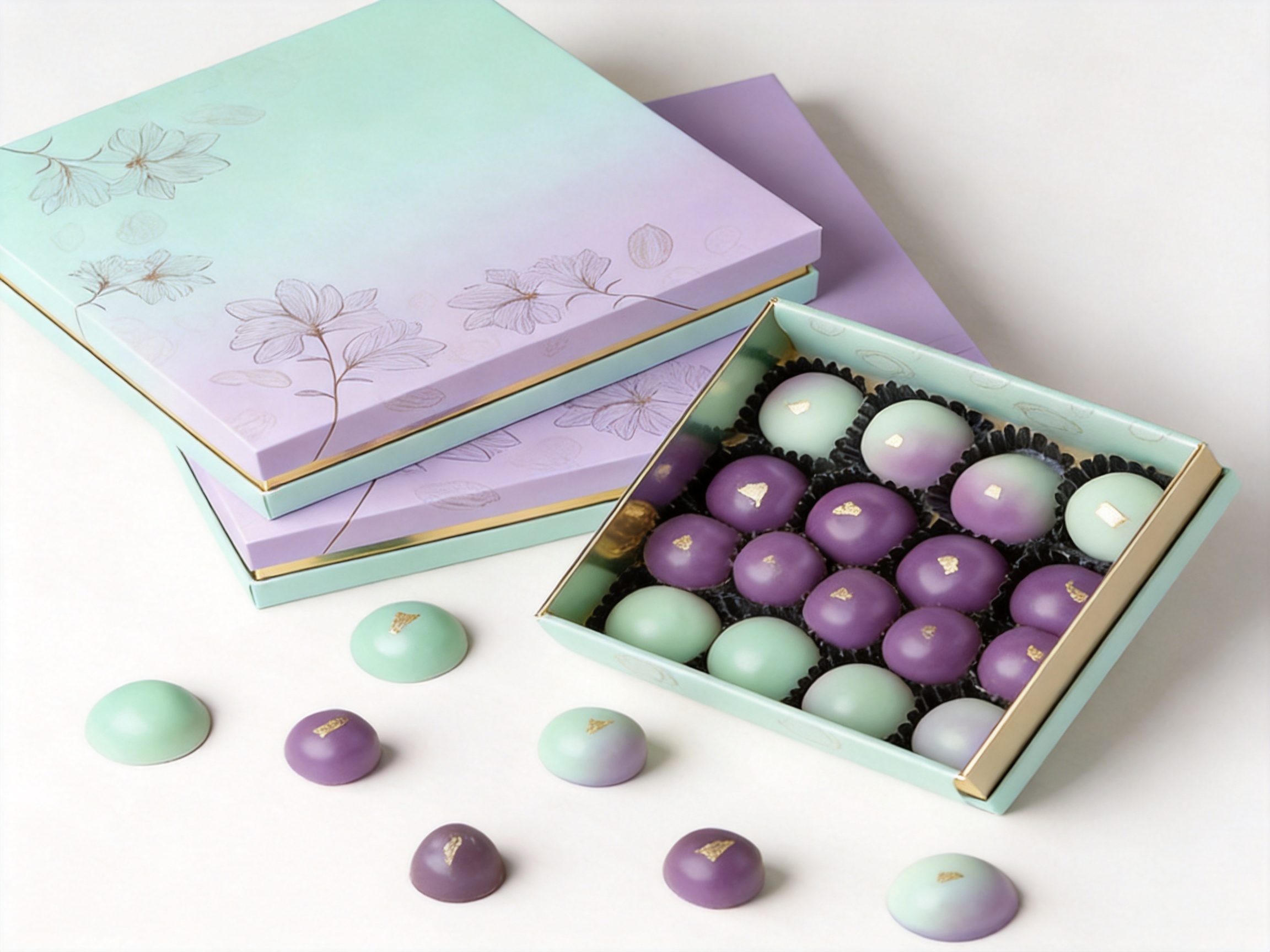
In the premium confectionery market, packaging is much more than a protective outer layer. It is the first physical expression of a brand, the part of a gift that creates anticipation before the box is opened, and an important factor in how customers evaluate quality. A well-designed chocolate package must combine visual appeal, structural stability, practical organization, and a refined unboxing experience. The SH-07 gradient two-piece chocolate gift box packaging is designed around these requirements, offering a coordinated solution for chocolates, nuts, desserts, and other carefully selected food gifts.
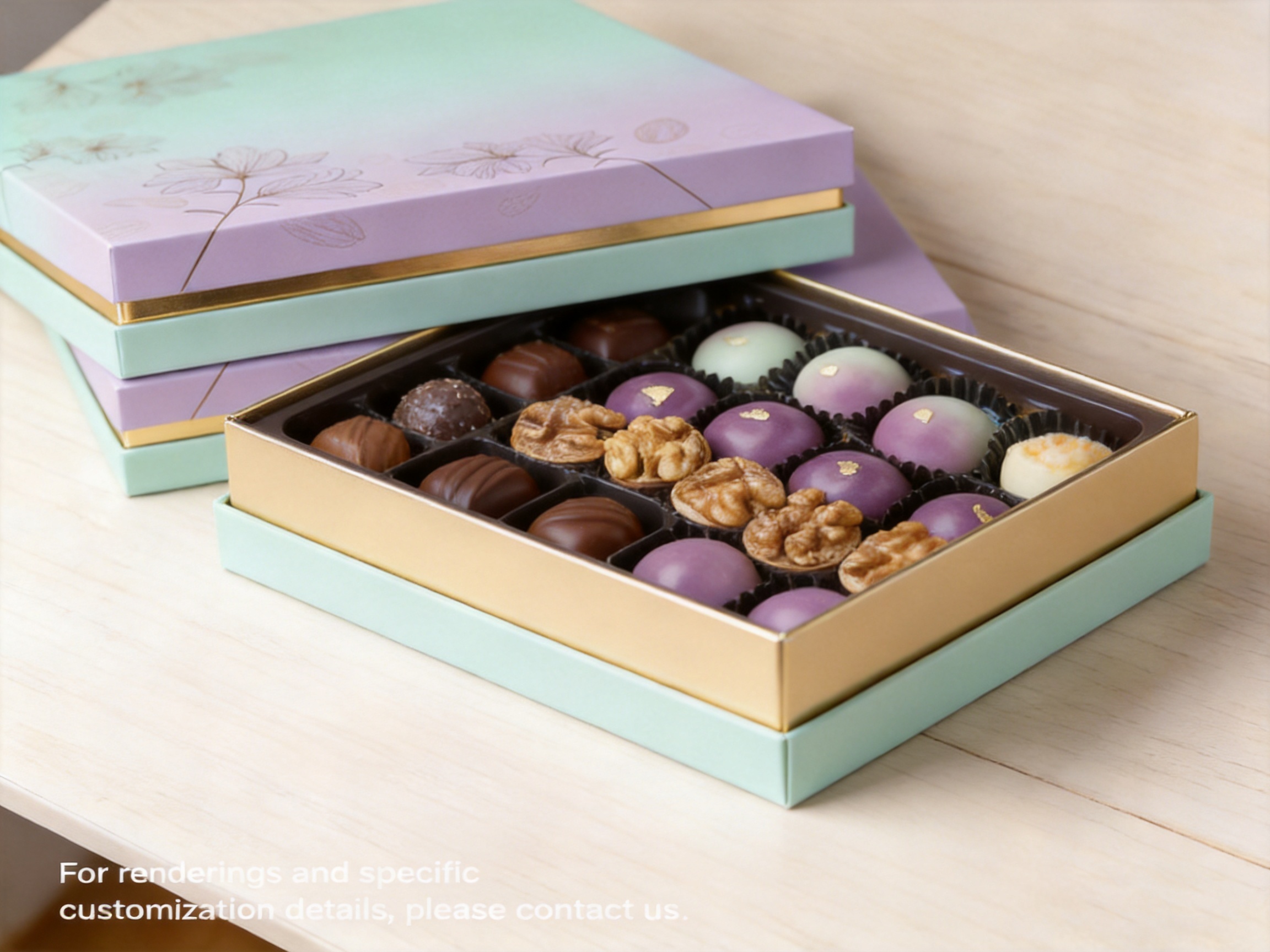
With its soft gradient of light purple and mint green, delicate floral line patterns, gold edge detailing, and layered internal arrangement, this gift box presents a fresh interpretation of luxury packaging. Its appearance is gentle rather than excessive, making it suitable for seasonal gifts, afternoon tea assortments, handmade chocolates, corporate presents, and premium retail collections. At the same time, its rigid cardboard construction and custom-fitted tray help protect the contents during handling, storage, and transportation.
The box uses a lid-and-base opening method, also known as a two-piece or top-and-bottom structure. This familiar format gives the package a substantial feel when lifted and opened. The outer lid fits securely over the base, while the internal organization creates separate zones for chocolates, nuts, snacks, or complementary confectionery products. Compared with a simple single-compartment box, this configuration can make a mixed gift assortment look more orderly and more valuable.
For brands searching for a custom gift box manufacturer, the product demonstrates how thoughtful design can unite decorative printing, rigid-board engineering, insert development, and high-volume production. Its combination of appearance and functionality allows it to compete with conventional folding cartons, basic paperboard boxes, and less organized gift packaging formats.
The SH-07 packaging concept is based on a calm, elegant color palette. Light purple and mint green transition into one another through a gradient treatment, creating visual movement across the surface without overwhelming the product inside. This color combination is especially suitable for chocolates and desserts because it communicates softness, freshness, celebration, and refinement. It can also be adapted for different campaigns by changing the gradient colors, printed graphics, or finishing details.
Floral line patterns are placed across the box to add a delicate decorative layer. Instead of relying on large, heavy illustrations, the design uses fine botanical elements that support a premium appearance while leaving enough visual space for logos, product names, seasonal messages, or other brand information. The result is a flexible design foundation that can serve many types of confectionery collections.
Gold detailing along the edges adds contrast to the cooler background colors. This trim helps define the box geometry and creates a polished frame around the lid and base. Depending on the final specification, selected floral elements or brand marks may also receive hot stamping or UV highlighting. These processes give the surface variations in shine and texture, allowing the package to attract attention under retail lighting or during a gift-opening moment.
The product is designed as a premium chocolate gift box rather than a disposable shipping carton. Its visual language is therefore carefully balanced. It communicates celebration and quality, but remains suitable for different age groups and occasions. A chocolate company can use the same structural concept for holiday assortments, wedding favors, festival gifts, corporate hampers, or limited-edition releases.
The main structural feature is the two-piece lid-and-base format. The lid and base are manufactured as separate components, allowing the lid to fit over the lower box section. When the recipient removes the lid, the opening action feels deliberate and substantial. This differs from a basic folding carton, which may be opened through a flap or tuck closure and can sometimes appear more utilitarian.
A well-fitted lid also contributes to the perceived quality of the product. If the lid is too loose, the box may look inexpensive and can open during transport. If it is too tight, the recipient may struggle to access the contents. The SH-07 format is intended to provide a secure fit while maintaining a smooth opening experience. Final tolerances can be adjusted during development according to the selected board thickness, insert configuration, product weight, and shipping requirements.
The internal arrangement uses a separate insert or tray to divide and stabilize the contents. Chocolates can be placed in shaped cavities, while nuts, snack pieces, or other complementary items can occupy separate sections. This approach prevents products from moving freely inside the box and helps maintain a clean presentation after transportation.
Layered organization is one of the product’s most important competitive advantages. A mixed assortment can otherwise become visually disordered when different pieces shift against one another. With an internal tray, each item has a defined location. The recipient can immediately understand the assortment, and the package can communicate abundance without appearing crowded.
The two-piece construction also creates opportunities for multi-level presentation. For example, the upper area may display individually wrapped chocolates, while a lower or separate section holds nuts, cookies, tea accessories, or other snack products. Brands can use the available space according to their product combinations, making the box suitable for more than one category of gift set.

SH-07 Gradient Color Top-And-Bottom Opening Chocolate Gift Box Packaging
The outer layer is specified as gradient light purple and mint green art paper mounted on high-rigidity grey cardboard. This combination supports both surface quality and structural performance. Art paper provides a smooth printable surface for gradients, floral patterns, branding, and decorative finishing. The grey cardboard beneath it provides stiffness, helping the lid and base retain their shape during handling.
Rigid board is particularly valuable for premium gift packaging because it resists bending more effectively than lightweight carton stock. A firm box gives the contents a stable enclosure and creates a more substantial tactile experience. When a customer picks up the package, the weight and resistance of the board can reinforce the perception that the product inside is carefully made and worth giving.
The internal lining uses a custom molded plastic tray. A molded tray can be engineered around the dimensions of individual chocolates, nuts, confectionery pieces, or snack containers. This helps reduce movement and contact between products. It can also make the opening presentation more consistent because each item remains in its intended position.
For chocolate packaging, dimensional accuracy is important. Chocolate pieces may have delicate coatings, decorative surfaces, or irregular shapes that can be damaged by excessive friction. A properly fitted cavity can provide support without applying unnecessary pressure. The exact tray material, cavity depth, and surface characteristics should be confirmed during product development according to food-contact requirements and the type of products being packed.
The packaging is not presented as a substitute for appropriate primary food wrapping. Chocolates and other edible products should still use suitable inner wrappers, pouches, cups, or sealed containers when required by the product and applicable regulations. The gift box functions as the organized secondary packaging structure, giving the assortment protection, identity, and presentation value.
Material selection also influences printing performance. A smooth art-paper surface can reproduce subtle transitions in the gradient more evenly than a rough surface. It can also support crisp floral linework and clear text. When combined with gold foil or UV effects, the surface becomes more visually dimensional, helping the package stand apart from plain printed boxes.
The surface treatment begins with gradient printing. Gradients require careful control because uneven color transitions can make a premium package look inconsistent. Color sampling, proofing, and production monitoring are important steps in preserving the intended balance between light purple and mint green. The selected color profile, paper surface, ink behavior, and drying conditions can all influence the final result.
Floral line patterns can be printed as a subtle background or emphasized through additional finishing. Their thin lines should be reproduced with sufficient clarity so that the design remains elegant rather than blurred. The placement of these details can be adjusted to leave room for a customer’s logo, ingredient information, seasonal wording, or other required packaging elements.
Hot stamping is suitable for adding metallic gold accents to selected areas. It may be used on borders, logos, floral details, product names, or small decorative marks. Because hot stamping is applied selectively, it can create a luxury effect without covering the entire package in metallic material. This allows the softer gradient background to remain visible while adding highlights that catch the light.
UV highlighting provides another way to create contrast. A glossy UV area can be applied over selected flowers, lines, lettering, or geometric features, producing a visible difference between matte and glossy surfaces. This effect is especially effective when the rest of the box has a restrained finish. The recipient may notice the detail visually first and then discover the texture by touching the surface.
Combining gradient printing with hot stamping and UV highlighting gives the box a layered decorative language. The base color provides atmosphere, the floral pattern provides identity, the gold trim provides refinement, and the selective gloss provides surface interest. This combination offers more design depth than a basic one-color printed carton while remaining adaptable to different brand styles.
Folding cartons are efficient and practical, but they often prioritize flat shipping and economical assembly over rigidity and presentation. A rigid two-piece gift box generally provides a more substantial opening experience. The lid and base give the package a stronger silhouette, while the firm board helps protect the contents and retain a premium shape.
For products positioned as gifts, this difference can influence the customer’s perception before the chocolate is tasted. A structured package suggests that the contents have been selected and arranged with care. It can also be kept by the recipient for storage or reuse, extending the practical life of the packaging.
A single-compartment box may force different products into one open space. This can cause pieces to shift, overlap, or appear less abundant than they actually are. The SH-07 concept uses an internal tray to create separate positions for different shapes and categories. The result is a clearer presentation and a lower risk of product contact during transportation.
Separate sections are particularly useful for gift combinations that include chocolate, nuts, dried fruit, biscuits, candy, or small dessert items. The box can present variety while maintaining visual order. This makes it more suitable for curated gift sets than packaging designed only for a single uniform product.
Many premium boxes use dark colors, heavy metallic decoration, or conventional black-and-gold styling. The light purple and mint green gradient offers a softer alternative. It can appeal to brands seeking a fresh, modern, and approachable interpretation of luxury. The floral details reinforce this distinction without making the box feel overly formal.
This design direction may be attractive for spring campaigns, afternoon tea collections, wedding gifts, wellness-oriented snacks, boutique confectionery, and products marketed toward customers who appreciate gentle color palettes. The structure remains premium, while the visual identity feels less predictable than standard dark luxury packaging.
The approximate dimensions of 20–25 centimeters in length, 15–20 centimeters in width, and 6–8 centimeters in height provide a useful starting range for multiple-item configurations. The size can be customized according to the required product count, piece dimensions, insert design, and shipping conditions. This flexibility allows one structural concept to serve several product combinations.
A brand may choose a compact version for a small chocolate selection or a larger version for a mixed assortment. It may also modify the internal tray while retaining the same external design language. This reduces the need to create a completely new package for every product variation.
The most direct application is packaging for handmade chocolates. Small chocolate producers often need packaging that communicates craftsmanship and creates a strong retail impression. The gradient surface, botanical linework, and gold accents can support a handmade positioning while the rigid structure protects the pieces.
The box is also suitable for premium chocolate assortments. A manufacturer can create separate cavities for truffles, pralines, molded chocolate pieces, filled chocolates, or coated confections. The insert can be customized to match the number and shape of each product. If the assortment changes seasonally, the internal layout can be revised without necessarily changing the entire outer concept.
Nut and dessert combinations represent another strong use case. The two-piece structure can hold different categories of products in separate zones, helping prevent the assortment from looking disorganized. Nuts, dried fruit, cookies, candy, and chocolate can be combined as a holiday gift or afternoon tea package.
Holiday gifting is a major opportunity for this type of packaging. The gold details create a celebratory accent, while the gradient colors provide a contemporary alternative to traditional red, green, or dark metallic themes. Seasonal messages, logos, greeting statements, or limited-edition graphics can be added to the lid to create a campaign-specific version.
Afternoon tea gifts can also benefit from the format. A box may include chocolates, tea sachets, biscuits, fruit snacks, or small accessories. The internal divisions make it possible to arrange these products as a coordinated experience rather than as a loose collection of items.
Corporate gifting is another possible application. Companies can customize the lid with a logo, event message, or commemorative design. The refined appearance can support customer appreciation programs, employee gifts, conference packages, and seasonal business promotions. Because the structure is durable, recipients may continue using the box after the food products have been consumed.
The package may also be considered for wedding favors, engagement celebrations, birthday gifts, boutique hotel amenities, and premium retail bundles. In each case, the basic advantages remain the same: a strong external structure, attractive decoration, organized internal presentation, and potential for customization.
Customization begins with dimensions. The approximate size range is not a fixed limitation. The final length, width, and height can be developed around the customer’s product specifications. This is important because chocolate pieces vary considerably in thickness, shape, wrapping style, and quantity.
The tray can be customized to match the product arrangement. Cavities may be designed for round truffles, square pralines, elongated chocolate bars, irregular handmade pieces, or mixed shapes. Separate areas can be included for nuts, biscuits, snack packs, or small accessories. The goal is to make the interior appear intentional while reducing unnecessary empty space.
Color is another major customization area. The light purple and mint green gradient can be retained as the signature appearance, or the palette can be adjusted for a specific brand or season. Other soft colors, stronger contrasts, or monochromatic gradients may be developed after reviewing brand guidelines and print requirements.
Printed elements may include a company logo, product name, flavor information, seasonal greeting, illustration, or storytelling text. The design should preserve sufficient contrast and readability, especially where mandatory product information is required. Decorative floral patterns can be retained, simplified, enlarged, or replaced with another visual theme.
Finishing options can also be adjusted. Gold hot stamping is a natural match for the existing concept, but other metallic tones or selective gloss effects may be considered. A brand may choose to emphasize the border, logo, floral elements, or opening panel. Different finishing combinations should be evaluated through physical samples because the interaction between paper, ink, foil, and UV coating is difficult to judge from a digital image alone.
Packaging development should also consider assembly and packing procedures. If the box will be filled manually, the tray and product cavities should permit efficient placement. If automated or semi-automated processes are planned, the internal configuration must be reviewed for compatibility with the equipment and workflow. Early discussion of these details can reduce production delays and improve consistency.
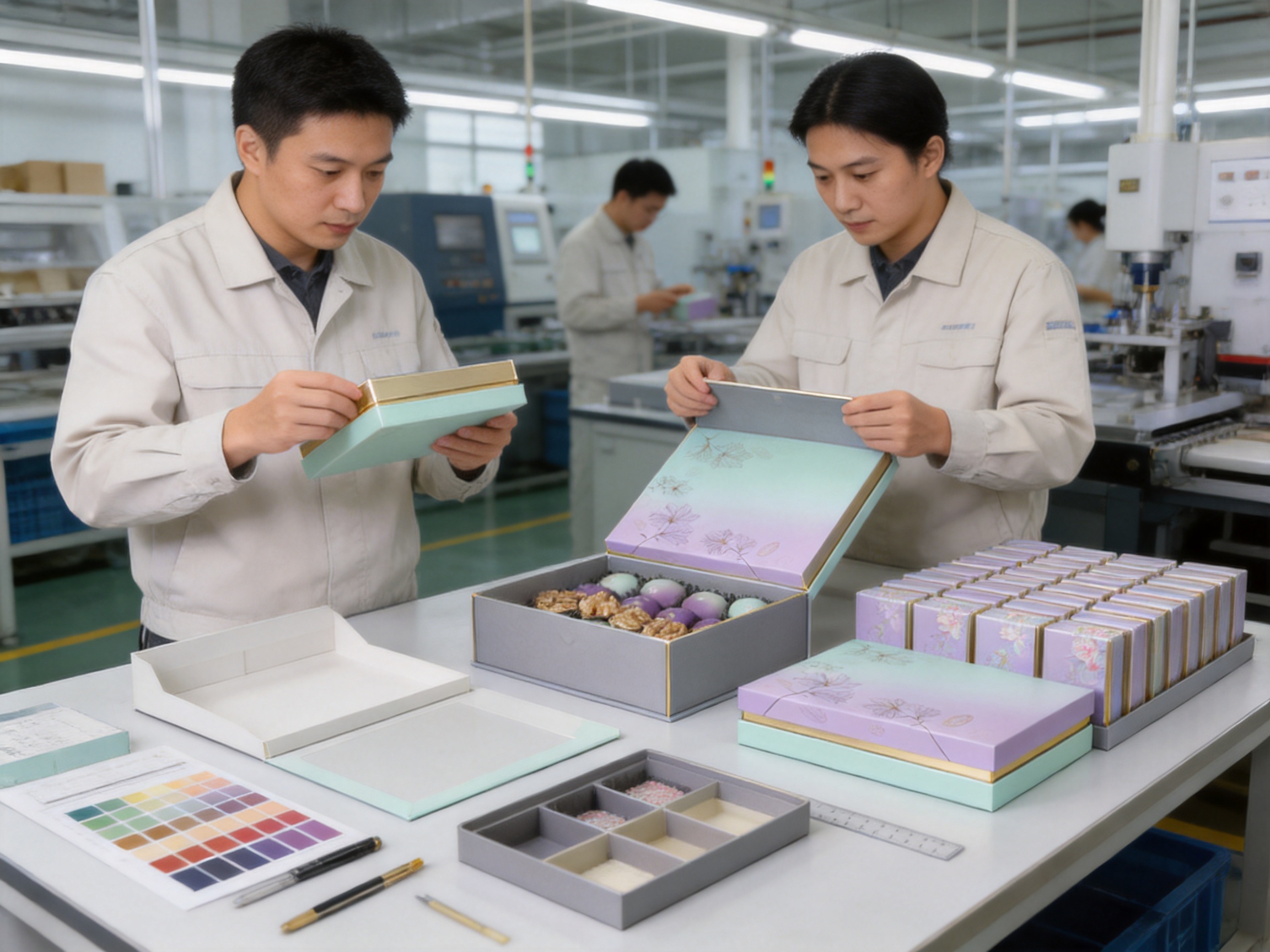
The manufacturer behind this product is an export-oriented packaging company specializing in the production, research and development, and sales of paper gift packaging boxes. With more than 15 years of industry experience, the company has developed capabilities covering design, material preparation, printing, finishing, structural assembly, quality control, and shipment coordination.
The reported production site covers approximately 20,000 square meters and employs around 300 people. This scale supports the development of both standard packaging products and customized projects. A workforce of this size can provide specialized attention across different stages, including graphic development, engineering, sample making, procurement, manufacturing, inspection, and customer service.
The reported average daily production capacity is about 5,000 sets of gift boxes. Capacity at this level can be valuable for customers that require repeat orders, seasonal volumes, or coordinated deliveries across multiple markets. It also provides a basis for scaling a successful design from an initial sample or small commercial launch to larger production quantities.
Advanced equipment supports the key processes required for this type of product. Gradient printing requires stable color control, while hot stamping and UV highlighting require accurate registration and controlled application. Rigid-box production additionally demands reliable cutting, board forming, paper wrapping, adhesive application, and assembly. Coordinating these steps is essential for maintaining a consistent appearance across a large order.
The company also maintains an in-house design team and updates dozens of products weekly, according to the supplied company information. This indicates an active approach to product development. For customers, access to design resources can make it easier to explore new color schemes, structural variations, seasonal themes, and internal layouts without beginning every project from zero.
Research and development are particularly important in customized packaging because appearance and function must be developed together. A beautiful design may fail if its lid fit is inaccurate, its insert does not support the product, or its surface finish is not durable enough for transportation. A manufacturer with integrated development capabilities can evaluate these elements as one coordinated system.
The company reports BSCI and FSC certifications. These certifications are relevant to customers evaluating social responsibility and responsible paper sourcing, although the exact scope, validity, and applicable product requirements should be confirmed during the procurement process. Certification documentation can be reviewed as part of a supplier qualification program.
FSC-related sourcing is especially relevant for paper-based packaging buyers who want to consider the origin and chain of custody of paper materials. Social compliance assessments such as BSCI can support a buyer’s evaluation of workplace practices within the supply chain. These credentials do not replace product-specific quality checks, but they can contribute to a broader responsible sourcing strategy.
The company exports to Europe, the United States, the Middle East, and other regions. International experience can help a manufacturer understand differences in customer expectations, packaging specifications, documentation, shipping schedules, and product presentation. Export capability also suggests familiarity with protective packing for cartons, container loading, and communication across time zones and markets.
For chocolate and food gift packaging, quality control should include several checkpoints. Printed color should be compared with an approved sample or standard. Decorative details should be checked for position, adhesion, and clarity. The lid should fit the base correctly, and the tray should align with the outer box. Corners and edges should be inspected for crushing, lifting, or paper damage.
Customers may also request pre-production samples, production samples, material confirmation, carton specifications, and inspection reports. These steps help ensure that the final delivery matches the approved design. The precise inspection plan should be agreed upon before mass production, especially for customized projects with multiple components.
An effective unboxing experience begins before the lid is removed. The gradient colors and floral lines create an immediate visual impression. Gold edge detailing encourages the recipient to notice the boundaries of the box and suggests that the contents deserve attention. These details establish a moment of anticipation and make the package appropriate for gifting.
The lid-and-base opening method adds a sense of ceremony. Instead of pulling a small tab or unfolding several flaps, the recipient lifts the upper section away from the base. This action reveals the contents gradually and gives the package a more deliberate rhythm. The opening experience can be enhanced further through the arrangement of the tray and the order in which the contents become visible.
A well-designed insert contributes to visual storytelling. Chocolates should appear evenly spaced and easy to identify. Complementary products should have their own positions rather than being placed randomly around the box. This organization allows the recipient to understand the selection at a glance and can make the assortment feel more generous.
The box can also support brand storytelling through printed messages inside the lid or beneath the tray. A short description of the chocolate collection, a thank-you note, a serving suggestion, or a seasonal greeting can add emotional value. These elements should be considered during the design stage so that they fit naturally into the opening sequence.
Reuse is another aspect of the experience. Rigid boxes often have enough durability for recipients to use them for stationery, jewelry, photographs, accessories, or household items. This second life can increase the perceived value of the original gift and keep the brand’s visual identity in the customer’s environment for longer.
Although the SH-07 box is designed for presentation, logistics must be considered from the beginning. The final dimensions, board thickness, insert material, and packing method influence carton quantity, pallet arrangement, container utilization, and shipping cost. A packaging supplier should review these elements with the buyer before confirming mass production.
The rigid structure helps resist deformation, but finished boxes still require proper protection during shipment. Individual boxes may be separated with suitable packing materials, while master cartons should prevent excessive movement. Corners and edges deserve particular attention because they are vulnerable to impact during handling.
The internal tray reduces movement of the product assortment after packing. This can be beneficial during transportation because chocolates and snacks are less likely to collide with one another. However, the tray design should be tested with the actual wrapped products. A cavity that is correct for an unwrapped sample may become too tight when a wrapper, cup, pouch, or protective film is added.
Product weight also affects the required structure. A light chocolate selection may require less reinforcement than a gift box containing jars, dense nut products, or multiple accessories. The lid fit, base strength, tray support, and outer carton configuration should all be reviewed according to the maximum intended load.
For international shipments, customers should also consider climate and storage conditions. Heat and humidity can affect paper, adhesives, printed surfaces, and chocolate products. Appropriate inner food packaging, transport conditions, and warehousing procedures remain essential. The gift box can provide structural and visual value, but it must be integrated into a complete packaging system.
| Packaging format | Presentation value | Internal organization | Structural protection | Typical suitability |
|---|---|---|---|---|
| Basic folding carton | Practical and economical | Often limited to one open compartment | Moderate, depending on board | Everyday retail products and lightweight items |
| Simple paperboard box | Moderate | May require separate dividers | Moderate to low | Standard promotional or short-term packaging |
| Rigid magnetic box | High | Can support inserts and multiple sections | High | Premium gifts and luxury collections |
| SH-07 two-piece gift box | High, with gradient, floral, and gold details | Custom molded tray and layered arrangement | High through rigid cardboard construction | Chocolate assortments, nuts, desserts, holiday and afternoon tea gifts |
| Clear plastic container | Product visibility is high, but luxury perception varies | Usually limited without additional components | Depends on plastic thickness and closure | Display-oriented products and practical snack packs |
This comparison shows the position of the SH-07 format between ordinary retail packaging and highly specialized luxury boxes. It offers a premium visual language and internal organization without requiring the design to become excessively elaborate. The two-piece structure is familiar to consumers, while the gradient printing and decorative finishing provide differentiation.
The first step is to define the product assortment. Buyers should provide the number of chocolate pieces, individual dimensions, wrapper or cup dimensions, total product weight, and any accompanying snacks or accessories. This information allows the manufacturer to create a realistic internal layout instead of relying on approximate measurements.
The second step is to determine the desired external size and opening experience. Some brands may prioritize a compact box that is easy to carry, while others may want a broader presentation surface for a larger gift assortment. The lid fit and opening resistance should be evaluated through a physical prototype.
The third step is to confirm the graphic direction. Buyers should provide brand colors, logo files, preferred typography, decorative references, and any required text. The gradient and floral concept can be retained or adapted. At this stage, the position of gold stamping, UV highlighting, and printed information should be planned.
The fourth step is sampling. A structural sample helps verify dimensions and fit, while a printed sample helps evaluate color and surface finishing. For complex projects, it may be useful to approve the structure first and then approve the final decorated sample. Actual products should be placed inside the sample to check cavity fit and overall appearance.
The fifth step is production approval and quality planning. The buyer and manufacturer should agree on material specifications, tolerances, finishing standards, packing requirements, inspection procedures, and delivery arrangements. Clear approval records reduce the risk of differences between the sample and the mass-produced goods.
The final step is post-production evaluation. After delivery, the buyer can review the packaging in the actual filling, warehousing, and retail environment. Feedback from sales teams and customers may guide improvements to the tray, opening fit, color palette, or product arrangement in future orders.
A specialized gift box manufacturer can coordinate several technical requirements that are often difficult to manage through unrelated suppliers. The SH-07 project involves rigid board, art paper, gradient printing, floral decoration, hot stamping, UV highlighting, a custom tray, and final assembly. When these elements are managed within an experienced packaging production system, the risk of mismatched color, inaccurate fitting, or inconsistent finishing can be reduced.
Specialization also supports faster communication during customization. A manufacturer familiar with rigid gift boxes can identify potential problems in the early design stage, such as insufficient edge allowance, an unsuitable cavity depth, an impractical lid tolerance, or a finishing area that may be difficult to register. Early technical input protects both the appearance and the production schedule.
Production scale provides another advantage. A facility with substantial daily capacity can support both development and repeat orders. This is useful for brands that plan to launch a product in one market and expand it to other regions, or for companies that require seasonal packaging in predictable cycles.
Design capability adds further value. The company’s reported in-house design team and frequent product updates suggest that it can contribute ideas beyond basic manufacturing. Buyers can use this resource to explore alternative layouts, colorways, insert systems, and decorative approaches while keeping the project aligned with commercial goals.
Finally, export experience and reported certifications can support supplier evaluation. Buyers should still conduct their own due diligence, but an established export-oriented operation may provide a stronger foundation for international packaging programs than a supplier focused only on small local orders.
The box is designed primarily for multiple chocolates, but it can also hold combinations of chocolates, nuts, desserts, biscuits, candy, dried fruit, and similar gift items. The internal tray should be customized according to the exact product dimensions and packaging format.
No. The supplied approximate dimensions are 20–25 centimeters in length, 15–20 centimeters in width, and 6–8 centimeters in height. These dimensions can be adjusted according to the product assortment, required capacity, tray configuration, and transportation needs.
The box uses a lid-and-base style. The lid and lower box are separate components, and the lid fits over the base. This two-piece structure creates a substantial opening experience and provides a clear surface for decorative printing and branding.
Yes. The molded tray can be developed for different chocolate shapes, quantities, and mixed gift combinations. Buyers should provide accurate product measurements, including wrappers, cups, pouches, and other primary packaging that will be placed inside the cavities.
Its rigid cardboard construction, coordinated gradient design, floral line decoration, gold edge detailing, and custom-fitted internal tray work together to create a premium presentation. The structure also helps maintain order and reduce movement during handling.
Yes. The light purple and mint green gradient can be adapted, and the floral pattern can be modified or replaced. Logos, product names, seasonal messages, and other brand elements can be added after the artwork and print specifications are confirmed.
The supplied specification includes gradient printing and hot stamping or UV highlighting of floral patterns. Hot stamping can create metallic accents, while UV highlighting can add selective gloss and tactile contrast. The exact combination should be approved through physical samples.
The rigid construction and fitted tray are intended to improve protection during transportation. However, shipping performance depends on the final product weight, tray design, outer carton, stacking method, and logistics conditions. A transport or handling test is recommended for commercial programs.
The gift box is a secondary packaging component. Chocolates and other edible products should use appropriate inner wrappers, cups, pouches, or sealed containers according to the product and applicable food-packaging requirements. The tray and other materials should be reviewed for their intended food-contact use.
The supplied company information states that the manufacturer has passed BSCI and FSC certifications. Buyers should request current documentation and confirm the scope of each certification as part of their supplier approval process.
The company reports an average daily production capacity of approximately 5,000 sets of gift boxes. Actual capacity for a particular project depends on the structure, materials, finishing requirements, order quantity, and production schedule.
Yes. The lid can be customized with a corporate logo, message, event theme, or seasonal artwork. The combination of organized internal presentation and refined surface decoration makes the format suitable for customer gifts, employee presents, business events, and holiday programs.
The SH-07 gradient two-piece chocolate gift box packaging combines a soft, contemporary visual identity with a practical rigid structure. Its light purple and mint green gradient creates a fresh appearance, while floral line patterns and gold detailing provide refinement. The lid-and-base format delivers a more substantial opening experience than a basic folding carton, and the custom molded tray gives chocolates, nuts, and dessert products a more organized presentation.
Its competitive strength comes from the balance between beauty and function. The box is decorative without being overly complicated, durable without appearing industrial, and flexible enough for different gift assortments. Its approximate size range can be customized, and the insert can be developed around a wide variety of products. Printing, hot stamping, UV highlighting, and artwork changes provide additional opportunities for brand differentiation.
The manufacturing capabilities behind the product further support its commercial potential. An export-oriented operation with more than 15 years of experience, a reported 20,000-square-meter facility, around 300 employees, advanced equipment, an in-house design team, and an average daily capacity of approximately 5,000 sets can support both customized development and larger repeat orders. Reported BSCI and FSC certifications, together with export experience in Europe, the United States, the Middle East, and other markets, provide additional points for buyer evaluation.
For chocolate companies, dessert producers, gift retailers, and corporate buyers, this packaging format offers a strong foundation for building a memorable product presentation. With accurate product measurements, careful sampling, appropriate material review, and a well-planned quality process, the two-piece box can become more than a container. It can serve as a durable expression of product quality, brand personality, and gifting value.
1. Product specification sheet for SH-07 Gradient Color Top-and-Bottom Opening Chocolate Gift Box Packaging.
2. Manufacturer-provided company profile and production capability information.
3. General packaging engineering principles for rigid paperboard boxes, molded inserts, and protective product presentation.
4. General guidance on paper packaging material selection, decorative printing, hot stamping, and UV finishing.
5. General considerations for secondary food packaging, product protection, sampling, inspection, and international shipment preparation.
Recommended Products

Contact Us

No. 15, Xiayang Road, Huangzhai Town, Jinhua, Zhejiang, China

(+86) 579-84230069

(+86) 13085675766


Products

Gift Box Packaging Manufacturer
 English
 Français
 Español
 عربى