2026-08-06
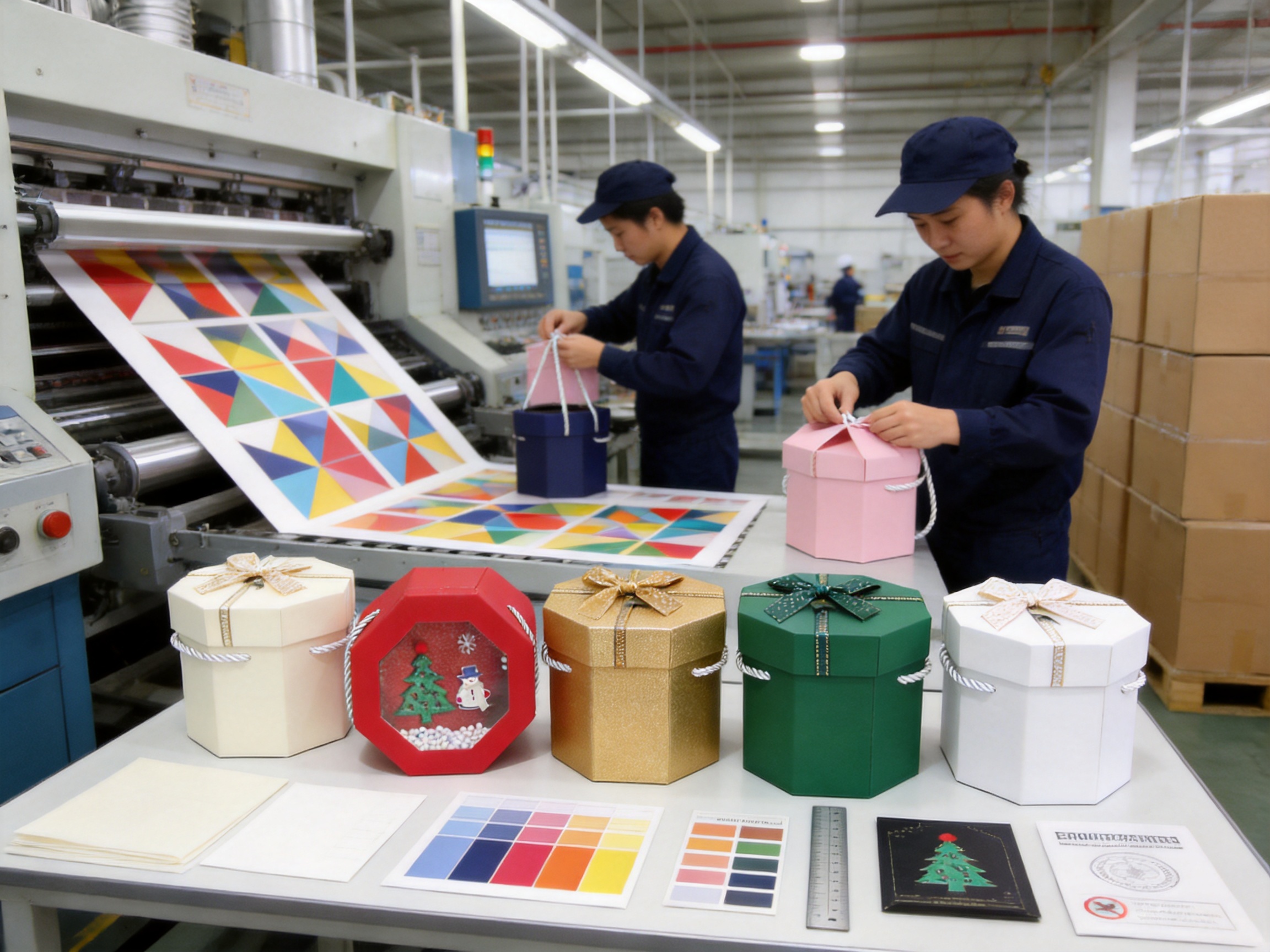
Packaging is often the first physical impression a guest, customer, or gift recipient receives. At weddings, holiday celebrations, corporate events, and seasonal retail campaigns, a well-designed package does more than protect its contents. It contributes to the atmosphere, communicates the character of the occasion, and turns a small gift into a memorable presentation. The 4007 Octagonal 3D Holiday Wedding Candy Gift Box with Hanging Rope is designed around this idea, combining a distinctive geometric structure with practical capacity, convenient handling, and extensive customization potential.
Unlike a basic rectangular carton or an ordinary flat favor box, this octagonal candy gift box uses a three-dimensional form to create visual interest from every angle. Its hanging rope adds another layer of functionality, allowing the package to be carried, displayed, or suspended from a Christmas tree, wedding backdrop, dessert table, reception stand, or decorative installation. The result is a versatile packaging format that can serve as a candy container, a party favor, a table decoration, or a small branded gift package.
This article examines the product’s structure, appearance, usability, customization options, packaging performance, production considerations, and commercial value. It also explains why a specialized gift box manufacturer can provide advantages over general packaging suppliers, particularly when buyers require consistent quality, export-ready production, coordinated design development, and scalable custom orders.
The 4007 model is an octagonal 3D holiday and wedding candy gift box supplied with a hanging rope. It is categorized as a candy gift box and is also relevant to broader product categories such as gift boxes, other paper products, and stationery storage boxes. Its compact size makes it suitable for candies, chocolates, sugared almonds, small accessories, keepsakes, and other lightweight items commonly exchanged at celebrations.
The box measures approximately 13 x 13 x 12.8 centimeters. This proportion creates a balanced package with enough internal room for a practical quantity of treats while remaining compact enough for favors, place settings, gift displays, and retail presentation. The octagonal profile gives the package more visual presence than a standard square format without making it excessively large or difficult to transport.
The three-dimensional construction is one of the product’s primary design features. Instead of relying only on printed graphics to attract attention, the box creates appeal through its physical silhouette. Multiple sides catch light differently, and the angular structure can support coordinated color panels, metallic accents, printed patterns, ribbons, labels, or decorative finishing. This makes the package suitable for both understated and highly festive visual themes.
The hanging rope is integrated into the overall concept rather than treated as an optional afterthought. It enables recipients to carry the box comfortably and makes it possible to hang the package as part of an event display. At weddings, several boxes can be suspended from a decorative arrangement or placed beside each guest’s seat. During holiday campaigns, the same format can be used as a tree ornament, countdown gift, stocking-style favor, or seasonal retail accent.
Although the product is especially appropriate for candy, its use is not limited to confectionery. Depending on the selected material, construction, and internal dimensions, it may hold small soaps, tea samples, jewelry accessories, miniature candles, craft items, promotional products, or personalized mementos. Buyers can therefore adapt the same basic package to multiple occasions and product categories.
The octagonal shape differentiates the 4007 box from the large number of conventional folding cartons available in the market. Rectangular and square packages are efficient and familiar, but their common geometry can make them blend into a crowded display. An octagonal format introduces a more decorative outline while retaining a practical footprint for packing and presentation.
Its three-dimensional structure provides depth and volume. This is important because a candy favor must look generous even when the contents are relatively small. A flat pouch or narrow carton can appear limited, while a dimensional box gives the impression of a more substantial gift. The angled surfaces also create natural areas for contrasting colors, foil details, printed names, event dates, or themed illustrations.
The shape has particular relevance to celebrations. Eight-sided forms can be associated with balance, continuity, and visual harmony, although the exact symbolism may vary by market and event style. More importantly, the silhouette looks decorative without requiring complex external accessories. A buyer can achieve an elevated appearance through the structure itself, reducing the need for excessive ribbons, stickers, or secondary wrapping.
For wedding applications, the octagonal design can complement romantic, elegant, rustic, modern, or culturally specific themes. Soft ivory, blush, champagne, and sage green can create a refined appearance, while deep red, burgundy, gold, and silver support more traditional or festive events. For holidays, the same package can carry seasonal patterns, snowflake details, stars, ornaments, gift illustrations, or customized greetings.
The form also improves display flexibility. When several boxes are arranged together, their angled sides create a more dynamic visual composition than a group of identical rectangular cartons. They can be placed in rows, clustered in baskets, arranged around centerpieces, or hung at different heights. This is valuable to event planners and retailers who want the packaging to contribute to the overall decoration rather than disappear into it.
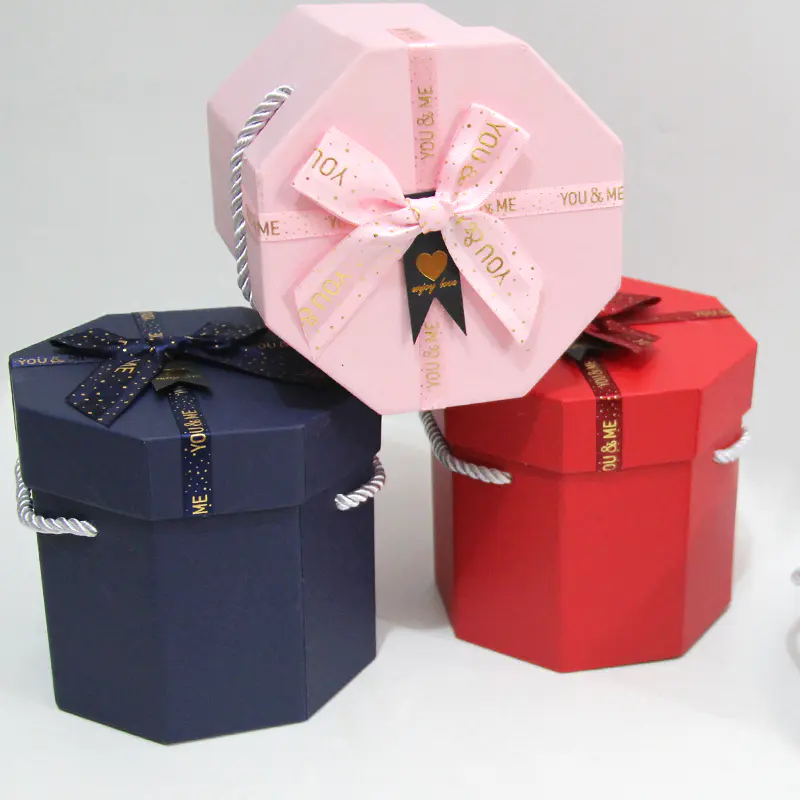
4007 Octagonal 3D Holiday Wedding Candy Gift Box with Hanging Rope
A decorative package must still perform its basic job: containing and protecting the product. The 4007 box is designed to provide usable internal volume for candies and other small gifts while remaining easy to fill and retrieve. Its dimensions support the practical requirements of event favors, where each package must be prepared efficiently and presented consistently.
The box can be filled with individually wrapped candies, chocolate pieces, mints, sugared almonds, cookies, small snack portions, or other lightweight treats. Depending on the product shape and packing method, internal separators, tissue paper, or a small protective insert may be used. These additions can help prevent movement, preserve presentation, and create a more premium opening experience.
Easy access is another important consideration. Event packaging is often prepared in large quantities, so a complicated closure can increase labor time. A well-designed folding or opening system allows staff to assemble, fill, close, and arrange the boxes efficiently. For recipients, convenient opening improves the experience and reduces the likelihood that the package will be damaged during use.
The hanging rope serves several practical purposes. It creates a handle for carrying, gives the package a suspension point, and provides a visual detail that can be matched to the printed design. A rope in gold, white, red, natural fiber, or another coordinated color can reinforce the chosen event palette. It may also make the box easier to identify when many favors are distributed at a busy venue.
For retail buyers, the rope can support point-of-sale presentation. Packages can be hung on display hooks, seasonal racks, decorative branches, or merchandising frames. This allows products to be seen from multiple angles and can save valuable shelf space. The hanging feature is especially useful during holiday sales, when customers expect packaging to be decorative as well as functional.
For corporate gifting, the box can be used as a compact branded touchpoint. A company logo, campaign message, QR code, or event date may be printed on the exterior, while the contents provide a small but tangible expression of appreciation. Because the box is suitable for both direct distribution and decorative display, it can support conferences, product launches, customer appreciation campaigns, and seasonal business gifts.
The following specifications describe the standard 4007 model. Buyers should confirm final dimensions, materials, colors, finishing details, and packing arrangements with the manufacturer before placing a production order, especially when custom tooling or structural changes are required.
| Item | Standard Information |
|---|---|
| Model number | 4007 |
| Product name | Octagonal 3D Holiday Wedding Candy Gift Box with Hanging Rope |
| Product category | Candy gift box |
| Box size | 13 x 13 x 12.8 cm |
| Quantity per carton | 96 pieces |
| Carton measurement | 82.5 x 55.5 x 54 cm |
| Gross weight | Approximately 13 kg |
| Net weight | Approximately 12 kg |
| Main application | Wedding favors, holiday gifts, candy packaging, event decoration, promotional packaging |
| Special feature | Octagonal 3D structure with hanging rope |
The carton quantity of 96 pieces is suitable for wholesalers, event suppliers, retail distributors, and project buyers who require multiple units. It may also be practical for wedding planners managing larger guest lists or for seasonal campaigns that need standardized packaging across several locations.
The listed carton dimensions allow buyers to estimate warehouse requirements, shipping volume, and pallet planning. Because packaging products can be affected by compression, humidity, and handling, appropriate outer-carton protection is important. Buyers should review the manufacturer’s packing method and confirm whether the boxes are supplied assembled, folded, nested, or partially collapsed.
Customization is one of the strongest commercial advantages of a specialized gift packaging product. A standard shape can become highly distinctive through the selection of colors, artwork, text, surface finishes, and accessories. The 4007 format provides several visible panels that can be coordinated as a complete design rather than treated as a single flat front face.
Wedding buyers may request the couple’s names, wedding date, initials, monogram, venue identity, or a short message. These details can transform a general candy box into a personalized keepsake. The package may be matched to invitations, menus, table cards, flower arrangements, or other event stationery to create a unified visual language throughout the celebration.
Holiday buyers can use seasonal colors and illustrations to communicate a particular time of year. Red and green may support Christmas themes, while silver, white, and blue can create a winter appearance. Gold, burgundy, and deep green may be selected for a premium or traditional presentation. Because the box is three-dimensional, designers can distribute patterns across multiple surfaces to create a richer effect than a single-panel package.
Finishing options may include offset printing, digital printing, metallic foil, embossing, debossing, spot effects, matte coating, gloss coating, soft-touch coating, or textured paper. The ideal process depends on the artwork, order quantity, target price, and desired appearance. A manufacturer with in-house or closely coordinated production capabilities can help buyers choose an appropriate combination rather than adding unnecessary treatments.
The hanging rope can also be customized. Its color, thickness, material, and attachment method may be selected to complement the paper and graphics. A satin-style cord can create a refined wedding appearance, while braided paper or natural-fiber rope may suit rustic, handmade, or environmentally focused themes. The attachment point should be reviewed carefully to ensure that it remains secure during carrying and display.
Customization can extend to the interior. Buyers may choose a contrasting inner print, a printed greeting, a colored lining, a small insert, or a message panel. For branded projects, the interior can reinforce the customer journey by displaying a thank-you message, product information, or a short brand story after the box is opened.
Paper-based gift packaging is increasingly evaluated not only for appearance and cost but also for material responsibility. The 4007 box can be produced with paper or related packaging materials selected according to the required strength, print quality, finish, and environmental objectives. The exact material should be specified during development because different contents and shipping conditions may require different board grades.
Recyclable and biodegradable material options may help buyers align their packaging with sustainability policies and consumer expectations. FSC-certified paper, when applicable to the final supply chain and documentation, can support responsible forestry objectives. Water-based coatings, reduced-plastic accessories, and recyclable paper ropes may also be considered where they are compatible with the desired design and performance.
Sustainability should be assessed across the complete package rather than through a single material claim. Adhesives, coatings, metallic elements, ropes, windows, inserts, and mixed-material components can affect recyclability. Buyers should therefore request clear material information and confirm whether the completed product can be processed through the recycling systems available in the target market.
Lightweight packaging can reduce material consumption and transportation impact, but it must remain strong enough for its intended use. A box that collapses, tears, or loses its shape may create product waste and damage the customer experience. The best approach is to balance structural efficiency with adequate compression resistance, fold durability, and closure performance.
A specialized manufacturer can support this balance through sampling and production testing. The development process may include checking paper thickness, crease quality, edge condition, rope attachment, print adhesion, color consistency, and resistance to ordinary handling. Such checks are particularly important when the box will be filled with food products or transported over long distances.
The performance of a gift box depends heavily on the manufacturing system used to produce it. A creative design may lose its value if the folding lines are inaccurate, the print colors vary from batch to batch, or the rope is attached inconsistently. For this reason, buyers often benefit from working with a factory that combines design development, material purchasing, printing, converting, assembly, quality control, and export coordination.
Zhejiang Shihao Gift Packaging Co., Ltd. is an export-oriented manufacturer specializing in paper gift packaging, product development, and sales. The company has more than 15 years of industry experience and operates a facility covering approximately 20,000 square meters. Its workforce of around 300 employees supports a production organization capable of managing both standard packaging programs and customized orders.
The company reports an average daily production capacity of approximately 5,000 sets of gift boxes. This capacity is important for buyers who need dependable replenishment, seasonal volume, or coordinated production across several designs. A larger operating base can also help reduce the risk that a single small production line will become a bottleneck during peak wedding or holiday periods.
Advanced equipment supports several stages of the manufacturing process. Prepress and design systems help prepare artwork for the multiple faces of an octagonal package. Printing equipment transfers graphics to the selected paperboard, while die-cutting and creasing equipment creates the required outline and fold structure. Gluing, forming, rope attachment, inspection, and packing then convert printed sheets into finished boxes.
Accurate die-cutting is especially important for the 4007 model. An octagonal structure contains more angled edges and folding relationships than a simple rectangular carton. Small deviations can affect symmetry, closure, panel alignment, and the final three-dimensional appearance. Controlled tooling and regular inspection help ensure that the finished boxes retain the intended form.
Creasing quality also influences the user experience. Properly formed creases allow the board to fold cleanly without excessive cracking or distortion. This becomes more important when the package uses dark colors, metallic printing, coated stock, or a heavier paperboard. A well-managed converting process helps maintain a neat edge and consistent shape throughout the production run.
Printing control is another key strength. Wedding and holiday buyers often require precise color matching because the box must coordinate with invitations, brand guidelines, or event decorations. A professional workflow can include digital proofing, physical samples, production approvals, color checks, and inspection against approved standards. These steps reduce the possibility of significant variation between the approved sample and the mass-produced goods.
Rope attachment deserves dedicated attention because it combines appearance and mechanical function. The attachment must be positioned consistently so that the box hangs evenly. It must also resist ordinary pulling and carrying forces. Depending on the construction, reinforcement may be used around the attachment area. Inspection should verify both the visual alignment and the practical security of the cord.
International buyers typically need more than an attractive sample. They require repeatable production, stable documentation, reliable packing, and communication across design, manufacturing, and shipping stages. An export-oriented supplier is familiar with the need to prepare goods for international transport and to coordinate packaging details with customers in different markets.
The company identifies BSCI and FSC certifications among its qualifications. Buyers should request current certification information and confirm the scope and applicability of each certification to the specific order. Social-compliance systems and responsible-material certifications can be useful components of a broader supplier-evaluation process, particularly for retailers and brands with formal procurement requirements.
Quality management for a product such as the 4007 box may involve several checkpoints. Incoming paper and accessory materials can be reviewed before production. Printed sheets can be checked for color, registration, image clarity, and surface defects. Die-cut components can be inspected for correct dimensions and clean edges. Formed boxes can be examined for symmetry, glue condition, folding accuracy, and rope placement.
Final inspection can verify carton quantity, product assortment, packaging condition, and shipping marks. For large orders, buyers may agree on an inspection standard or acceptable quality limit before production begins. Clear approval procedures are particularly helpful when custom printing, multiple colors, or several versions are included in the same shipment.
Export packing is also part of product quality. Finished gift boxes should be protected from crushing, moisture, dust, and abrasion. Carton loading should be arranged to reduce unnecessary movement and to make the quantity easy to verify. The shipping carton information for the 4007 model gives buyers a starting point for logistics planning, but final packing should be confirmed according to whether the boxes are assembled or flat-packed.
The 4007 box has several advantages over ordinary rectangular candy cartons. Its first advantage is visual differentiation. In a retail environment or event setting filled with similar packages, the octagonal 3D shape attracts attention without relying solely on bright printing or extra decoration.
Its second advantage is multi-purpose display. A conventional box may sit on a table, while the 4007 model can be placed, carried, or hung. This additional display capability expands the number of ways that event organizers and retailers can use the package. One product can function as packaging and as part of the decorative environment.
Its third advantage is perceived value. Dimensional structures often feel more special than plain folded cartons because they create a more substantial opening and handling experience. When combined with a coordinated rope, high-quality paper, and personalized printing, the package can make a modest candy assortment feel like a considered gift.
Its fourth advantage is design adaptability. The box is appropriate for weddings, holidays, corporate promotions, seasonal retail, and other celebrations. Competitor products designed around only one occasion may have limited reuse, whereas this format can be redesigned for different markets while maintaining the same structural platform.
Its fifth advantage is manufacturer support. A specialized producer with its own design team can help buyers move from a general concept to a manufacturable package. The company reports that its design team updates dozens of products weekly, indicating an active product-development environment. This can be useful when customers want a fresh seasonal version, a private-label variation, or a coordinated collection of gift boxes.
Of course, no single box is ideal for every application. A highly compact flat pouch may be cheaper for very large quantities, and a rigid box may be better for heavy or fragile products. The 4007 model is strongest when appearance, event suitability, moderate capacity, and flexible display are important purchasing criteria.
At weddings, the box can be filled with traditional sweets, chocolates, mints, nuts, cookies, or small keepsakes. It may be placed at each table setting, displayed near the reception entrance, or used as a thank-you gift for guests. The hanging rope allows each favor to be suspended from a decorative frame, floral installation, or personalized seating display.
Customization can include the couple’s names, wedding date, initials, a monogram, or a short message. The color scheme can match the invitation suite and venue decoration. For a formal event, metallic foil and satin-style cord may create a luxurious appearance. For a garden or rustic wedding, natural paper colors and textured finishes may be more appropriate.
Retailers, hotels, restaurants, and consumer brands can use the package for holiday gift sets and promotional campaigns. It may contain sample products, seasonal candy, loyalty rewards, or small branded merchandise. The hanging feature makes it suitable for Christmas trees, seasonal displays, checkout areas, and gift hampers.
Because holiday packaging is often produced on a schedule, early artwork approval and production planning are important. A manufacturer with significant capacity can help buyers manage deadlines and reduce the risk of shortages during peak demand. Seasonal designs can also be updated annually while retaining the recognizable octagonal structure.
For conferences, exhibitions, employee celebrations, and customer appreciation programs, the 4007 box can act as a compact branded gift. The exterior may carry the company identity, event theme, campaign slogan, or product message. The contents can be selected according to the audience and distributed at registration desks, meeting tables, hospitality lounges, or departure areas.
The product is particularly useful when the client wants a package that looks more distinctive than a standard promotional carton but remains efficient to produce in quantity. A custom design can reinforce brand recognition while maintaining a friendly and celebratory appearance.
Boutiques, bakeries, hotels, cafés, and specialty stores can use the box for seasonal confectionery or small gift items. A retailer may sell the package as part of a ready-to-gift assortment or use it as branded packaging for customer purchases. Hospitality businesses may fill it with welcome treats, holiday amenities, wedding favors, or room-service gifts.
Although categorized primarily as a candy gift box, the format can also support lightweight stationery and small accessories. Examples may include erasers, clips, miniature notebooks, decorative tags, craft materials, or small jewelry items. The suitability of these alternative uses depends on the dimensions, product weight, and required protection, so buyers should conduct a sample test before confirming a new application.
A successful custom packaging project usually begins with a clear product brief. The buyer should identify the intended contents, target market, event or campaign, estimated order quantity, desired delivery date, color requirements, and budget. It is also helpful to provide reference artwork, logos, existing packaging, or mood boards so that the design team can understand the desired direction.
The next stage is structural confirmation. The manufacturer and buyer should review the box dimensions, folding method, closure, rope position, internal capacity, and shipping format. If the package will hold food, the buyer should also discuss whether an inner bag, liner, or separate food-contact component is needed. Product weight and distribution should be considered because a package filled with dense items may require stronger construction than one filled with lightweight candy.
Artwork preparation follows structural approval. Because the box has multiple panels, the printer needs an accurate dieline and clear instructions for panel orientation. Important text should be kept away from fold lines and attachment points. Barcodes, legal information, logos, and decorative details should be checked at actual size before production.
A physical sample is highly recommended. It allows the buyer to evaluate color, proportion, folding, rope length, opening behavior, capacity, and overall appearance. For wedding or retail projects, the sample can also be compared with the surrounding décor or product line. Any changes should be approved before mass production begins.
Production planning should include the required quantity, packing method, inspection procedure, shipping terms, and delivery schedule. Seasonal orders should be planned well ahead of the event because artwork revisions, sampling, manufacturing, inspection, and international transport all require time. Clear communication at each stage helps prevent costly changes after production has started.
Wholesale buyers need products that can be sold to multiple customer types. The 4007 box supports this requirement because its core structure can be adapted for weddings, holidays, retail promotions, and corporate gifting. A distributor can therefore present one packaging format to event planners, confectionery businesses, hotels, gift shops, and branding agencies.
Project buyers benefit from the ability to coordinate packaging with a specific theme. The box can be produced in a custom color palette and printed with event-specific information. This reduces the need to combine generic packaging with separate labels or decorations, potentially simplifying procurement and improving visual consistency.
Retailers may appreciate the package’s shelf and display flexibility. It can be sold individually, grouped into gift sets, or used as a seasonal feature. The hanging rope gives merchandising teams an additional option when ordinary shelving is crowded or when a vertical display is preferred.
Importers and distributors also need dependable carton information. The 96-piece carton quantity and listed measurement, gross weight, and net weight assist with preliminary freight calculations. Final logistics planning should use confirmed production data, but early specifications help buyers compare suppliers and estimate landed cost.
A manufacturer focused specifically on gift packaging is more likely to understand the relationship between structure, decoration, assembly, and presentation. This expertise can reduce the gap between a design that looks attractive on a computer screen and a finished box that performs well in production.
More than 15 years of experience can support better decision-making around paper selection, folding behavior, finishing compatibility, packing efficiency, and seasonal production. Experience does not replace testing, but it can help identify potential problems earlier and recommend practical solutions.
A facility of approximately 20,000 square meters and a workforce of around 300 employees provide a foundation for larger-scale coordination. Different departments can manage design, purchasing, printing, converting, assembly, quality inspection, and export documentation. This structure is valuable for customers who prefer to work with one supplier rather than coordinate several independent vendors.
An average daily production capacity of about 5,000 sets gives the factory the ability to handle repeat orders and larger programs. Buyers should still confirm available capacity for their required production window, but a substantial manufacturing base generally provides more flexibility than a very small workshop.
The company’s own design team is another potential advantage. Packaging trends change quickly, and buyers may need new colors, seasonal graphics, alternate closures, or related products. A design team familiar with the production equipment can create concepts that are both distinctive and manufacturable. This can shorten development time and improve communication between design and production.
The reported BSCI and FSC certifications may support the supplier-assessment process for customers that prioritize social compliance and responsible paper sourcing. Certification documents should always be reviewed for validity, scope, and relevance to the order. Together with quality controls, export experience, and production resources, these qualifications can contribute to a more complete sourcing profile.
Paper gift boxes should be stored in a clean, dry, and temperature-stable environment. Excessive humidity can soften paperboard, affect adhesive performance, and reduce the box’s ability to maintain its shape. Direct sunlight may cause printed colors to fade over time, particularly for products stored before a seasonal event.
Cartons should not be stacked beyond the recommended limit. Excessive compression can deform the octagonal structure or create permanent marks on finished surfaces. If the boxes are supplied flat or partially folded, they should be assembled on a clean surface with care taken around creases and decorative finishing.
Before filling, staff should check that the box is fully formed and that the rope is correctly positioned. Contents should be distributed evenly rather than concentrated on one side. Heavy or sharp-edged items should not be used unless the structure has been tested for that purpose.
When boxes are used as hanging decorations, the suspension point and supporting fixture should be appropriate for the total weight. The product is intended for lightweight gifts and display use; it should not be treated as a load-bearing container. Testing a representative sample before an event can help confirm that the hanging arrangement is secure and visually balanced.
The 4007 box is designed mainly for candies, wedding favors, holiday gifts, and small promotional items. Its octagonal 3D construction and hanging rope also make it suitable for decorative displays and event presentation.
The listed standard size is approximately 13 x 13 x 12.8 centimeters. Buyers should confirm whether these measurements refer to the finished external dimensions and should request a sample when internal capacity is critical.
The standard carton quantity is 96 pieces. The final quantity and packing format should be confirmed if the buyer requests assembled boxes, special inserts, or additional protective materials.
Yes. Customization may include the couple’s names, wedding date, initials, colors, patterns, logos, messages, surface finishes, and rope color. A printed sample should be approved before mass production.
Yes. The box can be adapted for Christmas, winter celebrations, seasonal retail campaigns, corporate events, birthdays, anniversaries, and other occasions requiring decorative small-gift packaging.
Typical contents include wrapped candy, chocolates, mints, sugared almonds, cookies, small accessories, samples, and lightweight keepsakes. The suitability of any product depends on its size, weight, shape, and packaging requirements.
Yes. It can be used as a carrying handle and as a suspension feature for trees, backdrops, display fixtures, reception decorations, and seasonal merchandising systems.
Recyclable or biodegradable material options may be available, depending on the required construction and finishing. Buyers should ask for specific material details and verify how the complete package, including rope, coatings, and adhesives, should be disposed of in the target market.
A sample allows the buyer to verify the final size, color, folding accuracy, rope attachment, capacity, opening method, and general appearance. It is especially important for custom designs and event orders with a fixed delivery date.
The octagonal 3D structure creates stronger visual differentiation and a more decorative silhouette. The hanging rope adds carrying and display functions, while the multiple panels provide additional opportunities for coordinated printing and personalization.
The manufacturer is export-oriented and provides carton specifications for logistics planning. Buyers should confirm final packing, shipping marks, documentation, production lead time, and inspection arrangements for each international order.
Yes. The package can be developed for corporate branding, promotional campaigns, hospitality programs, and customer gifts. Artwork specifications, color references, and approval procedures should be agreed upon before production.
The 4007 Octagonal 3D Holiday Wedding Candy Gift Box with Hanging Rope combines decorative impact with practical event packaging. Its eight-sided structure gives it a distinctive appearance, while its three-dimensional volume provides useful space for candy and other small gifts. The hanging rope expands its function from simple containment to carrying, display, and decoration.
Its strongest advantages over conventional gift boxes are its memorable silhouette, multi-angle presentation, adaptable design, personalized printing potential, and suitability for both table and hanging displays. These qualities make it relevant to wedding planners, seasonal retailers, confectionery brands, hotels, event agencies, corporate buyers, wholesalers, and packaging distributors.
The manufacturing resources behind the product further support its commercial potential. An experienced export-oriented factory with a substantial facility, a large workforce, modern equipment, dedicated design capabilities, reported BSCI and FSC certifications, and an average daily output of approximately 5,000 sets can offer more than a standard catalog item. It can provide structural development, material guidance, printing coordination, production control, customization, and export support.
For buyers, the best results will come from treating the box as part of a complete packaging project. Clear specifications, accurate artwork, material confirmation, physical sampling, quality expectations, and early production planning will help ensure that the final product meets both visual and practical requirements. When these steps are managed carefully, the 4007 box can turn a small candy favor into a coordinated, attractive, and memorable part of the customer or guest experience.
1. Product specification sheet for Model 4007, including dimensions, carton quantity, carton measurements, and weight information.
2. General principles of paperboard packaging design, including structural development, folding accuracy, die-cutting, creasing, and packaging usability.
3. General guidance on sustainable paper packaging, recyclable materials, responsible sourcing, coatings, adhesives, and mixed-material components.
4. General event-packaging practices for weddings, holidays, corporate celebrations, retail merchandising, and hospitality gifting.
5. Supplier-provided company information concerning manufacturing experience, production capacity, design resources, facility size, export markets, and certification claims.
6. Common quality-control procedures for printed gift boxes, including artwork approval, color inspection, structural testing, accessory attachment, final inspection, and export packing.
Recommended Products

Contact Us

No. 15, Xiayang Road, Huangzhai Town, Jinhua, Zhejiang, China

(+86) 579-84230069

(+86) 13085675766


Products

Gift Box Packaging Manufacturer
 English
 Français
 Español
 عربى