2026-08-31
Perfume packaging must do much more than hold a bottle. It must protect a fragile product, communicate the character of a fragrance, create an attractive presentation, and support a consistent brand experience from the first visual impression through the moment of unboxing. The SHC-04 lid-and-base perfume gift box is designed to meet these requirements through a combination of rigid construction, refined surface finishing, precise internal protection, and flexible customization.
This two-piece cosmetic gift box is manufactured for perfume brands, fragrance companies, salon brands, gift businesses, and retailers that need dependable packaging for standard perfume bottles and premium product collections. Its structure combines thickened gray board, specialty paper wrapping, a fitted sponge insert, and an elegant flip-top opening method. The result is a box that provides practical protection while also presenting the product as a carefully considered gift.
Unlike lightweight folding cartons that may crease, collapse, or lose their shape during transportation, the SHC-04 is built around a high-rigidity board structure. Unlike generic rigid boxes with loose interiors, it can be supplied with a high-density foam insert cut to accommodate the bottle shape. Unlike ordinary packaging with limited decoration options, its outer appearance can be customized through hot stamping, logo embossing, UV printing, spot varnishing, color selection, texture selection, and other finishing processes.
For brands seeking custom gift box packaging from an experienced factory, this product offers a balanced solution that combines structural reliability, visual quality, production scalability, and brand-specific design flexibility.
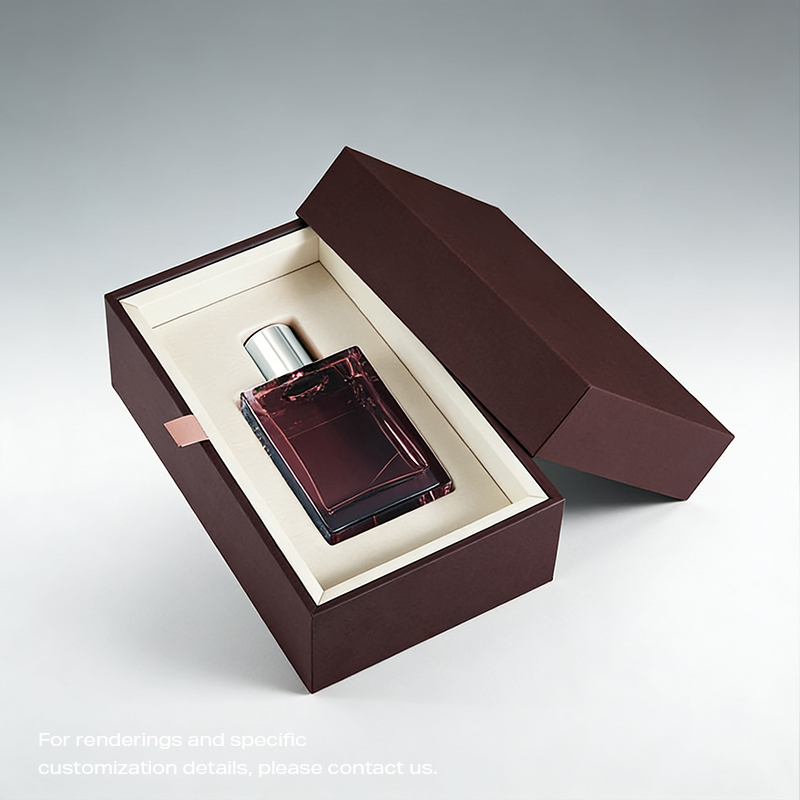
SHC-04 Lid And Base Perfume Gift Box Packaging With Sponge Insert
The SHC-04 is a two-piece perfume gift box consisting of a lid and a base. This construction is widely used for premium packaging because it creates a stable, substantial presentation. The lid and base fit together to create a clean exterior, while the separate-piece design gives the box a satisfying opening experience that is often associated with higher-value products.
The box is manufactured with thickened gray board, also known as rigid board or high-rigidity cardboard. This material forms a strong structural core that helps the package resist bending, deformation, and compression. The board is then covered with selected specialty paper, allowing the exterior to achieve a smooth, matte, textured, or otherwise customized appearance.
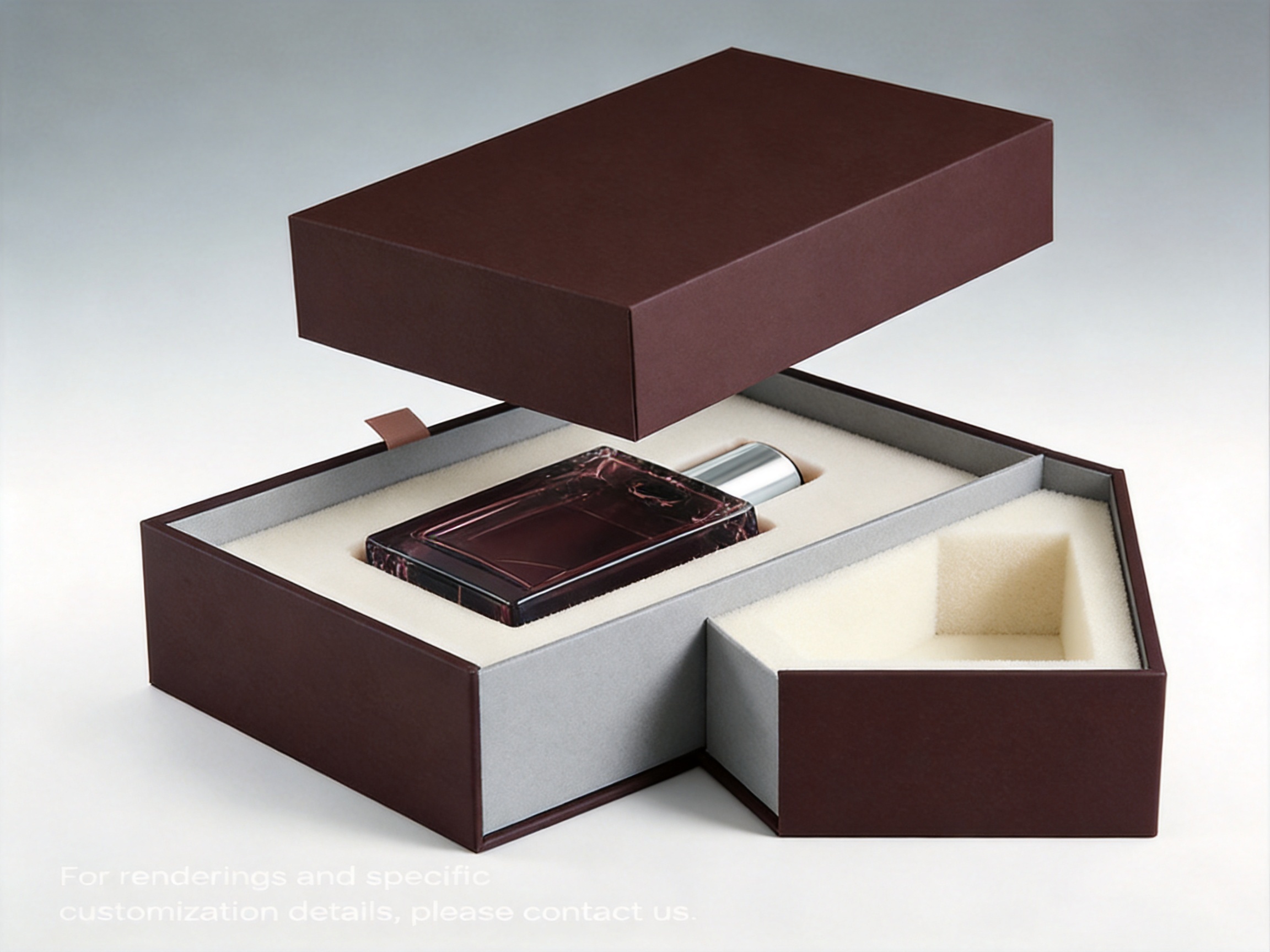
The interior includes a high-density sponge or foam insert with precisely cut openings. The insert is not simply decorative. It is an important functional element that keeps the perfume bottle positioned in the correct location and helps reduce movement during handling and transportation. By limiting unnecessary movement, the insert can help protect the bottle from impact, abrasion, and contact with other packaging components.
The package is intended for single perfume bottles, including many bottles in the approximately 50–100 ml range. Because perfume bottles vary considerably in shape and proportion, the dimensions and internal opening can be adjusted according to the customer’s product. Customization is available for the length, width, height, insert profile, outer paper, lining, and decorative treatment.
The standard reference dimensions are approximately 12–15 cm in length, 8–10 cm in width, and 6–8 cm in height. These dimensions are only a starting point for development. A packaging project can be engineered around a specific bottle, cap, label, accessory, sample vial, or gift set configuration.
Perfume bottles are often made from glass, which gives them a premium appearance but also makes them vulnerable to cracking, chipping, and breakage if the package is poorly designed. A suitable gift box must therefore combine exterior strength with interior cushioning. The SHC-04 addresses both requirements through its rigid gray board shell and fitted protective insert.
The thickened board structure provides a firm outer barrier around the product. It helps the box maintain its form when placed on a shelf, packed into a shipping carton, or handled during order fulfillment. A box that keeps its shape also presents a more professional appearance when it reaches the customer.
The specialty paper covering performs several roles. It protects the board surface, creates the desired visual finish, and provides a printable or decorative exterior for brand communication. The covering can be selected to support different visual directions, including understated luxury, modern minimalism, natural elegance, seasonal gifting, or bold promotional packaging.
The interior sponge or foam insert adds a second level of protection. Its precisely cut opening is designed to hold the bottle in a defined position. A well-fitted insert prevents the bottle from sliding freely inside the box and can reduce the amount of empty space around the product. This makes the package more stable during transportation and gives the customer a more organized unboxing experience.
Compared with packaging that relies only on tissue paper, loose paper filler, or a general-purpose carton, the SHC-04 offers a more controlled presentation. The perfume bottle is displayed in a dedicated cavity rather than being placed loosely inside the package. This is especially valuable for glass bottles with unusual caps, heavy bases, decorative shoulders, or delicate surface details.
The protective structure can also be adapted for product variations. If a brand offers several bottle sizes or shapes, separate insert designs can be developed while maintaining a common outer box style. This allows a product range to share a consistent visual identity without forcing every bottle into the same internal configuration.
Packaging strongly influences how consumers perceive a fragrance before they smell it. A carefully constructed gift box can suggest quality, exclusivity, craftsmanship, and attention to detail. The SHC-04 is designed to support these impressions through its substantial feel, clean two-piece structure, and customizable exterior.
The lid-and-base format opens smoothly and gives the customer a clear reveal of the perfume bottle. The opening motion is simple and intuitive, yet more substantial than the quick opening of a basic folding carton. This makes the package suitable for birthdays, anniversaries, weddings, holidays, promotional launches, subscription boxes, limited editions, and premium retail presentations.
For perfume brands, the box can become an extension of the fragrance identity. A soft neutral paper with subtle embossing may support a delicate floral fragrance. Dark, textured paper with metallic hot stamping may be appropriate for an intense or masculine fragrance. Bright colors, seasonal graphics, or playful finishing can be used for younger consumer segments or special campaigns.
The box also creates an opportunity to coordinate several branding elements. The company logo can be placed on the lid, side panels, interior panel, or insert platform. Product names, fragrance notes, collection information, manufacturing details, and promotional messages may be printed according to the design requirements. The exterior and interior can be coordinated to create a complete visual story.
A premium presentation does not depend only on expensive materials. It depends on the relationship between structure, proportion, color, surface, typography, and the opening experience. The SHC-04 provides a reliable structural foundation, allowing the brand’s design team to focus on these creative decisions.
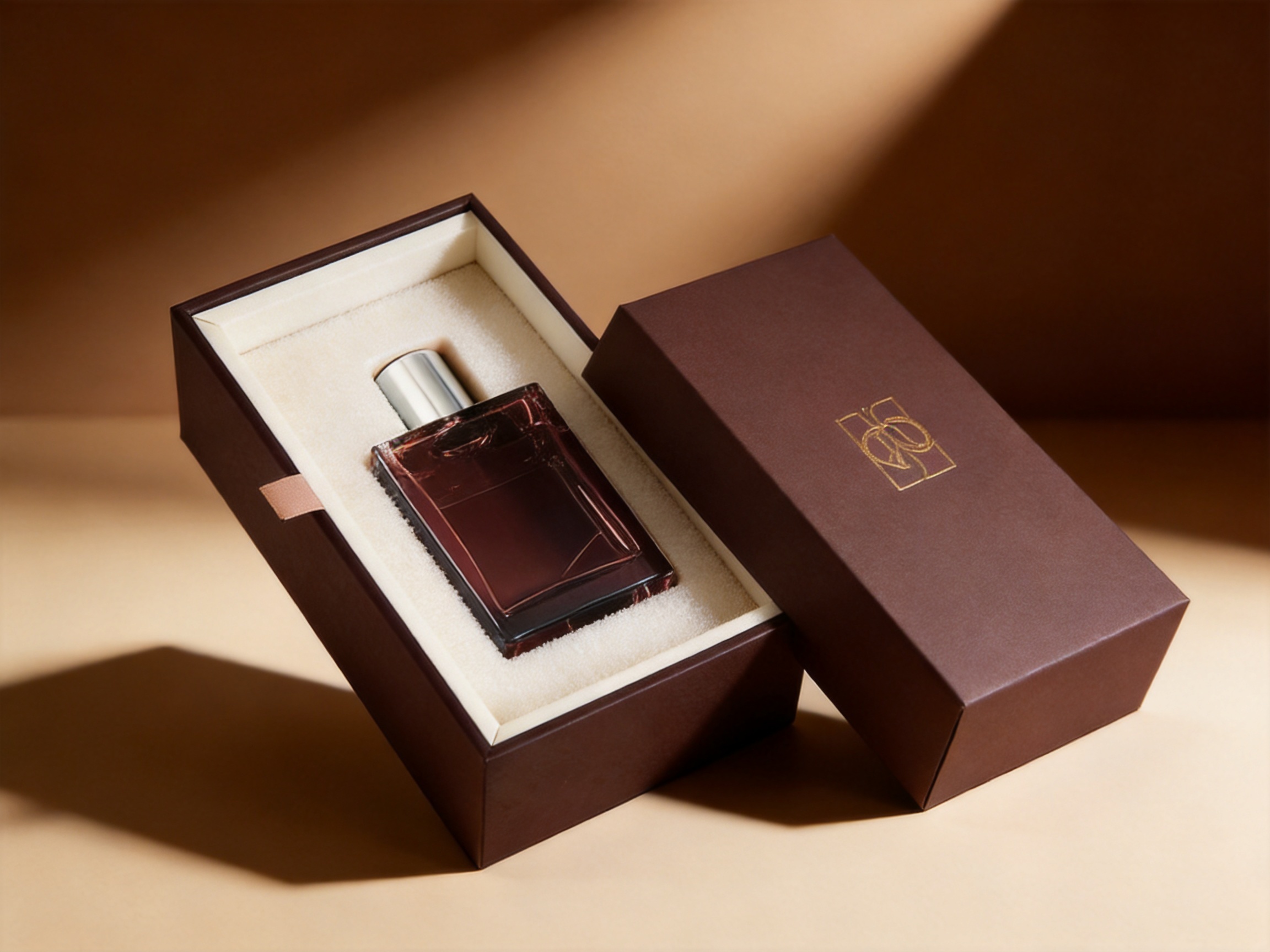
One of the main advantages of this perfume gift box is the range of available finishing processes. Different surface treatments can be combined to create a packaging design that is recognizable, tactile, and visually consistent with the product positioning.
Hot stamping applies a metallic or colored foil to selected areas of the box surface. Gold, silver, copper, black, and other foil effects can be used for logos, product names, borders, symbols, or decorative patterns. When applied to a matte or dark specialty paper, hot stamping can produce a strong contrast and a high-end appearance.
Hot stamping is especially suitable for fragrance packaging because it can communicate refinement without requiring a highly complex graphic layout. A small metallic logo on a restrained background may be enough to create a distinctive premium effect.
Embossing raises a logo, pattern, or lettering above the paper surface, while debossing presses the design into the material. These processes create a tactile feature that customers can see and feel. Embossing may be used alone or combined with hot stamping to give a brand mark additional depth.
Tactile finishing can be valuable for luxury fragrance packaging because it encourages interaction. The customer notices the box not only through color and graphics but also through the physical feel of the surface. A carefully designed embossed pattern can reinforce a botanical, geometric, heritage, or contemporary brand theme.
UV printing supports sharp graphic reproduction and can be used for logos, illustrations, product information, gradients, or decorative artwork. It is suitable for designs that require strong color definition or localized printed effects. Depending on the artwork, UV printing can be combined with matte paper or other finishing methods to create contrast between glossy and non-glossy areas.
Spot varnish places a selective glossy coating on specific parts of the package. A glossy logo, line, pattern, or image against a matte background can create a subtle but noticeable visual effect. Spot varnishing can also help direct attention to important brand elements without covering the entire box in a high-gloss finish.
The standard box body can feature matte lamination. This finish reduces surface glare and creates a smooth, refined appearance. Matte lamination is often associated with modern premium packaging because it provides a soft visual character and can make printed colors appear more controlled and sophisticated.
It also provides an additional protective layer over the printed or wrapped exterior. The exact appearance depends on the selected paper, color, artwork, and other processes, so sample approval is recommended before mass production.
The inside of a perfume gift box is just as important as the outside. A beautiful exterior cannot compensate for an insert that is too loose, too tight, poorly aligned, or unsuitable for the bottle’s weight. The SHC-04 includes an interior insert designed to support the product and improve presentation.
The high-density sponge or foam is cut according to the bottle dimensions. The opening can be developed around the main body, base, shoulders, neck, and cap, depending on the product design. If the perfume bottle includes an unusually large cap or decorative accessory, the insert can be modified to accommodate the complete product.
A fitted insert helps ensure that the bottle remains centered and visible when the lid is opened. It also creates a consistent appearance across multiple units. For brands that sell through retail, e-commerce, or international distribution, this consistency is important because every customer should receive a product that looks properly positioned.
The insert can be produced in different colors and surface treatments. The reference configuration includes an off-white flocking or sponge lining, while dark, light, neutral, or brand-specific colors may be considered for customized projects. Flocking can add a soft visual and tactile quality, helping the interior feel more luxurious than a plain uncovered foam surface.
The internal structure can also include additional compartments when required. For example, a box may be designed to hold a perfume bottle together with a small sample vial, fragrance card, travel spray, ribbon, message card, or care leaflet. These additions must be planned during the structural design stage so that they do not compromise the fit or protection of the primary bottle.
For shipping, the gift box should normally be placed inside a suitable outer carton with appropriate spacing and cushioning. The rigid gift box and internal insert provide important product protection, but the complete logistics system should be evaluated according to the bottle weight, shipping distance, stacking conditions, and distribution environment.
| Item Number | SHC-04 |
| Product Type | Two-piece lid-and-base perfume gift box |
| Category | Cosmetic gift box and custom fragrance packaging |
| Recommended Application | Single perfume bottles, commonly in the 50–100 ml range |
| Reference Dimensions | Approximately 12–15 cm length × 8–10 cm width × 6–8 cm height |
| Size Availability | Custom dimensions available according to the bottle and project requirements |
| Opening Method | Flip-top opening with separate lid and base construction |
| Outer Structure | High-rigidity gray cardboard covered with specialty paper |
| Reference Exterior Material | Dark brown art paper with matte lamination |
| Inner Protection | High-density sponge or foam insert with precision-cut opening |
| Inner Lining | Off-white flocking or sponge; customized options may be considered |
| Available Processes | Hot stamping, UV printing, embossing, logo treatments, spot varnishing, and related finishing options |
| Typical Uses | Perfume gift sets, holiday gifts, limited editions, salon products, and premium fragrance launches |
The specifications above describe the reference version of the product. Final dimensions, materials, insert construction, colors, and finishing processes should be confirmed through the customer’s technical drawings, product samples, or approved prototypes.
Folding cartons remain useful for many products, but they are not always suitable for premium perfume presentation. Their thinner paperboard structure can be more vulnerable to crushing, creasing, and corner damage. Their light weight may also make the product feel less substantial during unboxing.
The SHC-04 offers a rigid alternative. Its thickened gray board gives the box a stronger physical presence and helps it retain its shape. This can be particularly beneficial for premium fragrances, limited collections, and gift-oriented sales channels where presentation has a direct effect on perceived value.
The separate lid-and-base structure also offers advantages in design flexibility. It creates broad, clean surfaces for branding and provides a clear reveal when opened. The customer can remove the lid and see the bottle seated in its insert, rather than opening a carton with folded flaps that may obstruct the product.
The internal insert is another major difference. Many ordinary cartons depend on the bottle’s own packaging or a small paper support. A dedicated foam cavity can provide better positioning and make the package appear purpose-built for the product. This is useful for brands that have invested in distinctive bottle design and want the packaging to reflect that investment.
Rigid gift boxes can also be retained by customers for storage. After the perfume has been opened, the box may continue to serve as a protective container for the bottle, especially when the product is used occasionally or displayed in a bedroom, dressing area, retail cabinet, or salon.
Not all rigid boxes provide the same level of quality or suitability. A generic rigid box may have an attractive exterior but lack precise internal support. It may also use a standard size that creates excessive empty space around the bottle. Too much empty space can reduce stability and make the package look less refined.
The SHC-04 is developed specifically for perfume packaging. Its design considers the relationship between the outer box, the bottle, the insert, and the opening experience. The insert can be adjusted to the product dimensions, and the exterior can be customized to match the identity of the fragrance brand.
The product also benefits from manufacturing capabilities that support repeat production. Consistency in color, dimensions, paper application, finishing, and insert placement is important when a fragrance is sold across multiple batches or markets. A box that looks excellent in a first order must continue to meet the same standard in replenishment orders.
Another advantage is the ability to combine several processes within one coordinated production program. A brand may require matte lamination, hot stamping, embossing, and a flocked interior in the same packaging project. Managing these elements through an experienced manufacturer can reduce the risk of mismatched colors, inaccurate positioning, or inconsistent finishing.
Perfume brands often manage several product lines, including core fragrances, seasonal editions, gift sets, travel sizes, and premium releases. The SHC-04 platform can be adapted to support these different commercial purposes while preserving a recognizable family appearance.
For a regular fragrance range, the box may use a stable structure and a consistent outer material. Product names, colors, and decorative details can distinguish individual scents. This approach makes the collection easy to recognize while allowing each fragrance to maintain its own personality.
Holiday packaging can use special colors, metallic foil, seasonal illustrations, ribbons, or greeting messages. The rigid structure gives seasonal packaging a stronger gift character than a basic carton. It may also be designed to include a card, small accessory, or additional product.
Limited-edition fragrances often require packaging that feels distinctive and collectible. Embossing, textured paper, unusual color combinations, serialized printing, and special foil effects may be used to create a sense of exclusivity. The rigid box format provides a suitable platform for these enhancements.
Salons, spas, and professional beauty businesses may use perfume packaging for retail products, client gifts, loyalty programs, or private-label fragrances. The box can be customized with the salon’s logo and brand colors while maintaining a polished appearance suitable for customer-facing sales.
Companies may use perfume gift boxes for corporate events, hospitality programs, client appreciation, or employee recognition. The exterior can carry a restrained logo treatment, while the interior protects the fragrance during presentation and distribution.
A high-quality gift box depends on more than a good design. It also requires disciplined manufacturing, reliable equipment, trained operators, accurate process control, and inspection at multiple stages. Zhejiang Shihao Gift Packaging Co., Ltd. operates automated production lines and applies strict quality control to support stable, high-volume supply.
The company is an export-oriented manufacturer specializing in paper gift packaging boxes. It has more than 15 years of experience in production, research and development, and sales. Its facilities cover approximately 20,000 square meters and include a workforce of around 300 employees. This scale supports the coordination of design, sampling, material preparation, production, finishing, assembly, inspection, and shipment.
The reported average daily production capacity is about 5,000 sets of gift boxes. This capacity is valuable for perfume brands that need more than a small trial quantity or that require repeat orders for several markets. A scalable factory can help reduce supply interruptions and make it easier to plan promotional launches, seasonal demand, and replenishment schedules.
Automated production lines contribute to process stability by improving repeatability. In rigid box manufacturing, small differences in cutting, folding, paper wrapping, corner forming, or assembly can affect the final appearance. Equipment-supported production helps control these operations, while experienced workers remain important for setup, adjustment, finishing, and inspection.
Quality control should begin with incoming materials. Gray board must meet the required thickness and rigidity, specialty paper must be checked for color and surface quality, and sponge or flocking materials must be evaluated for consistency. Confirming material quality before production helps reduce defects later in the process.
During structural production, the board is cut and prepared according to the approved dimensions. Accurate cutting is important because the lid and base must fit properly. If the parts are too tight, opening may be difficult. If they are too loose, the box may look poorly finished or fail to provide a stable closure.
The paper-wrapping stage requires attention to alignment, corner formation, adhesive application, and surface cleanliness. Specialty papers with texture, metallic effects, or delicate coatings may require controlled handling to prevent scratches, wrinkles, glue marks, or visible misalignment.
Finishing processes such as hot stamping, embossing, UV printing, and spot varnishing must be positioned according to approved artwork. Registration accuracy is important when several processes overlap. For example, a hot-stamped logo placed over an embossed area must be aligned correctly to achieve a clean result.
The insert production stage also requires dimensional control. The opening must match the perfume bottle without damaging it or allowing excessive movement. Samples should be tested with the actual bottle whenever possible because nominal dimensions do not always describe every curve, shoulder, cap, or surface detail.
Final assembly and inspection can include checks for color consistency, structural fit, surface defects, insert placement, opening performance, and overall cleanliness. This process helps ensure that finished boxes meet the customer’s approved standard before packing and shipment.
Packaging development often involves more than selecting an existing catalog style. A perfume bottle may have a unique shape, an unusually heavy glass base, a tall cap, or a decorative component that requires structural adaptation. The manufacturer’s design and research capabilities can help transform the customer’s concept into a practical package.
Shihao maintains its own design team and updates dozens of products weekly. This indicates an active approach to product development rather than relying only on a fixed range of standard packaging. For customers, an in-house design capability can make communication more efficient during the early stages of a project.
A typical development process begins with the product requirements. The customer provides bottle dimensions, product images, drawings, target quantity, preferred materials, desired colors, artwork, and performance expectations. The manufacturer can then assess the box size, insert structure, paper coverage, and decoration plan.
After the structural proposal is reviewed, a prototype or sample may be created. The sample should be checked for bottle fit, lid movement, visual proportion, surface appearance, logo position, insert stability, and compatibility with the intended shipping method. Adjustments can be made before mass production.
Sampling is especially important for perfume packaging because small visual differences can have a major impact on perceived quality. The box may look correct in a digital drawing but require changes after the actual paper, foil, lamination, and insert materials are combined. A physical sample allows the customer to evaluate the complete experience.
Design support can also help brands consider production practicality. Some effects may look attractive but require additional setup, higher waste, or more complex registration. An experienced packaging manufacturer can recommend alternatives that preserve the visual objective while improving production efficiency and consistency.
Material selection affects packaging appearance, protection, production performance, and environmental positioning. The SHC-04 uses a rigid gray board core with a specialty paper exterior. This construction provides a strong basis for a premium package and can be specified according to the project’s performance and appearance requirements.
Shihao has passed BSCI and FSC certifications. These certifications provide important information about responsible business practices and forest-related material sourcing within the applicable certification scope. Customers should confirm the precise certification details, chain-of-custody requirements, and material declarations needed for their destination market.
Paper-based packaging can support sustainability goals when materials are selected responsibly and the package is designed for efficient use. Avoiding unnecessary empty space can reduce material consumption and improve transport efficiency. A right-sized insert can also reduce the need for excessive loose cushioning inside the box.
The rigid box may be retained by consumers for storage or reuse, extending its functional life beyond the initial unboxing. However, recycling outcomes depend on the final combination of board, paper, coatings, adhesives, foams, flocking, and decorative materials. Brands with strict sustainability requirements should evaluate the complete material system rather than considering the paperboard alone.
Manufacturers and customers can discuss options such as FSC-related paper sourcing, reduced plastic components, water-based or lower-impact coatings where technically suitable, simplified material combinations, and packaging designs that are easier to separate after use. The best option depends on the required appearance, durability, market regulations, and product positioning.
Perfume packaging is often purchased for international distribution, which makes production consistency and logistics planning essential. A supplier must be able to maintain communication across sampling, approval, production, inspection, packing, and shipment. It must also understand that packaging may be exposed to different climates, handling systems, and retail environments.
Shihao exports gift packaging to Europe, the United States, the Middle East, and other regions. This export experience supports projects that require international shipment, documentation coordination, and repeat communication with overseas customers. Its location in Jinhua, Zhejiang, China, places the company within a major manufacturing region with access to packaging materials, labor resources, production services, and transport networks.
Stable supply is particularly important for fragrance launches. If boxes arrive late, the perfume may not be ready for retail presentation, promotional photography, seasonal campaigns, or online fulfillment. A manufacturer with substantial capacity can help customers plan larger orders while reducing the risk associated with relying on very small workshops.
Consistency is also essential when the same package is ordered repeatedly. Customers typically expect the second production run to match the approved sample in dimensions, color, surface treatment, and insert fit. Detailed specifications, retained samples, production records, and quality inspection procedures can all support this objective.
Packaging should be packed carefully for shipment. Finished boxes may be stacked with protective separation to reduce scuffing and compression. Outer cartons should be selected according to the box size, weight, shipping method, and handling conditions. Customers may also request packaging tests or shipping simulations for especially delicate perfume bottles or long-distance distribution programs.
The SHC-04 can be used in physical retail environments where packaging must attract attention on a shelf or display table. Its rigid form gives it a strong presence, while the broad lid surface provides space for a logo, fragrance name, pattern, or campaign message. Multiple boxes can be developed as a coordinated collection for a more unified display.
In e-commerce, the box contributes to the customer’s unboxing experience. Online shoppers cannot touch the package before purchasing, so the arrival condition becomes an important moment of brand interaction. A rigid box that arrives clean, stable, and visually refined can help reinforce trust in the product and company.
E-commerce packaging must also be evaluated as part of a larger shipping system. The gift box should generally be placed in an appropriate mailer or shipping carton with sufficient protection. The correct combination can preserve the appearance of the presentation box while controlling shipping damage and unnecessary material use.
The box can also support influencer campaigns, press kits, subscription services, and promotional mailings. If additional fragrance samples or printed materials are included, the interior can be redesigned to provide organized compartments. This turns the package into a complete communication tool rather than a simple container.
The first step is to define the product requirements. Customers should provide the perfume bottle length, width, height, cap dimensions, weight, shape drawings, product photographs, and any accessories that must be included. Measurements should be taken at the widest and highest points, including protruding caps, collars, pumps, and decorative elements.
The second step is to determine the packaging objective. A box for standard retail sale may require a practical and efficient design, while a limited edition may prioritize special papers, multiple finishing techniques, and a more elaborate interior. The intended sales channel, target customer, price level, and shipping environment should all be considered.
The third step is to select the outer materials and visual direction. Customers can choose paper color, paper texture, lamination, printed artwork, metallic foil, embossing, UV treatment, and other surface details. A material board or physical paper sample can help the design team make decisions based on actual appearance and touch.
The fourth step is to develop the insert. The insert should hold the bottle firmly without exerting excessive pressure on fragile parts. It should also present the bottle attractively when the lid is removed. If a card, sample, ribbon, or accessory is required, its location should be incorporated into the structural plan.
The fifth step is sample approval. The customer should inspect the actual prototype, not only digital files. Important points include lid fit, opening smoothness, corner quality, exterior alignment, color, logo position, insert material, bottle stability, and overall perceived value.
The final step is mass production and inspection. Once the sample, artwork, materials, and specifications are approved, production can proceed. Clear approval records help ensure that the finished order matches the intended design and reduce misunderstandings between the customer and factory.

Quality control for a perfume gift box should cover both appearance and function. A box may have excellent printing but still fail if the lid does not fit or the insert allows the bottle to move. Conversely, a structurally strong box may not satisfy the customer if the paper has scratches or the logo is poorly positioned.
Inspectors can check the overall length, width, height, squareness, lid-to-base fit, corner formation, board rigidity, and resistance to visible deformation. The lid should open and close smoothly, and the box should remain stable when placed on a flat surface.
The exterior should be checked for wrinkles, bubbles, scratches, glue marks, paper lifting, color variation, edge damage, and uneven lamination. Textured or specialty papers may require particular attention because surface defects can be more visible under directional light.
Hot stamping, UV printing, embossing, and spot varnishing should be reviewed for position, clarity, adhesion, completeness, and consistency. If several finishing processes are used together, their registration should be checked carefully.
The insert should be checked for correct dimensions, clean cutting, secure placement, suitable density, and compatibility with the perfume bottle. The bottle should be tested in the insert to verify that it is held securely without being difficult to remove.
The assembled gift box should be evaluated as a complete unit. The inspection should confirm that the product sits at the correct height, the lid does not interfere with the bottle or cap, the interior appears clean, and the overall package matches the approved sample.
Choosing a packaging factory is not only a matter of comparing unit prices. The supplier’s experience affects design accuracy, communication, material selection, production stability, quality control, and delivery performance. A factory that has worked with gift boxes, storage boxes, jewelry boxes, folding boxes, kits, and other paper products may be better prepared to identify structural and finishing issues before they become expensive problems.
Zhejiang Shihao Gift Packaging Co., Ltd. has specialized in paper gift packaging for more than 15 years. Its product scope includes various kits, storage boxes, folding boxes, jewelry boxes, and gift boxes. This broader experience can support perfume brands that need several packaging formats across a product portfolio.
The company’s approximately 20,000-square-meter facility and around 300 employees provide a production base for both development and large-volume manufacturing. Its reported daily capacity of approximately 5,000 gift box sets demonstrates the ability to manage substantial orders while maintaining a repeatable production system.
Its own design team supports product development and customization. This is useful when a customer has a concept but needs help turning it into a manufacturable structure. The combination of design resources, equipment, production workers, and quality management can reduce the number of separate suppliers involved in a packaging project.
Certifications such as BSCI and FSC can also be relevant to international buyers. BSCI relates to social compliance practices, while FSC certification concerns responsible forest-based material sourcing within the relevant certified supply chain. Buyers should request current documentation and verify that the selected materials and production scope meet their own procurement standards.
A perfume is an emotional product. Consumers often select a fragrance based on memory, aspiration, lifestyle, identity, or the desire to give a meaningful gift. Packaging contributes to these emotional associations by shaping the first physical interaction with the product.
The SHC-04 allows brands to build a more complete experience around the fragrance. The sturdy exterior suggests care and substance. The refined paper finish establishes the visual tone. The customized logo and decoration communicate identity. The fitted insert presents the bottle with order and precision. The two-piece opening creates a deliberate moment of reveal.
These details can support customer confidence and encourage positive sharing. A well-designed package may be photographed, displayed, reused, or remembered after the perfume itself has been opened. For emerging brands, packaging can help create a professional market presence. For established brands, it can strengthen recognition and differentiate a special product line.
Packaging can also communicate price positioning. A standard carton may be appropriate for an everyday fragrance, while a rigid gift box is more suitable for a premium price point, special bundle, or limited release. The SHC-04 gives brands the flexibility to choose the level of finishing needed for each commercial purpose.
Premium packaging does not have to mean uncontrolled cost. Cost efficiency can be achieved through early structural planning, appropriate material selection, repeatable dimensions, accurate artwork, and coordinated production. A box that is designed correctly from the beginning is less likely to require costly changes, excessive material use, or repeated sampling.
Using a common outer structure for a fragrance collection can simplify purchasing and production. Different paper colors, printed graphics, or finishing combinations may distinguish product versions while keeping the basic dimensions stable. This can support more organized inventory management and improve visual consistency across the range.
Custom sizing can also reduce waste. A box that is too large may require more board, paper, foam, and shipping space. A box that is too small may compromise protection or create pressure on the bottle. Developing the package around the actual product helps establish a practical balance between protection, presentation, and material consumption.
Finishing should be selected according to the desired effect. A small hot-stamped logo may create the required premium impression without applying foil to the entire surface. Matte lamination combined with selective spot varnish may provide a sophisticated contrast at a lower complexity than multiple decorative layers. The factory can help compare options during the development stage.
The SHC-04 is designed primarily for single perfume bottles and fragrance products. It is suitable for many standard 50–100 ml perfume bottles, as well as selected premium, holiday, salon, promotional, and limited-edition fragrance applications.
Yes. The outer dimensions and internal foam or sponge insert can be customized according to the bottle’s measurements and shape. Customers should provide accurate dimensions or a physical sample so the insert can be developed precisely.
The product uses a two-piece lid-and-base structure with a flip-top opening method. The lid and base are designed to open and close smoothly while creating a substantial gift presentation.
The reference construction uses high-rigidity gray cardboard for the structural core and specialty paper, including dark brown art paper in the listed configuration, for the outer covering. The interior uses an off-white flocking or sponge lining and a high-density protective insert.
Yes. The outer paper, color, texture, printed artwork, and decorative treatment can be customized according to brand requirements and the intended market positioning.
Available options include matte lamination, hot stamping, UV printing, embossing, logo treatments, spot varnishing, and other customized processes subject to design review and production feasibility.
The precision-cut insert is designed to reduce movement and help protect the bottle inside the gift box. The complete shipping package should also include a suitable outer carton and cushioning system based on the bottle’s weight, fragility, and distribution conditions.
Additional items such as sample vials, fragrance cards, message cards, travel sprays, or small accessories may be possible. The interior layout must be redesigned to accommodate them without reducing bottle stability or creating excessive pressure.
Yes. The manufacturer operates automated production lines, maintains strict quality control, and reports an average daily capacity of approximately 5,000 gift box sets. Final production capacity depends on the order specifications, finishing processes, quantity, and delivery schedule.
Yes. The box is suitable for e-commerce presentation, but it should be placed inside an appropriate shipping carton with adequate protective material. The gift box itself is the product presentation package, while the outer shipping package should be designed for logistics protection.
Useful information includes the perfume bottle dimensions, quantity, box size, material preferences, paper color or texture, artwork, logo treatment, insert requirements, target market, shipping destination, and desired delivery schedule. A physical bottle sample or technical drawing can improve quotation accuracy.
Yes. A common box structure can support a collection while different papers, colors, graphics, foils, or embossed details distinguish individual fragrances. Separate insert designs can be developed if the bottles have different shapes or sizes.
The supplied company information states that Zhejiang Shihao Gift Packaging Co., Ltd. has passed BSCI and FSC certifications. Customers should request the current certificates and confirm their applicability to the selected materials and production order.
The company is located at No. 15, Xiayang Road, Huangzhai Town, Jinhua, Zhejiang, China. It serves international customers and exports packaging to Europe, the United States, the Middle East, and other regions.
Before approving a custom perfume gift box, customers should confirm the bottle fit. The bottle should sit securely in the insert, remain visually centered, and be easy for the customer to remove. The cap should not contact the lid unless that contact is intentionally designed and tested.
Customers should also evaluate the opening experience. The lid should not be excessively tight or loose, and the box should not produce visible paper damage during repeated opening and closing. The edges and corners should remain clean after handling.
Color should be checked under suitable lighting. Printed color, specialty paper color, foil appearance, and lamination can look different on a screen than they do on the finished product. A physical color standard or approved sample is recommended for important brand colors.
Surface finishing should be reviewed from different angles. Spot varnish, embossing, and hot stamping may appear differently under retail lighting, photography lighting, or natural light. The customer should make sure the final effect matches the intended brand image.
Shipping tests should be considered for fragile glass bottles, long-distance transportation, or e-commerce distribution. The test package should represent the actual production materials and shipping configuration as closely as possible.
Finally, customers should confirm production tolerances, packaging quantity per carton, inspection standards, approved artwork, material specifications, lead time, and shipment terms. Clear documentation helps protect both the buyer and the manufacturer throughout the project.
The SHC-04 lid-and-base perfume gift box is a practical and premium packaging solution for fragrance brands that need more than a basic carton. Its rigid gray board construction helps resist deformation, while the specialty paper exterior provides a flexible surface for brand customization. Its high-density foam or sponge insert supports bottle stability, reduces internal movement, and improves the visual quality of the unboxing experience.
The two-piece flip-top design creates a smooth and memorable presentation suitable for retail products, gifts, seasonal collections, limited editions, salon brands, and promotional fragrance projects. Custom dimensions allow the package to be adapted to different bottle shapes, while hot stamping, UV printing, embossing, spot varnishing, matte lamination, and other processes provide numerous opportunities for visual differentiation.
The product is supported by the manufacturing capabilities of Zhejiang Shihao Gift Packaging Co., Ltd., an export-oriented packaging manufacturer with more than 15 years of industry experience, an approximately 20,000-square-meter facility, around 300 employees, automated production lines, an in-house design team, and a reported daily production capacity of about 5,000 gift box sets. Its BSCI and FSC certifications, international export experience, and broad paper packaging product range further support custom packaging projects for global customers.
For brands seeking a reliable custom gift box manufacturer, the most important advantages are the combination of protection, presentation, customization, and production capacity. By developing the box around the actual perfume bottle and confirming materials and finishes through sampling, customers can create packaging that protects the product, strengthens brand recognition, and delivers a more valuable experience to the final consumer.
1. Product specification information for the SHC-04 two-piece perfume gift box, including materials, dimensions, opening method, insert construction, finishing options, and applications.
2. Company information supplied for Zhejiang Shihao Gift Packaging Co., Ltd., including manufacturing history, facility scale, workforce, production capacity, export markets, certifications, and product range.
3. General packaging engineering principles concerning rigid board construction, protective inserts, dimensional fitting, surface finishing, and transport preparation for fragile glass products.
4. General fragrance packaging and consumer experience principles concerning presentation, unboxing, product positioning, retail display, and gift-oriented packaging design.
5. General responsible sourcing considerations for paper-based packaging, including certification verification, material combinations, reuse potential, and end-of-life evaluation.
Recommended Products

Contact Us

No. 15, Xiayang Road, Huangzhai Town, Jinhua, Zhejiang, China

(+86) 579-84230069

(+86) 13085675766


Products

Gift Box Packaging Manufacturer
 English
 Français
 Español
 عربى