2026-11-18
In the premium chocolate market, packaging is more than a protective outer layer. It is a significant part of the product experience, a visual signal of quality, and an important element of brand communication. Before a customer tastes a chocolate, the box has already begun telling a story about craftsmanship, occasion, and value. The SH-04 5×3 Grid Hot-Stamped Chocolate Gift Box is designed for brands that want to present high-end chocolates in a package that combines visual luxury, structural protection, organized presentation, and flexible customization.
With its gold color scheme, glossy surface, hot-stamped pattern, fitted inner tray, and lid-and-base opening structure, this chocolate gift box offers a complete packaging solution for premium confectionery collections. It is suitable for holiday gift sets, business gifts, luxury desserts, souvenirs, retail chocolate assortments, and other products that require a strong first impression.
The box is produced from high-rigidity grey cardboard covered with gold glossy art paper. Its surface can receive glossy film lamination and decorative hot stamping, allowing metallic patterns to stand out with a sharp, reflective appearance. Inside, a gold blister tray separates the chocolates and helps prevent movement during handling, storage, and transportation. The result is a presentation box that supports both the visual and practical requirements of premium food packaging.
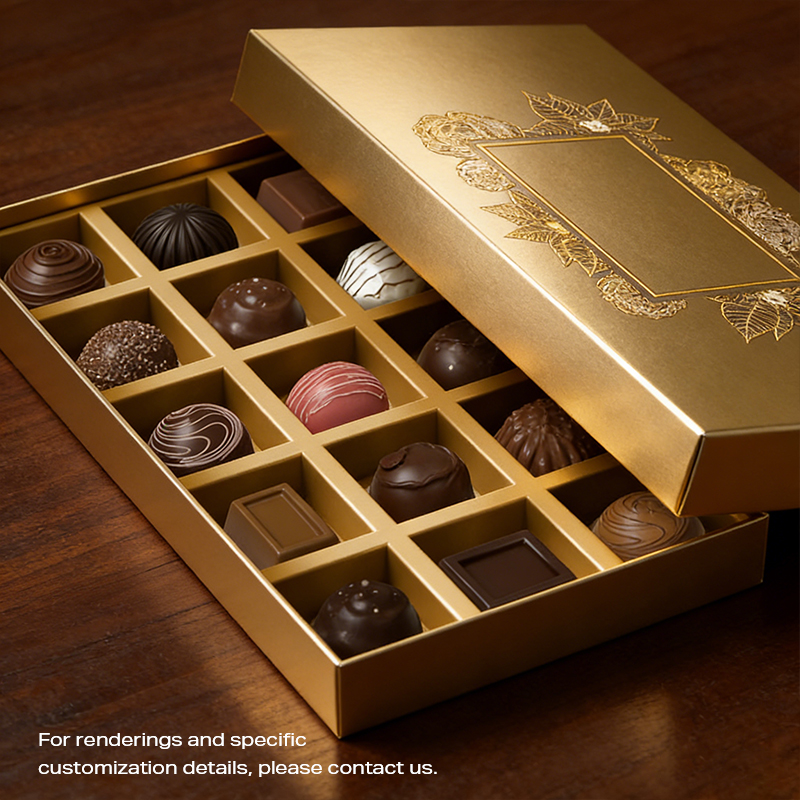
SH-04 5x3 Grid Hot Stamping Process Chocolate Gift Box
Chocolate is frequently purchased as a gift, which means the package must perform several roles simultaneously. It must protect delicate pieces, display the assortment attractively, communicate quality, and create an appropriate emotional response. A package that looks ordinary may weaken the perceived value of an otherwise excellent product. In contrast, a carefully designed gift box can make the same chocolate collection feel more special, more memorable, and more suitable for presentation.
Premium packaging is particularly important for seasonal campaigns and corporate gifting. During holidays, customers often compare products based on appearance before making a final purchase decision. A box with a rich metallic finish and a well-organized interior can immediately communicate celebration and exclusivity. For corporate gifts, the packaging also reflects the professionalism of the purchaser. A refined box demonstrates attention to detail and can make a business gift feel more thoughtful.
The SH-04 addresses these expectations through a coordinated design. The exterior creates a luxurious visual impression, while the interior provides orderly placement for individual chocolates. The gold color links the outside and inside surfaces, producing a unified appearance when the box is opened. This coordination helps the package feel intentional rather than assembled from unrelated components.
Another important advantage is the way the box supports the unboxing experience. A lid-and-base structure creates a clear transition between the closed presentation and the displayed chocolate assortment. When the lid is lifted, the chocolates are revealed in a defined arrangement instead of being hidden in a loose bag or crowded container. For gift recipients, this opening moment can become part of the product’s perceived value.
The SH-04 is a high-end chocolate gift box developed for multi-piece chocolate packaging. Its design features a rectangular rigid box, a gold exterior, decorative hot-stamped patterns, and a fitted inner insert. The box is intended for applications where the packaging must look luxurious while still offering a practical structure for repeated handling.
The product information identifies the box as a 5×3 grid design. The listed specification also indicates suitability for approximately 16 chocolates, while the product title refers to a 5×3 grid. Because cavity count may vary according to chocolate size, shape, and insert configuration, buyers should confirm the final number of compartments during the customization stage. The inner structure can be adapted to the dimensions of the intended chocolates, making it possible to balance visual spacing, product protection, and overall box size.
| Item | Specification |
| Product model | SH-04 |
| Product type | Luxury chocolate gift box |
| Grid configuration | 5×3 grid design; final cavity quantity to be confirmed according to product dimensions |
| Suggested capacity | Approximately 16 chocolates, customizable |
| Approximate dimensions | 25–30 cm length × 20–25 cm width × 5–7 cm height |
| Opening method | Lid and base style |
| Outer material | High-rigidity grey cardboard with gold glossy art paper |
| Inner material | Gold blister tray |
| Surface treatment | Glossy film lamination and hot-stamping pattern printing |
| Primary applications | Luxury chocolate sets, holiday gifts, business gifts, souvenirs, and premium dessert packaging |
The approximate dimensions provide a useful starting point for product planning, but packaging dimensions should always be finalized after the chocolate samples and insert drawings have been reviewed. Chocolate pieces may differ considerably in height, width, weight, and shape. A successful package must allow sufficient clearance while avoiding excessive empty space that could make the contents appear undersized.
The most distinctive feature of the SH-04 is its hot-stamped decorative surface. Hot stamping uses heat and pressure to transfer metallic foil onto selected areas of a printed or coated surface. When gold foil is applied to a suitable substrate, it produces a reflective effect that cannot be fully replicated by ordinary ink printing.
During the process, a heated stamping die presses the foil against the paper surface. The combination of temperature, pressure, and controlled dwell time allows the metallic layer to adhere to the intended pattern. When the foil carrier is removed, the selected design remains on the box with a clean and brilliant finish. Properly controlled hot stamping creates sharp edges, strong contrast, and a refined metallic sheen.
For chocolate packaging, this process has several advantages. First, gold decoration is naturally associated with celebration, premium quality, and gift-giving. Second, the reflective surface changes subtly as the box moves under different lighting conditions, adding depth to the presentation. Third, hot-stamped patterns can be used to highlight borders, logos, geometric details, seasonal motifs, or selected visual elements without covering the entire surface with heavy decoration.
The SH-04 combines hot stamping with a gold glossy art paper exterior. This combination creates a layered visual effect: the paper provides the overall background, the glossy surface enhances light reflection, and the foil pattern adds areas of concentrated metallic brilliance. Compared with a plain printed carton, this treatment gives the box greater visual richness and a more tactile impression.
Hot stamping also offers a valuable advantage in competitive retail environments. Many standard chocolate boxes depend primarily on printed color and artwork. A metallic pattern can create a stronger shelf presence, especially when the design is viewed from a distance. The box can appear brighter and more distinctive under retail lighting, helping a premium assortment attract attention among similar products.
The quality of the final result depends on more than the foil itself. The surface must be properly prepared, the stamping die must be accurately produced, and the production line must maintain consistent temperature and pressure. Poorly controlled hot stamping may cause incomplete transfer, blurred edges, uneven shine, or misalignment. The manufacturing process behind the SH-04 is therefore important because the decorative effect is directly connected to production precision.
A premium gift box must look elegant without becoming fragile. The SH-04 uses high-rigidity grey cardboard as the structural base of the outer box. Grey cardboard is widely used in rigid packaging because it provides stiffness, dimensional stability, and a solid hand feel. It helps the box maintain its shape during filling, stacking, transportation, and presentation.
Compared with lightweight folding paperboard, rigid grey cardboard can give the package a more substantial feel. This matters in the luxury sector because consumers often use weight and firmness as informal indicators of quality. A rigid box is less likely to feel disposable, and it can be retained for storage or repurposed after the chocolates have been consumed.
The structural board is covered with gold glossy art paper. This outer paper provides a smooth and attractive surface for lamination, printing, and hot stamping. It also allows the packaging design to achieve a clean appearance without exposing the rougher structural board beneath. The result is a combination of internal strength and external refinement.
Glossy film lamination provides another protective layer. It can improve resistance to everyday scuffing and help preserve the printed and decorative surface during handling. Lamination also intensifies the gloss of the paper, making the gold background appear more polished. In combination with hot stamping, it creates a smooth, reflective finish suitable for premium gift packaging.
The material structure is especially useful for products that may be handled several times before reaching the recipient. Chocolate gift boxes are often moved through manufacturing, warehousing, retail display, delivery, and final gifting. A rigid board construction and protected surface can reduce the risk that the packaging will lose its visual appeal before it is opened.
The inner insert is designed to separate individual chocolate pieces and maintain a consistent arrangement. A grid structure is practical because it gives every piece a defined position. Instead of allowing chocolates to shift against each other, the insert creates boundaries that support orderly placement.
The supplied description identifies a custom-designed 5×3 grid. The inner tray can be developed around the dimensions of the intended product, allowing the package to accommodate different chocolate shapes. This is important because premium chocolate collections may include squares, rectangles, domes, filled pieces, truffles, or other molded forms. Each style may require a different cavity shape and clearance allowance.
A fitted insert offers several benefits. It can reduce contact between individual pieces, help prevent movement when the box is carried, and make the assortment look more deliberate. It also simplifies filling operations because each chocolate has a designated position. For customers, the organized arrangement makes it easier to understand the assortment and select individual pieces.
The gold blister tray complements the external color scheme and helps maintain a consistent luxury appearance inside the package. When the lid is opened, the recipient sees more than the chocolates themselves; the tray becomes part of the presentation. A mismatched or low-quality insert can weaken the effect of an elegant exterior, so the coordinated gold interior is a valuable design choice.
For manufacturers and chocolate brands, the insert can also support product planning. A defined cavity layout makes it easier to calculate chocolate quantities, estimate total package weight, and prepare product photography. It helps the brand create a repeatable presentation across different production batches.
Although a 5×3 grid is visually balanced, customization remains important. The final insert should be checked against the chocolate’s maximum length, width, height, wrapper thickness, and tolerance. If the chocolates are individually wrapped, the wrapper dimensions should be measured rather than the unwrapped pieces alone. The insert should also provide sufficient space for easy removal without allowing the chocolates to move excessively.
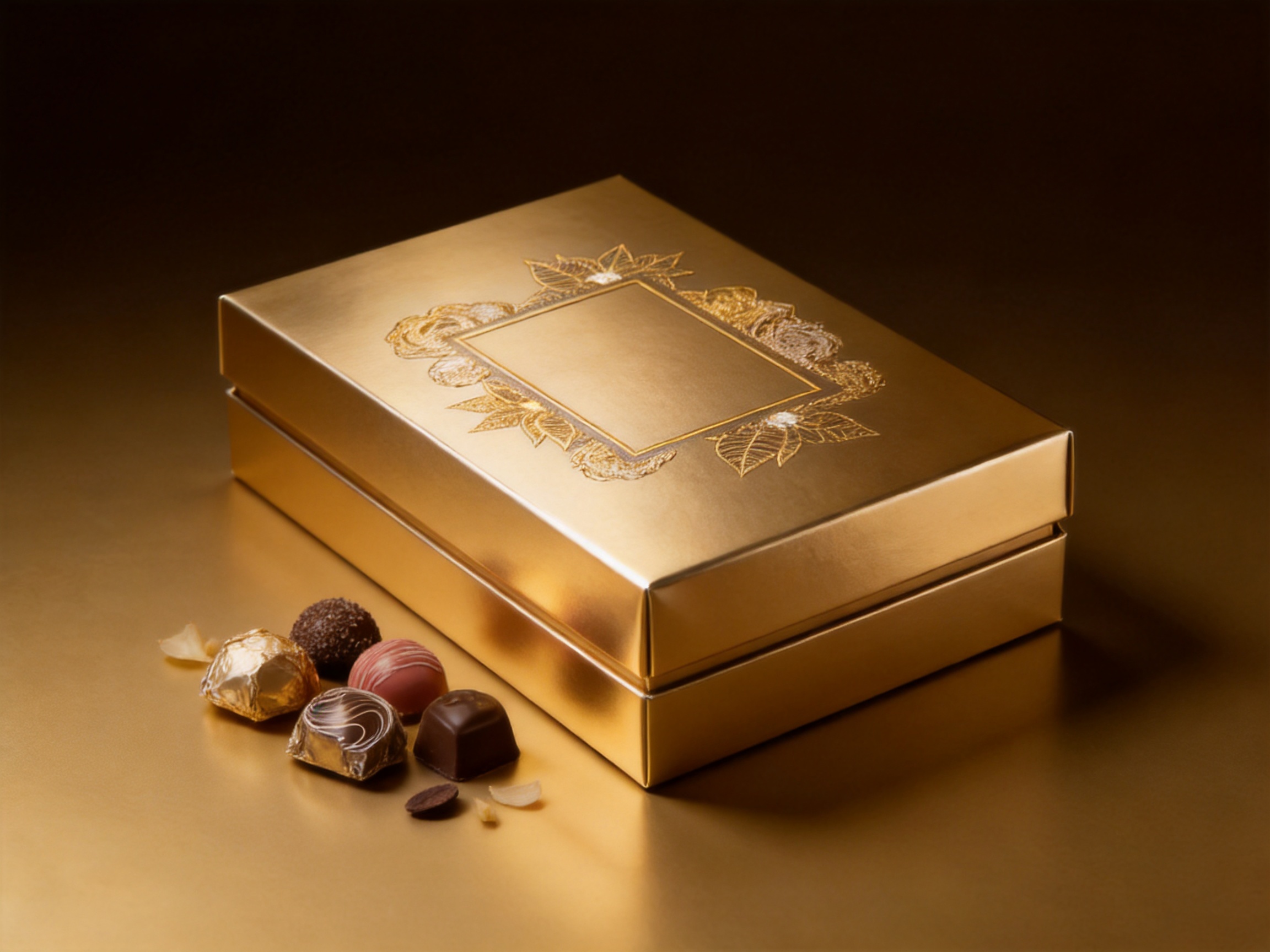
The SH-04 uses a lid-and-base style opening method. This structure offers a familiar and practical user experience. The base supports the chocolate tray, while the lid protects the contents and completes the presentation when closed. Depending on the exact construction, the lid may be hinged, attached, or designed as a fitted cover, so the final opening detail should be confirmed in the approved production drawing.
A well-made lid-and-base box has a clear and stable form. It can be opened smoothly, closed securely, and placed on a table without collapsing. For gift presentation, this is important because the recipient should be able to open the box without tearing, forcing, or damaging the package.
The structure also supports brand photography and retail display. A closed box communicates luxury through the exterior decoration, while an open box reveals the grid arrangement and chocolate assortment. This makes the packaging versatile for product pages, social media campaigns, catalogues, and in-store displays.
Compared with a simple folding carton, a rigid lid-and-base box can provide a more memorable opening experience. The recipient often perceives a difference between opening a lightweight carton and lifting the lid of a substantial gift box. That difference can reinforce the premium positioning of the chocolates and encourage the customer to keep the box for future use.
The SH-04 offers several advantages over ordinary chocolate packaging formats. Standard folding cartons can be efficient and economical, but they may not provide the same combination of rigidity, metallic decoration, and organized interior presentation. The SH-04 is designed for brands that need packaging to communicate a higher level of value.
The gold glossy surface and hot-stamped pattern can create a stronger visual presence than a basic printed carton. Metallic details catch the light and can help the box stand out during holiday campaigns or premium retail displays. The decorative treatment can also be adapted to support different brand identities, seasonal themes, and collection concepts.
A rigid box with a substantial hand feel often communicates quality more effectively than a thin package. The combination of high-rigidity cardboard, glossy lamination, and metallic foil creates a multi-sensory experience involving sight, touch, and movement. These details can support a higher-end price position when they are matched by the quality of the chocolate itself.
The fitted grid insert provides a defined place for each chocolate. This is an advantage over loose-fill packaging, where pieces may shift, collide, or appear disordered. Organized presentation makes the assortment easier to inspect and gives the customer a clearer sense of the number and variety of chocolates included.
The gold color, decorative foil, and structured opening method are naturally suited to gifts. The box can be used for festive occasions, business relationships, weddings, anniversaries, hotel amenities, and luxury dessert collections. Its appearance can reduce the need for additional wrapping in certain sales environments.
The dimensions, cavity layout, pattern, colors, printed elements, and finishing details can be reviewed during development. This allows brands to adapt the box to their chocolate range rather than forcing the product into a fixed, unsuitable container. Customization is especially useful when a brand has multiple piece sizes or wants packaging reserved for a limited edition.
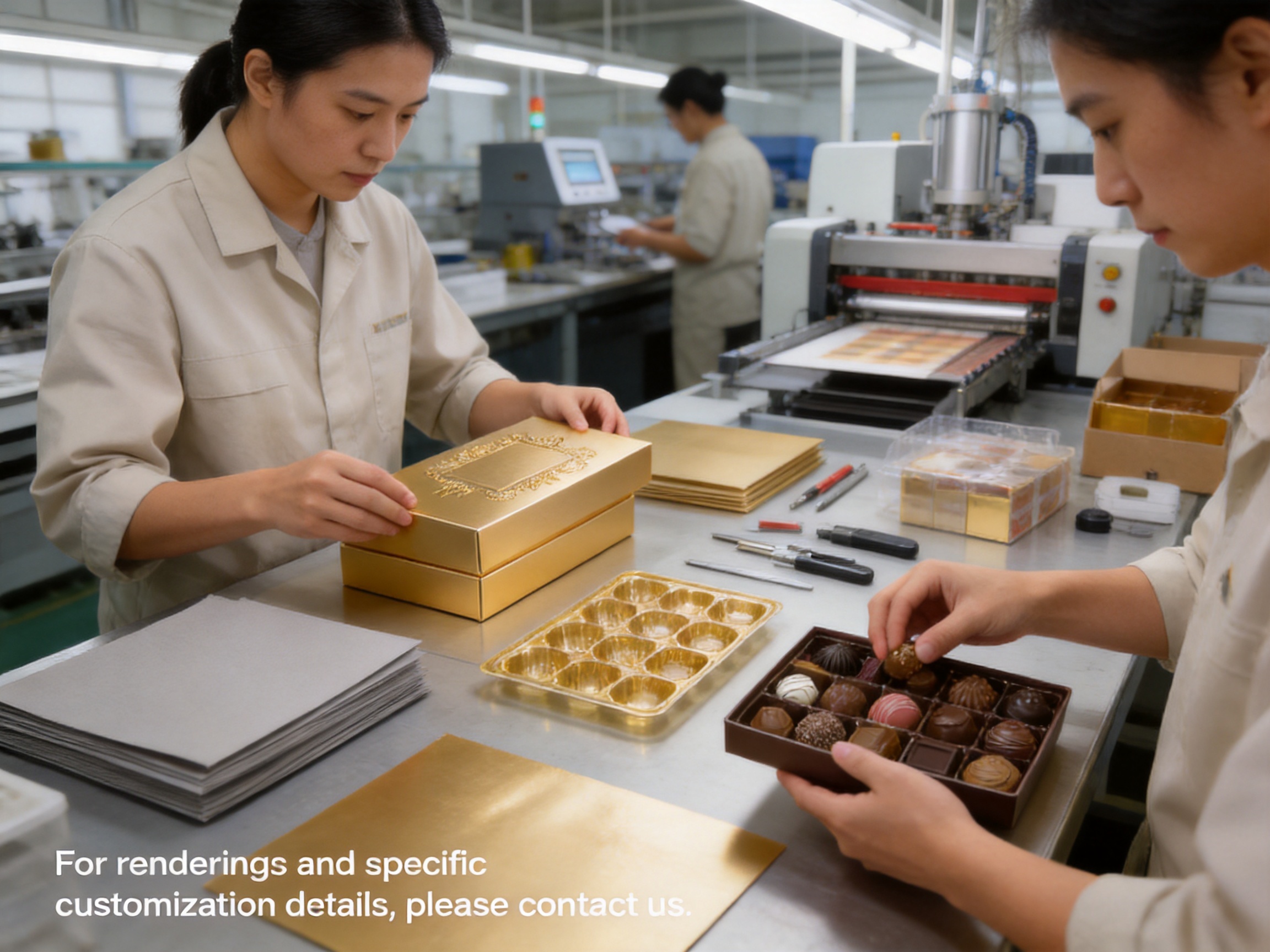
The performance of a premium gift box depends on the manufacturer’s ability to coordinate multiple processes. Structural board preparation, paper covering, printing, lamination, hot stamping, die cutting, folding, assembly, insert production, inspection, and packing must all work together. A weakness at any stage can affect the appearance or usability of the final package.
Zhejiang Shihao Gift Packaging Co., Ltd. is an export-oriented manufacturer specializing in paper gift packaging boxes. The company has more than 15 years of experience in production, research and development, and sales. Its reported facility covers approximately 20,000 square meters and employs around 300 people. This scale supports the development and production of packaging for different markets and product categories.
The company reports an average daily production capacity of approximately 5,000 sets of gift boxes. Capacity at this level can be important for brands planning seasonal promotions, repeat orders, or coordinated packaging launches. A manufacturer with established production resources may be better positioned to manage larger quantities while maintaining a consistent process schedule.
Advanced equipment is used across the company’s production operations. For a product such as the SH-04, suitable equipment supports accurate cutting, stable paper covering, consistent lamination, controlled hot stamping, and efficient assembly. Automation and specialized machinery can reduce variation between units, while experienced operators remain important for monitoring material behavior and handling customized requirements.
The company also maintains its own design team and reports updating dozens of products weekly. This indicates an active approach to product development rather than relying solely on fixed catalogue designs. For buyers, an internal design capability can help with artwork adaptation, structural improvements, finishing recommendations, and packaging concepts for specific market segments.
Product development begins with understanding the chocolate collection. The manufacturer needs information about the piece dimensions, total quantity, individual wrapping, product weight, storage requirements, and intended sales channel. These details influence the box size, insert design, board thickness, opening method, and finishing options.
The next stage is structural engineering. The box dimensions are converted into a technical drawing that defines the lid, base, walls, corners, insert, and tolerances. The drawing must account for the thickness of the grey cardboard, the covering paper, lamination, and any additional decorative layers. Small dimensional errors can affect lid fit and overall appearance, so the structure should be reviewed carefully before mass production.
For the inner tray, sample chocolates should be used whenever possible. A computer drawing can establish the general layout, but physical samples help verify whether pieces can be inserted and removed conveniently. The trial should also examine whether the chocolate sits at the desired depth and whether the insert remains stable inside the box.
After the structure is approved, the surface artwork and hot-stamping pattern can be prepared. Hot-stamped details require precise registration. If a pattern must align with a printed logo, border, or box edge, the artwork and die must be coordinated with the cutting and forming tolerances. A reliable workflow reduces the risk of visible misalignment.
Paper covering and lamination must also be controlled. The covering paper should be positioned smoothly around the rigid board, with clean corners and minimal wrinkles. The laminated surface should remain even and free from bubbles, scratches, or cloudy areas. These details are highly visible on a gold package because reflections can emphasize surface defects.
Hot stamping follows the preparation of the surface and die. The production team must adjust heat, pressure, speed, and foil selection according to the paper and pattern. A successful result has complete coverage, clean edges, consistent gloss, and a strong bond. Samples should be checked under different lighting conditions because metallic decoration can appear different under warm, cool, and natural light.
Final assembly brings the components together. The lid and base must be checked for alignment, the tray must fit securely, and the box should open and close without excessive resistance. The finished package should then be inspected for appearance, structural stability, contamination, and packaging cleanliness before shipment.
For international buyers, manufacturing quality includes more than the appearance of an individual sample. It also involves repeatability, communication, documentation, production scheduling, packing methods, and the ability to meet destination-market expectations.
Zhejiang Shihao Gift Packaging Co., Ltd. reports BSCI and FSC certifications. BSCI is associated with social compliance evaluation in supply chains, while FSC relates to responsible forest management and certified paper sourcing under applicable chain-of-custody requirements. Buyers should confirm the current status, scope, and applicability of any certification for a specific order.
Certification can be useful when brands must provide responsible sourcing or social compliance information to retailers and customers. It does not replace product inspection, but it can form part of a broader supplier assessment process. Buyers should also request material specifications and confirm whether the particular paper, board, tray, and finishing components meet their own requirements.
Quality control for the SH-04 should include several inspection points. Structural dimensions should be measured to confirm that the finished box corresponds to the approved sample. The lid should fit correctly, and the base should remain stable when filled. The hot-stamped pattern should be checked for completeness, clarity, and position. The laminated surface should be examined for scratches, bubbles, wrinkles, and color variation.
The inner tray should be tested with actual chocolate pieces. Inspectors should verify the cavity count, cavity dimensions, depth, fit, and removal experience. The tray should not create unnecessary pressure on the chocolate or allow excessive movement. If chocolates are individually wrapped, the inspection should use the final wrapped product.
Export packing is another important consideration. Rigid boxes can be protected with suitable inner packing and master cartons to reduce the risk of corner damage, surface abrasion, or crushing during transportation. Carton strength, stacking arrangement, moisture protection, and palletization should be discussed according to the shipping route and order quantity.
Although the standard SH-04 presentation uses a luxurious gold theme, the overall design can serve as a foundation for multiple market applications. A brand may adjust the hot-stamped pattern, printed artwork, color balance, logo treatment, and interior arrangement while retaining the rigid box format.
For holiday collections, the pattern can include seasonal geometry, stars, snow-inspired details, floral elements, or symbolic motifs. For corporate gifts, the design may use restrained borders and a discreet logo. For wedding favors or anniversary collections, the box can incorporate elegant typography and coordinated decorative details. For luxury desserts, the interior can be developed around a smaller or larger selection of specialty pieces.
Color customization can also change the mood of the package. Gold communicates celebration and richness, while combinations with black, deep red, ivory, navy, or dark green may create different levels of contrast. The precise choice of art paper, foil color, and printed ink should be evaluated together because metallic finishes can affect how surrounding colors appear.
The insert can be customized for product shape and quantity. A brand may request deeper cavities for filled chocolates, broader spaces for molded pieces, or different arrangements for mixed assortments. If the collection includes multiple product sizes, a carefully planned insert can create a balanced composition without allowing pieces to touch unnecessarily.
Dimensions may also be adapted for logistics. A compact box may be suitable for boutique retail or premium samples, while a larger box may be intended for corporate gifting. The manufacturer can assess whether the selected dimensions are appropriate for the number of chocolates, the desired presentation, and the shipping carton configuration.
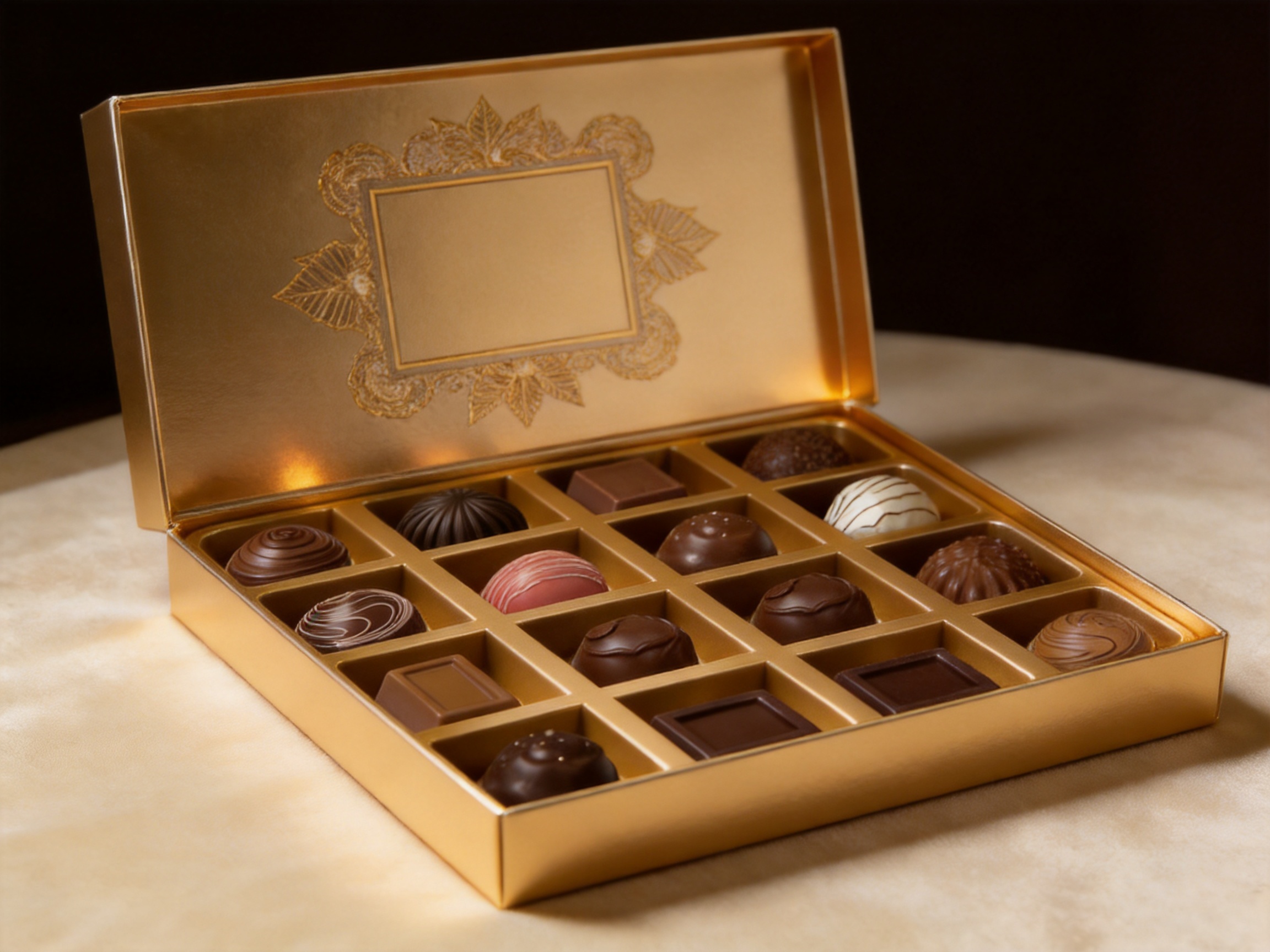
The gold surface and metallic decoration make the SH-04 suitable for Christmas, New Year, Lunar New Year, Valentine’s Day, anniversaries, and other seasonal campaigns. A well-designed pattern can make the box feel connected to the occasion without requiring extensive additional wrapping. Seasonal packaging can also encourage customers to purchase chocolates as ready-to-give gifts.
Businesses often require gifts that are elegant, practical, and easy to present. A rigid chocolate box with a refined finish can be used for customer appreciation, employee recognition, conference gifts, and business relationship programs. A customized logo or pattern can add brand visibility while preserving a premium appearance.
Pastry shops, chocolatiers, hotels, and specialty food brands can use the box for curated dessert selections. The grid layout helps display assorted flavors and allows the seller to create a structured tasting experience. The box can support premium positioning when the chocolates are sold as a collection rather than as individual pieces.
High-end chocolates are commonly purchased as souvenirs. A durable and attractive rigid box can help protect the contents during travel and make the product more suitable for gifting after the customer returns home. Local patterns, cultural motifs, or destination-specific artwork can be incorporated into the hot-stamped or printed design.
Limited-edition chocolate collections benefit from packaging that feels distinct from the standard product line. The SH-04 can be customized with special artwork, numbered editions, unique foil details, or a different insert arrangement. Its rigid construction also helps create a sense of permanence appropriate for a collectible or collaboration product.
Packaging contributes to brand value by making a product recognizable and by shaping the customer’s expectations. The SH-04 offers several surfaces and structural elements that can support brand storytelling. The lid can display a logo or central pattern, the borders can carry supporting decoration, and the interior can reveal a carefully arranged assortment.
The use of gold should be intentional. Gold is powerful as a premium signal, but it is most effective when the artwork remains balanced. Excessive decoration can reduce clarity, while carefully controlled foil placement can guide the viewer’s attention. The manufacturer’s design team can help determine where metallic details will have the greatest visual effect.
The box can also encourage repeat recognition. If a brand uses a consistent structural format across several chocolate collections, customers may begin to identify the packaging as part of the brand’s signature. Seasonal artwork can change while the core box shape and opening experience remain familiar.
Another benefit is the potential for secondary use. A rigid gift box may be reused to store small items after the chocolates have been consumed. Continued use extends the life of the packaging and keeps the brand’s visual identity in the customer’s environment. This is especially relevant for premium boxes that are too attractive to discard immediately.
Buyers should begin by confirming the product assortment. Provide the manufacturer with the exact number of chocolates, maximum dimensions, wrapped dimensions, total weight, and any special handling requirements. If the product contains fragile fillings or decorative toppings, the insert should be tested to ensure that contact does not cause damage.
The cavity quantity should be clarified because the product is described as a 5×3 grid while the specification lists approximately 16 chocolates. This may reflect a customizable or product-specific insert configuration, but the approved drawing must state the exact number of cavities. The sample should be filled with the final chocolates before mass production begins.
Artwork files should be prepared according to the manufacturer’s requirements. Buyers should identify which areas use ordinary printing, which areas use hot stamping, and whether the foil is gold, silver, colored, holographic, or another type. The artwork should also define logo size, pattern position, background color, and any required finishing effects.
Sampling is strongly recommended. A physical sample can reveal issues that may not be obvious in a digital rendering, including lid tightness, tray depth, color balance, foil reflection, corner quality, and the visual relationship between the chocolate and the interior. Approval should be based on both packaging quality and the complete filled presentation.
Order planning should include production quantity, delivery schedule, shipping method, carton packing, labeling, and inspection arrangements. Holiday packaging may require earlier planning because production capacity and shipping space can become limited during peak periods. Early confirmation gives more time for design approval, sampling, revisions, and production.
Brands should also consider food-contact requirements for the inner tray and any material that may directly or indirectly contact the chocolate. The manufacturer and buyer should agree on applicable regulations, material declarations, and testing documents for the destination market. The rigid outer box is primarily a presentation structure, but all components must be selected appropriately for the complete packaging system.
Premium appearance and responsible packaging do not necessarily conflict. Material selection, efficient structural design, responsible paper sourcing, and reduced unnecessary components can all contribute to a more considered packaging solution. The box should be sized appropriately so that it protects the chocolates without creating excessive unused volume.
The reported FSC certification associated with the manufacturer may support responsible paper sourcing, subject to certification scope and order-specific verification. Buyers seeking environmental claims should confirm the exact certified materials used in the product and ensure that any marketing statement accurately reflects the documentation.
The rigid format may also support reuse. A sturdy box can have a longer practical life than a thin single-use carton, particularly when it is designed with an attractive surface and durable construction. However, reuse alone should not be treated as a complete environmental assessment. Buyers should also evaluate the full material composition, coatings, inserts, transport efficiency, and end-of-life options.
Design teams can explore ways to reduce waste by using appropriate board thickness, optimizing the cutting layout, and limiting decorative components to areas that contribute meaningfully to the visual result. A well-planned hot-stamping pattern can create luxury without requiring multiple layers of additional material.
Experienced packaging manufacturers understand that a successful gift box requires coordination between design, materials, production, and logistics. A supplier may offer a beautiful sample but struggle with consistency at scale. Another may have strong production capacity but limited design support. The ideal partner combines both capabilities.
With more than 15 years in the paper gift packaging sector, Zhejiang Shihao Gift Packaging Co., Ltd. has developed experience across kits, storage boxes, folding boxes, jewelry boxes, and gift boxes. This broad product range can be valuable because many packaging requirements overlap. Knowledge of rigid construction, decorative finishing, inserts, and assembly can be transferred across product categories.
The company’s reported workforce, facility size, equipment base, daily production capacity, and internal design resources indicate the ability to support both standard and customized projects. Its export experience in Europe, the United States, the Middle East, and other regions also suggests familiarity with international customer communication and shipment requirements.
For the SH-04 specifically, the manufacturer’s capabilities are relevant to the most important quality factors: precise structural assembly, consistent gold surface treatment, clean hot stamping, fitted tray production, and scalable order fulfillment. These elements distinguish a professionally produced luxury box from a basic container with decorative paper applied to it.
A practical development workflow begins with a product briefing. The buyer should provide chocolate samples or detailed measurements, target quantity, intended market, preferred dimensions, branding requirements, desired surface treatment, target order volume, and expected delivery date.
The manufacturer can then recommend a preliminary structure and insert layout. At this stage, the buyer should review whether the box will provide enough space, whether the grid arrangement looks balanced, and whether the selected opening method suits the desired customer experience.
Next, artwork and finishing details should be approved. The buyer should examine the relationship between the gold background, printed colors, hot-stamped pattern, and logo. It is useful to view a physical or realistic color proof because metallic foil and glossy lamination can appear differently from screen-based artwork.
A structural and decorated sample should follow. The sample should be filled with the final chocolate pieces and tested through opening, closing, handling, stacking, and transport simulation where appropriate. Any changes to the tray, lid fit, surface pattern, or dimensions should be made before final approval.
Mass production should proceed only after the approved sample, artwork, material specifications, and inspection standards have been documented. During production, quality checks should be performed at key stages rather than waiting until all boxes are complete. This approach helps identify problems early and reduces waste.
Before shipment, finished cartons should be inspected for quantity, appearance, packing strength, labeling, and order conformity. Retaining production samples and inspection records can support future repeat orders and help maintain consistency across seasonal campaigns.
The SH-04 is a rigid luxury chocolate gift box with a gold glossy exterior, hot-stamped decorative patterns, and a fitted inner tray. It is intended for multi-piece chocolate assortments and premium gift applications.
The product is described as having a 5×3 grid, while the listed specification indicates suitability for approximately 16 chocolates. Because the cavity layout can be customized according to chocolate size and shape, the final quantity should be confirmed in the approved technical drawing and physical sample.
The listed dimensions are approximately 25–30 cm in length, 20–25 cm in width, and 5–7 cm in height. These measurements are customizable and should be finalized according to the chocolate assortment, insert design, and desired presentation.
The outer structure uses high-rigidity grey cardboard covered with gold glossy art paper. The inner lining or insert is described as a gold blister tray. The box body can receive glossy film lamination and hot-stamping pattern printing.
Hot stamping is a decorative process that transfers metallic foil onto a surface using controlled heat and pressure. It creates reflective patterns with defined edges and a premium metallic appearance.
Hot-stamped artwork can generally be customized according to the approved design. Buyers should specify the desired pattern, logo, foil color, placement, and registration requirements during the artwork and sampling stage.
Yes. The insert can be developed around the size, shape, quantity, and arrangement of the chocolates. A physical sample of the chocolate or its final wrapper is recommended for accurate cavity development.
Yes. Its rigid construction, gold finish, organized interior, and premium opening experience make it suitable for business gifts, customer appreciation programs, employee gifts, and corporate holiday campaigns.
Yes. The decorative pattern, printed artwork, foil treatment, and logo placement can be adapted for holidays, anniversaries, weddings, limited editions, and other special events.
The rigid outer structure and fitted tray are designed to support protection and organization during normal handling. The final protection level depends on the chocolate shape, insert fit, shipping conditions, and outer transport packing. A filled transport test is recommended for commercial orders.
Buyers should confirm the exact cavity count, dimensions, chocolate fit, board and paper specifications, artwork, foil pattern, color, opening method, sample approval, order quantity, packing method, inspection standards, and delivery schedule.
The supplier reports more than 15 years of industry experience, a 20,000-square-meter facility, approximately 300 employees, advanced equipment, an average daily capacity of about 5,000 gift box sets, an internal design team, export experience, and BSCI and FSC certifications. Certification details and order-specific material documentation should be verified during procurement.
The SH-04 5×3 Grid Hot-Stamped Chocolate Gift Box is designed for chocolate brands that want packaging to communicate luxury from the first glance through the final unboxing moment. Its high-rigidity grey cardboard structure provides a substantial foundation, while gold glossy art paper, lamination, and hot stamping create a polished exterior. The fitted gold tray supports organized presentation and helps individual chocolates remain separated.
Compared with ordinary folding cartons or loose-fill chocolate packaging, the SH-04 offers stronger visual impact, a more substantial hand feel, a more organized interior, and greater suitability for gifting. Its customizable dimensions, insert arrangement, decorative artwork, and finishing details allow the package to support different chocolate collections and market strategies.
The manufacturer’s experience, production scale, equipment, design resources, export background, and reported certifications provide a foundation for developing and producing customized packaging at commercial volume. To obtain the best result, buyers should provide accurate product measurements, confirm the cavity configuration, approve a filled physical sample, and establish clear inspection requirements before mass production.
For premium chocolates, the package is part of the product—not merely a container. With its metallic presentation, structured interior, and adaptable manufacturing approach, the SH-04 can help brands create a gift box that protects the product, elevates perceived value, and gives customers a more memorable experience.
1. Packaging Manufacturers Association. Principles of Rigid Paperboard Gift Box Design and Production.
2. Smithers. Trends in Premium Food and Confectionery Packaging.
3. Technical Association of the Pulp and Paper Industry. Paperboard Materials, Coatings, and Surface Finishing Practices.
4. International Organization for Standardization. Quality Management Principles for Manufacturing and Supplier Evaluation.
5. Forest Stewardship Council. Guidance on Responsible Forest Product Sourcing and Chain of Custody.
6. Business Social Compliance Initiative. Supply Chain Social Responsibility Assessment Principles.
7. Packaging Institute. Best Practices for Protective Inserts and Retail Gift Packaging.
8. Confectionery Packaging Research Reports. Chocolate Presentation, Product Protection, and Consumer Unboxing Experience.
Recommended Products

Contact Us

No. 15, Xiayang Road, Huangzhai Town, Jinhua, Zhejiang, China

(+86) 579-84230069

(+86) 13085675766


Products

Gift Box Packaging Manufacturer
 English
 Français
 Español
 عربى