2026-09-11
Packaging plays an important role in how customers perceive a cosmetic product. Before a lipstick, lip gloss, or miniature makeup item is used, the package communicates the brand’s positioning, product value, and attention to detail. For premium cosmetics, packaging must do more than hold the product. It should create anticipation, protect the contents, support retail presentation, and provide a memorable opening experience.
The SHC-01 triangular prism-shaped pull-out lipstick gift box is designed to meet these requirements. Its distinctive three-sided structure, contrasting black handle, rigid board construction, and smooth pull-out opening create a packaging format that is visually recognizable and practical for everyday use. Unlike standard rectangular lipstick cartons, this box offers a sculptural silhouette that can help a product stand out in crowded retail displays, promotional campaigns, online product photography, and holiday gift collections.
Manufactured by Zhejiang Shihao Gift Packaging Co., Ltd., the SHC-01 is suitable for single lipstick products, lip gloss, mini makeup items, limited-edition cosmetics, and multi-piece beauty gift sets. Its design combines high-rigidity gray cardboard with specialty art paper, creating a firm package that resists deformation during handling, shipping, and stacking. At the same time, the box can be customized through lamination, hot stamping, spot UV, textured papers, and other decorative processes.
This article examines the structure, material advantages, manufacturing capabilities, customization options, product applications, logistics performance, and purchasing considerations associated with this cosmetic gift box. It also explains why a specialized packaging manufacturer can provide greater value than a general carton supplier when a brand needs consistent quality, distinctive design, and scalable production.
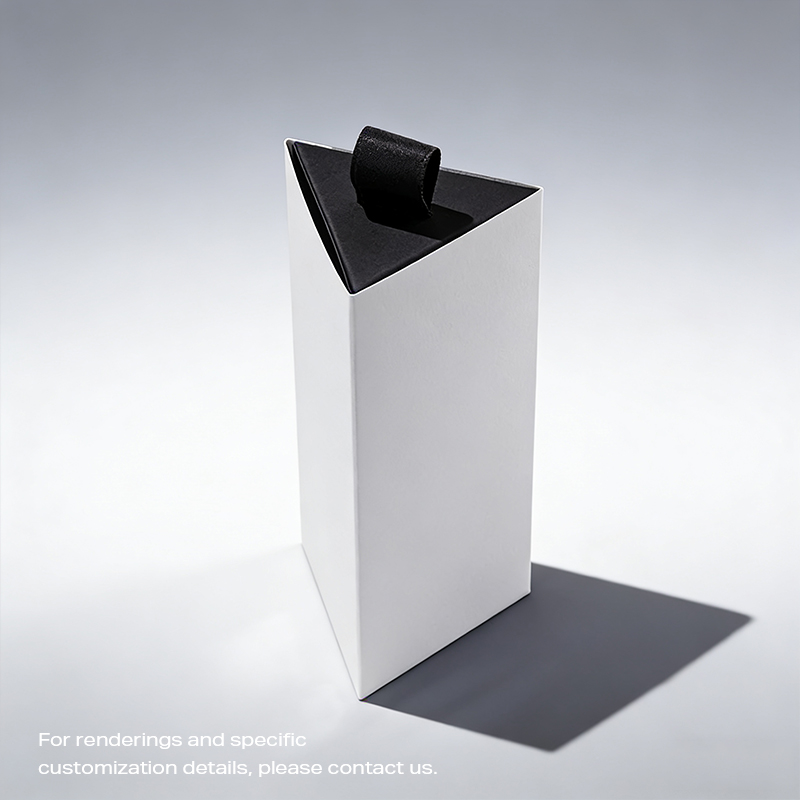
SHC-01 Triangular Prism-Shaped Pull-Out Lipstick Gift Box With Black Handle On Top
The SHC-01 is a triangular prism-shaped cosmetic gift box with a pull-out interior and a handle positioned on the top. The design combines geometric packaging with a functional opening method. When viewed from the outside, the package presents three angled sides rather than the conventional flat rectangular profile. This gives the box a more architectural appearance and creates additional opportunities for brand graphics, color blocking, foil decoration, and product storytelling.
The standard appearance uses a white outer body with a black handle. This high-contrast combination produces a clean, contemporary effect. White communicates purity, simplicity, and premium cosmetic positioning, while black adds visual weight and sophistication. Brands can retain this basic contrast for a minimalist identity or adapt the box with custom colors, printed graphics, metallic foil, textured paper, or specialty finishes.
The top handle is more than a decorative element. It enables the package to be carried easily and provides a convenient display feature. A gift box with a handle can be hung, presented by hand, or arranged in a way that differs from ordinary cosmetic cartons. For seasonal campaigns, event gifting, influencer mailers, and retail promotions, the handle can help communicate the idea of a ready-to-give package.
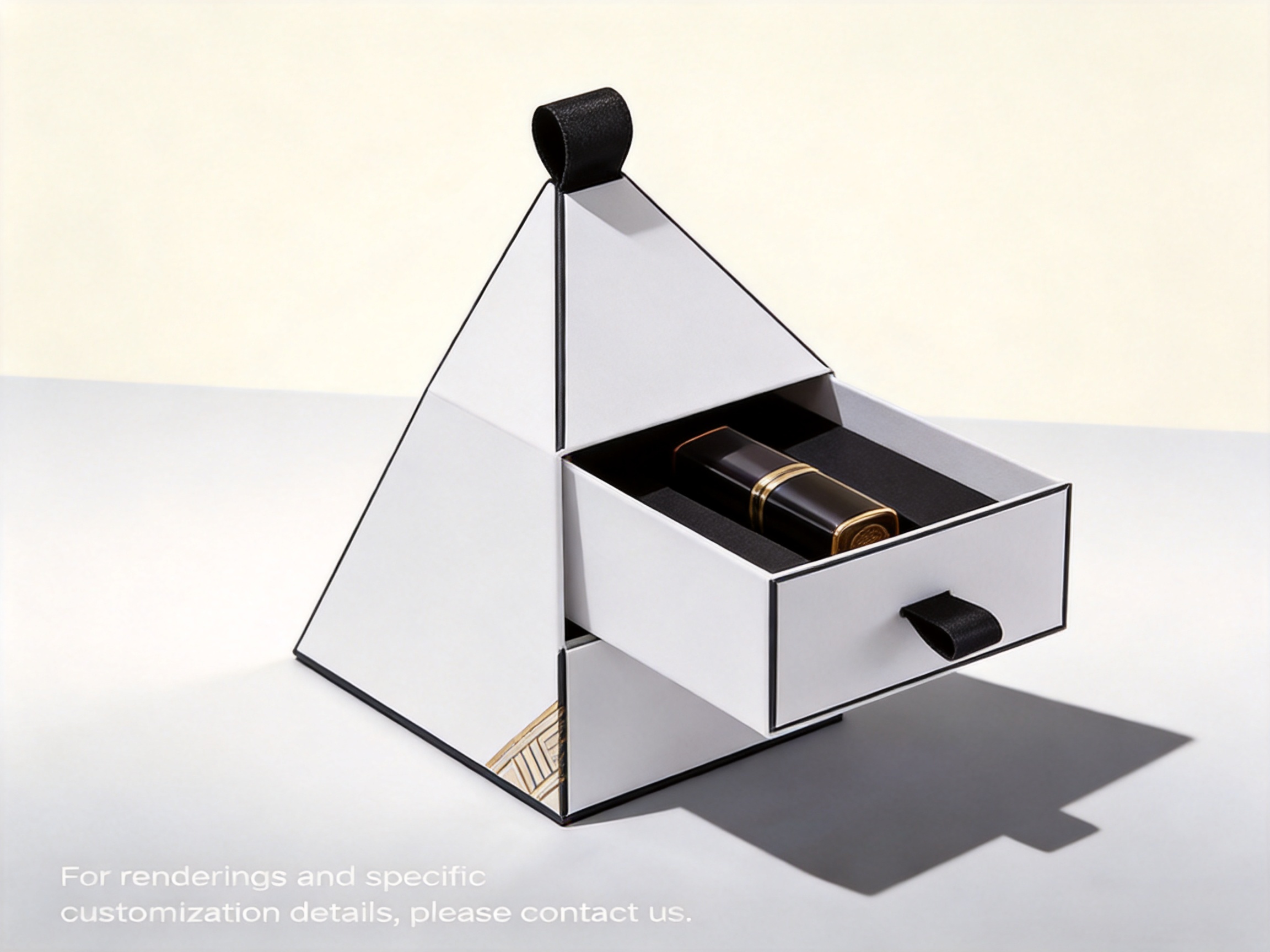
The internal pull-out structure creates a gradual opening experience. Instead of lifting a lid immediately, the user pulls the inner component outward, revealing the cosmetic product in stages. This type of unboxing can make a relatively small item feel more special and carefully presented. It also creates space for a custom insert, product card, usage instructions, or promotional message.
The basic dimensions are approximately 18–22 centimeters in length, 5–7 centimeters in side length, and 2.5–3.5 centimeters in height. These dimensions can accommodate a single lipstick, lip gloss, mini makeup item, or a carefully arranged small cosmetic combination. Final dimensions should be confirmed according to the product size, insert design, closure requirements, and transportation standards.
Many cosmetic gift boxes use familiar square or rectangular formats. These formats are efficient and economical, but they can look similar when displayed beside competing products. The triangular prism structure offers a different visual language. Its angled profile creates a strong silhouette that can be recognized from multiple directions, making it useful for brands that want packaging with a distinctive physical identity.
A unique shape can be especially valuable in categories where products are often presented in visually similar cartons. Lipstick packaging frequently relies on narrow rectangular boxes, standard drawer boxes, or folding cartons. The SHC-01 provides a more memorable alternative while retaining a practical size for a small cosmetic product. The shape can support limited editions, seasonal collections, collaboration products, and gift-with-purchase campaigns.
The three-sided structure also provides several visible surfaces for graphic communication. A brand may place the logo on one panel, product information on another, and decorative artwork or a campaign message on the third. Alternatively, the three sides can be designed as a continuous visual pattern. This flexibility gives designers more control over the unboxing narrative and the relationship between the outside of the box and the product inside.
From a merchandising perspective, the prism form can create a more dynamic display. Several units can be arranged in rows, staggered groups, or color-coordinated patterns. The black handle can provide a repeated visual accent across an entire product collection. This may help a gift set attract attention in stores, at exhibitions, in pop-up spaces, or in online product photography.
The structure is also suitable for gift-oriented marketing because it looks intentionally designed rather than purely protective. Customers often associate unusual shapes, rigid construction, and tactile finishes with higher perceived value. For a cosmetics brand, this can support premium pricing, improve gift appeal, and strengthen the connection between packaging and brand experience.
Folding cartons are useful for high-volume everyday products, but they may not provide the rigidity, presence, or reusable feel required for a premium gift package. The SHC-01 uses a gray board foundation covered with specialty paper, resulting in a more substantial structure. The box is designed to maintain its form instead of behaving like a thin paper sleeve.
The rigid format can reduce the visual impression of low-cost packaging. It offers a stronger surface for decorative finishing, creates more defined edges, and provides greater resistance to compression than a lightweight carton. This is important when the package is used in a gift set or presented as part of a brand campaign where customers will handle the box before opening it.
Conventional drawer boxes typically use a rectangular sleeve and tray. The SHC-01 retains the engaging pull-out action but adds a triangular prism profile and a top handle. This combination creates a more recognizable package while preserving the tactile satisfaction associated with a drawer-style opening.
The pull-out action is also suitable for staged product presentation. A brand can use the inner section to hold the cosmetic item securely while the outer section carries printed messaging or decorative graphics. With a custom insert, the box can be adapted to single or multiple products without changing the overall design concept.
A gift box must provide both presentation value and physical protection. Cosmetic products are often shipped through multiple distribution stages, including factory handling, carton packing, warehouse storage, courier transportation, retail movement, and final customer delivery. During these stages, packaging may experience compression, vibration, friction, and occasional impact.
The SHC-01 is built with high-rigidity gray cardboard covered by art paper or another selected outer material. The gray board provides the structural core, while the covering paper creates the finished surface. This combination helps the package maintain a stable shape and improves its resistance to bending and deformation compared with thin paper-only packaging.
Rigid construction is particularly valuable for lipstick and lip gloss gift boxes because these products are commonly positioned as small luxury items. A deformed corner, crushed panel, or loose structure can negatively affect the customer’s impression even if the cosmetic product itself remains usable. A firm package helps preserve the visual quality of the product from production to presentation.
The pull-out mechanism must be properly aligned so the internal component moves smoothly without excessive friction. A well-constructed track reduces the risk of tearing, uneven movement, or misalignment. It also creates a more refined user experience. The opening action should feel controlled rather than loose, unstable, or difficult to operate.
The inner space can be designed with a custom insert for one or more cosmetic products. Inserts may be developed according to the shape and dimensions of the lipstick tube, lip gloss container, miniature palette, sample product, or accessory. A properly fitted insert helps prevent movement inside the box, reducing the possibility of scuffing, impact, or product displacement during transportation.
Because cosmetic products differ significantly in size and form, the insert should be tested with the actual product rather than estimated only from nominal dimensions. Considerations may include cap clearance, product height, label orientation, removal force, tolerance, and the amount of space needed for protective wrapping or instruction cards.
Packaging stability is important for both warehouse efficiency and shipping reliability. The SHC-01’s rigid structure supports organized stacking when the external dimensions and shipping cartons are planned correctly. Consistent box geometry can help reduce unnecessary movement inside master cartons and create more predictable pallet arrangements.
For commercial production, packaging engineers should evaluate the box together with its inner insert, individual wrapping, master carton, and pallet configuration. The result should balance product protection with efficient use of shipping volume. A specialized manufacturer can assist with this process by reviewing the structure, material thickness, folding points, and packing method before mass production.
The standard design features a black handle made from black ABS plastic or hard cardboard covered with black film, depending on the selected specification. ABS plastic offers a firm, durable component with a consistent appearance, while a covered cardboard handle can support a more paper-based packaging concept. The final choice depends on the desired load-bearing performance, appearance, sustainability goals, and target cost.
The handle should be evaluated together with the box body. It must be securely fixed, aligned with the package center, and capable of supporting the intended carrying load. For heavier gift sets or multiple-product configurations, the attachment area may need reinforcement. Prototype testing is recommended before final approval.
Material selection affects the box’s appearance, strength, tactile impression, print quality, and environmental profile. The SHC-01 uses a high-rigidity gray cardboard core combined with art paper or specialty covering paper. This construction is widely used for premium rigid packaging because it creates a stable foundation while allowing considerable freedom in surface design.
Gray board provides thickness and stiffness. It helps form the triangular prism shape and supports the pull-out structure. Its structural role is especially important in a package with angled panels, because weak board may cause edges to lose definition or surfaces to flex during use. The board also creates a more substantial hand feel, which can reinforce the perceived value of the cosmetic product.
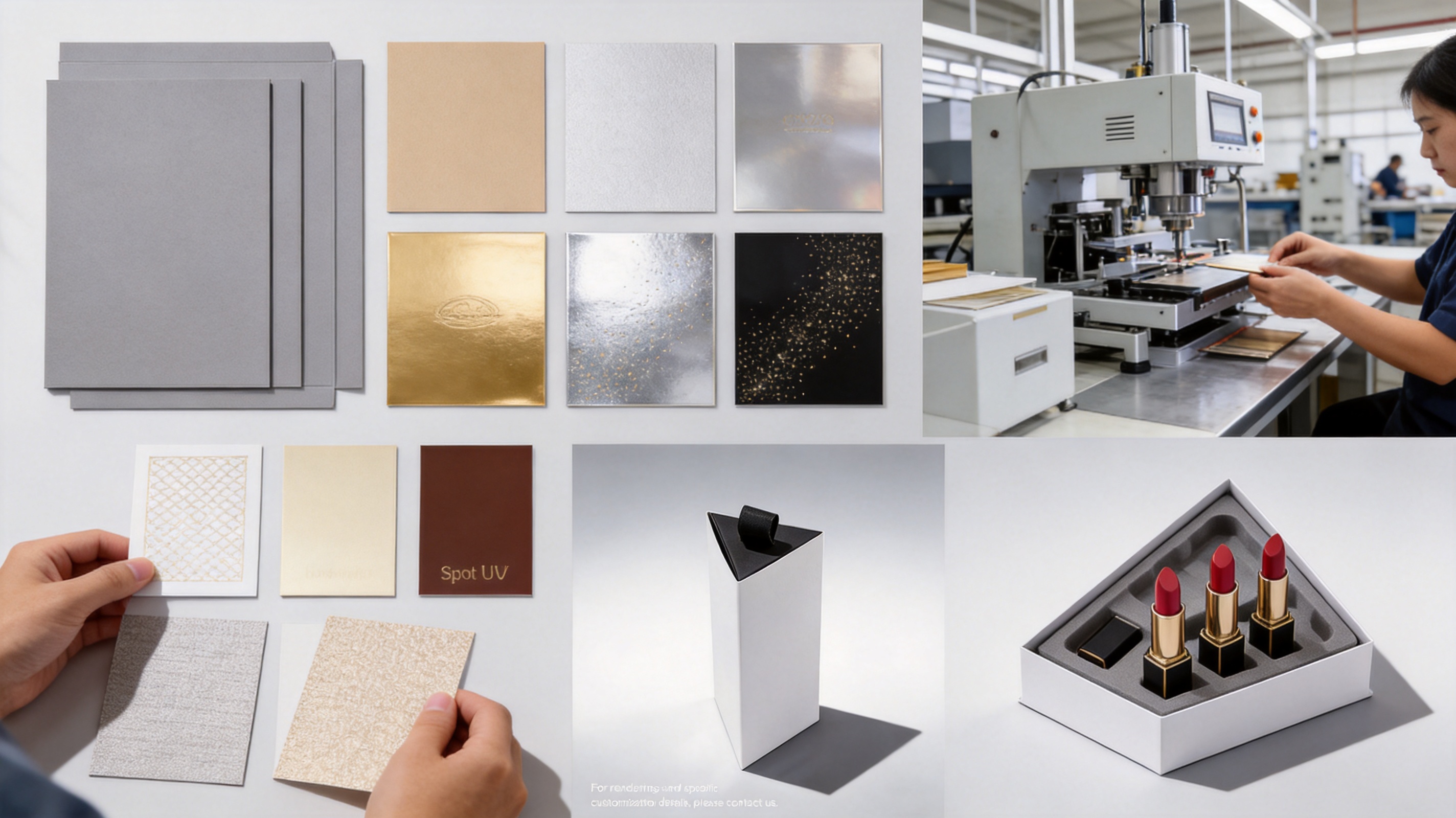
Art paper provides a smooth, printable outer surface. Depending on the brand’s requirements, it can be finished with matte or glossy lamination, foil stamping, spot UV, or other decorative effects. Textured papers may be selected when a brand wants a more tactile or natural visual identity. The paper covering can also be color-matched to a specific product collection or campaign theme.
Matte lamination creates a soft, understated appearance and can reduce surface glare in certain retail and photography environments. Glossy lamination produces a brighter, more reflective finish that can make colors appear vivid. The choice should be made according to the desired brand position, graphic design, handling conditions, and compatibility with additional decorative processes.
Textured paper can create an immediate tactile distinction. Embossed, linen-like, grain-effect, or other specialty papers may be suitable for luxury, natural beauty, artisan, or boutique cosmetic brands. Texture should be selected carefully because it can affect small text, fine lines, foil adhesion, and the perceived sharpness of printed graphics.
The manufacturer can also help coordinate the relationship between material, printing, finishing, and structure. For example, a dark background may require different printing considerations than a light background, while a heavily textured paper may not be ideal for very small text or detailed photographic images. Packaging design should therefore be treated as an integrated system rather than a series of isolated choices.
Decoration is one of the main ways a cosmetic brand transforms a structural package into a branded product experience. The SHC-01 supports several finishing options, including matte or glossy lamination, hot stamping with gold or silver foil, black and gold foil effects, spot UV printing, and textured paper applications.
Hot stamping applies metallic or pigmented foil to selected areas of the surface. Gold and silver are common choices for cosmetics because they suggest luxury, celebration, and premium quality. Black foil can create a sophisticated tone on lighter paper, while gold foil can highlight logos, product names, borders, symbols, or limited-edition messages.
Hot stamping is effective when used selectively. A restrained logo treatment may look more elegant than an overly decorated surface. On the triangular box, foil can be placed on one primary panel or distributed across all three sides as part of a continuous design. The angled surfaces can also create interesting changes in how light reflects from the package.
Production quality depends on accurate plate preparation, suitable pressure and temperature, material compatibility, and careful registration. Fine details should be evaluated during sampling because extremely small lettering or thin lines may require adjustment for reliable reproduction.
Spot UV applies a localized glossy coating to specific graphic elements. It can be used on a matte laminated surface to create contrast between glossy and non-glossy areas. Logos, patterns, product names, botanical illustrations, and geometric details can all be emphasized with this process.
The contrast between matte and gloss is particularly suitable for minimalist packaging. A white box with a subtle spot UV pattern can appear refined without relying on bright colors. Similarly, a dark or black graphic can be enhanced through selective gloss treatment, creating a premium effect that becomes visible as the package moves under light.
Lamination protects the printed surface and influences the tactile character of the box. Matte lamination provides a low-reflection surface and a soft visual effect, while glossy lamination creates a brighter finish. Lamination may also help improve resistance to ordinary handling marks, although the final durability depends on the complete material system and usage conditions.
When lamination is combined with hot stamping or spot UV, the sequence and compatibility of processes must be controlled. A professional packaging factory can manage these details through production specifications, sample approval, and quality inspection.
Color consistency is important for brands that produce multiple packaging batches or distribute products across different markets. Variations in paper, ink, lamination, lighting, and production conditions can affect the final appearance. Zhejiang Shihao Gift Packaging Co., Ltd. emphasizes controllable color consistency and uniform workmanship in mass production.
To achieve consistent results, customers should provide clear artwork files, color references, approved samples, and finishing specifications. If a particular brand color is critical, a physical color standard may be preferable to relying only on digital screen display. The manufacturer can then use the approved sample as a reference during production and inspection.
The quality of a packaging product depends not only on its design but also on the manufacturer’s ability to reproduce that design at scale. Zhejiang Shihao Gift Packaging Co., Ltd. is an export-oriented manufacturer specializing in the research, development, production, and sale of paper gift packaging boxes.
The company was founded more than 15 years ago and operates across approximately 20,000 square meters. Its workforce includes around 300 employees, supporting design, development, production, quality control, sales, and related manufacturing functions. This scale provides a foundation for handling both standard products and customized packaging projects.
The company reports an average daily production capacity of approximately 5,000 sets of gift boxes. Capacity at this level can be important for cosmetic brands preparing seasonal promotions, retail launches, large promotional campaigns, or international distribution. It also indicates that the manufacturer has experience coordinating material purchasing, production scheduling, assembly, inspection, and export packing.
Advanced equipment supports more stable production and helps the factory manage multiple stages of the packaging process. For a complex box such as the SHC-01, manufacturing may involve board cutting, paper preparation, surface printing, laminating, hot stamping, forming, assembly, handle installation, insert fitting, and final inspection. Each stage must be coordinated to preserve the accuracy of the triangular shape and the smooth operation of the pull-out mechanism.
A dedicated design and development team can help customers adapt a standard concept to their product requirements. According to the company information, Shihao updates dozens of products weekly and offers customized packaging solutions for different markets. This product development activity can support customers who need new structures, revised dimensions, alternative materials, or market-specific designs.
For a cosmetic brand, development support may include reviewing product dimensions, selecting an insert, adjusting the opening direction, testing handle placement, choosing decorative finishes, and preparing prototypes. Early cooperation with the factory can identify structural problems before tooling and mass production begin.
Packaging development should focus on the entire customer journey. The box must be attractive when displayed, stable during shipping, easy to open, appropriate for the product, and efficient to assemble. A manufacturer with experience across different gift box categories can help balance these objectives.
Shihao exports products to Europe, the United States, the Middle East, and other regions. International experience can be valuable because export packaging often requires careful attention to documentation, carton marking, inspection expectations, shipping schedules, and communication across time zones.
Different markets may also have different preferences regarding materials, colors, language, product information, sustainability claims, and gift-giving traditions. A manufacturer serving multiple regions may be better prepared to discuss these variations and adjust packaging specifications accordingly.
The company has passed BSCI and FSC certifications. BSCI is associated with social compliance and responsible working conditions within the supply chain. FSC certification relates to responsible forest management and traceability of certified paper and board materials when the relevant certified materials are specified and properly documented.
Certification alone does not replace project-specific verification. Customers should confirm the exact certification scope, material requirements, and documentation needed for their order. Nevertheless, these certifications provide useful evidence that the manufacturer has established systems relevant to responsible production and international customer requirements.
The SHC-01 is designed around lipstick packaging, but its internal configuration can be adjusted for other small cosmetics. Possible applications include lip gloss, lip balm, mini makeup items, travel-size products, sample collections, and selected accessory combinations.
For a single lipstick, the insert can be designed to hold the product centrally and maintain the desired orientation. The insert may include a finger notch or other removal feature so the consumer can take out the product without damaging the package. If the product is fragile or has a glossy surface, the insert should limit movement and reduce contact with the box walls.
For multiple lipsticks, the internal tray can be divided into individual compartments. This is useful for color collections, seasonal shades, promotional bundles, and discovery sets. The number of compartments must be balanced against the external dimensions and the clearance required for easy removal.
For lip gloss or irregularly shaped mini makeup products, the insert may need different cutouts and support points. The manufacturer should receive accurate product samples or technical drawings so the interior can be developed around actual dimensions rather than assumptions.
Custom packaging may also include paper cards, brand stories, usage instructions, ingredient information, campaign messages, or discount materials. These elements can be integrated into the pull-out area or placed above the product insert, provided that they do not interfere with opening and closing.
The outer panels can be customized with logos, product names, shade information, taglines, patterns, illustrations, or campaign artwork. Because the box has three visible sides, designers can create a coordinated system rather than limiting branding to a single front panel.
A brand may choose a restrained design with a small foil logo, a bold color-blocked design for younger consumers, or a botanical pattern for a natural cosmetics collection. The black handle can be retained as a consistent identity element or replaced with another approved color, depending on material and production feasibility.
The package can also be coordinated with the lipstick tube, secondary carton, shipping mailer, and retail display. Consistent color, typography, and finishing across these elements can create a more complete product system and improve recognition across different sales channels.
The rigid triangular form is suitable for holiday gifting, festival campaigns, anniversary collections, and limited-edition products. Gold or silver foil can support festive themes, while textured paper can create a more artisanal or winter-oriented appearance. The handle makes the box look ready for presentation, which can increase its suitability for seasonal gift programs.
Limited-edition packaging benefits from a sense of scarcity and visual distinction. A special color, numbered edition, exclusive pattern, or customized insert can make the package feel different from the brand’s regular product line. Since the SHC-01 can be adapted through surface decoration and internal layout, it can serve as a flexible platform for temporary campaigns.
Cosmetic packaging must perform differently depending on the sales channel. Retail packaging needs to attract attention on shelves and display tables. E-commerce packaging must also survive courier handling and create a strong unboxing moment when the customer receives the order.
The SHC-01 supports retail differentiation through its unusual prism form and visible handle. Its shape can help it stand apart from flat cartons, especially when products are grouped by color or arranged in a display. The rigid body also gives the package a more substantial appearance when customers pick it up.
For e-commerce, protective performance is essential. A package that looks premium but arrives crushed can damage customer satisfaction and generate replacement costs. The rigid board construction, suitable insert, and planned master carton can help reduce this risk. However, shipping tests should be performed with the final product and shipping configuration before large-scale launch.
The pull-out opening also creates content opportunities for e-commerce. Customers may photograph or film the opening process for social media, reviews, short-form videos, and unboxing content. A distinctive package can therefore contribute to organic product visibility. The visual sequence of pulling out the inner tray, revealing the product, and discovering printed messages can become part of the brand experience.
For promotional mailers, the box can be customized to match campaign graphics and influencer communication. Its compact format makes it practical for small cosmetic samples, product seeding, and launch events. The handle can make the package easier to carry during events or hand-delivery promotions.
A successful custom packaging project generally begins with product and brand information. The customer should provide the dimensions of the lipstick or cosmetic item, the desired quantity per box, artwork requirements, preferred materials, target market, estimated order volume, and expected delivery schedule.
The factory reviews the product size and confirms whether the standard SHC-01 dimensions are appropriate. If necessary, the length, side width, height, handle position, or pull-out clearance can be adjusted. The insert design is developed at this stage, along with the position of printed cards or additional components.
The customer chooses the board specification, covering paper, surface finish, handle material, and decorative processes. A matte finish may be selected for a subdued luxury appearance, while gloss may be preferred for bright, colorful artwork. Foil and spot UV should be planned alongside the printed design to ensure that all effects are technically suitable.
Graphic files should be supplied according to the manufacturer’s dieline and technical requirements. Designers need to consider the folding and joining areas, the direction of the triangular panels, the pull-out orientation, and the visible position of the handle. Text should remain clear after production, and important graphics should not be placed too close to edges or structural seams.
A prototype allows the customer to evaluate the physical size, opening force, insert fit, handle attachment, color, surface feel, and overall appearance. The actual lipstick or cosmetic product should be tested in the sample. If the package is intended for shipping, the sample should also be included in a representative master carton for preliminary handling tests.
After sample approval, the factory organizes materials, printing, finishing, forming, assembly, and inspection. Consistent production requires control of board cutting, paper application, adhesive use, panel alignment, decorative registration, handle installation, and pull-out movement.
Finished boxes should be checked for surface defects, color variation, scratches, foil misalignment, loose components, structural deformation, and opening performance. Approved units are then packed in shipping cartons according to the confirmed quantity and protection requirements. Clear carton identification supports warehouse management and export handling.
Quality control should cover both appearance and function. A visually attractive box is not sufficient if the pull-out mechanism sticks or the handle is insecure. Likewise, a structurally strong box may not meet brand expectations if the color or finish is inconsistent.
Appearance checks may include paper cleanliness, print clarity, foil coverage, spot UV positioning, lamination quality, edge condition, corner formation, and overall alignment. The triangular form should be examined from several angles because small deviations may be visible along the angled panels.
Functional checks should include opening and closing movement, tray alignment, insert fit, product removal, handle attachment, and resistance to ordinary handling. If the package is intended for a heavy gift set, the handle should be tested with the actual loaded weight and a suitable safety margin.
Sampling plans can be established according to order volume and customer requirements. For international orders, customers may also request pre-shipment inspection, retained samples, production photographs, or inspection reports. These processes help both parties maintain clear expectations.
Paper-based rigid packaging can support sustainability goals when material selection, sourcing, production efficiency, and end-of-life considerations are planned together. The use of paper and board provides a familiar foundation for recyclable packaging systems, although the final recyclability depends on laminations, coatings, adhesives, plastic components, and local recycling infrastructure.
Customers seeking a more paper-focused design may consider a hard cardboard handle covered with black film instead of an ABS plastic handle, subject to performance requirements. They may also evaluate uncoated or specially textured papers, reduced decorative coverage, and right-sized inserts. These choices should be balanced with durability, product protection, appearance, and the intended market.
FSC-related sourcing may be specified when certified paper or board is required. Brands should communicate their exact certification expectations to the manufacturer before material purchasing. Documentation, labeling, and certification claims must be used accurately and in accordance with applicable requirements.
Reducing waste also involves efficient structural design. A box that protects the product with minimal unnecessary material can reduce packaging volume and improve shipping efficiency. The manufacturer’s design team can help evaluate whether the internal insert, outer dimensions, and shipping carton are appropriately sized for the product.
A specialized gift packaging manufacturer offers advantages beyond basic box production. The company understands how structure, materials, decoration, assembly, and logistics interact. This is important for a product like the SHC-01, which combines an unusual shape, a moving pull-out component, a handle, and a premium printed surface.
Specialized experience can shorten the development process because the factory may already understand common challenges related to rigid board, paper covering, edge wrapping, drawer-style structures, and decorative finishing. The manufacturer can identify potential problems before they become expensive production changes.
Production scale is another advantage. A factory with established equipment, trained workers, material relationships, and quality systems can manage repeat orders more consistently than a small workshop with limited capacity. This is especially important for brands that require several thousand sets for a coordinated launch.
In-house or closely coordinated development resources can also help customers move from a general idea to a manufacturable package. The customer may begin with a reference image or basic concept, while the factory contributes technical recommendations concerning dimensions, board thickness, insert construction, handle materials, and finishing compatibility.
International export experience can further support communication, scheduling, documentation, and shipment coordination. Since Shihao serves Europe, the United States, the Middle East, and other regions, it has experience working with customers who may have different packaging expectations and delivery requirements.
The SHC-01 is particularly suitable for cosmetic gift boxes containing one lipstick or a compact combination of lip products. It can be used for holiday gifts, brand marketing programs, premium promotional sets, limited-edition releases, retail launch collections, influencer packages, and e-commerce gift orders.
Beauty brands may use the box to launch a new shade family, present a collaboration product, or create a seasonal assortment. The pull-out format can help the product feel more curated than a standard single-item carton. The handle can reinforce its role as a gift-ready package.
Cosmetic distributors and e-commerce companies may also use the structure for carefully selected mini makeup sets. A custom insert can organize several small items while the exterior communicates a consistent campaign identity. For corporate or event gifting, the surface may carry a company logo, event date, or special message.
Retailers can use the box for exclusive bundles or loyalty rewards. Because the structure is visually distinctive, it can be positioned as a collectible or reusable package rather than disposable secondary packaging. The final suitability depends on product dimensions, quantity, target price, and distribution conditions.
Before placing an order, buyers should confirm the exact product dimensions and determine whether the standard box size is sufficient. The length, side width, and height should include the product, cap, insert, and any additional protective material.
Buyers should also determine whether the package will hold one product or several products. This decision affects the insert, internal clearance, weight, opening force, and handle requirements. A multi-product package may require additional structural reinforcement.
The desired appearance should be described clearly. Important choices include white or colored paper, matte or glossy lamination, black or alternative handle materials, foil color, spot UV, textured paper, and the amount of printed coverage. Reference samples can help avoid misunderstandings.
Order quantity and delivery schedule should be discussed at the beginning of the project. Custom printing, tooling, sampling, material purchasing, assembly, inspection, and export shipment all require time. Seasonal projects should be scheduled early to allow for sample revisions and transportation delays.
Customers should request a physical sample when tactile quality, structural movement, color, or handle performance is important. Digital artwork approval alone cannot fully demonstrate how the package feels in the hand or how smoothly the drawer operates.
It is also advisable to confirm packing details, master carton quantity, shipping marks, inspection requirements, and destination information. These factors can affect the final logistics cost and delivery performance.
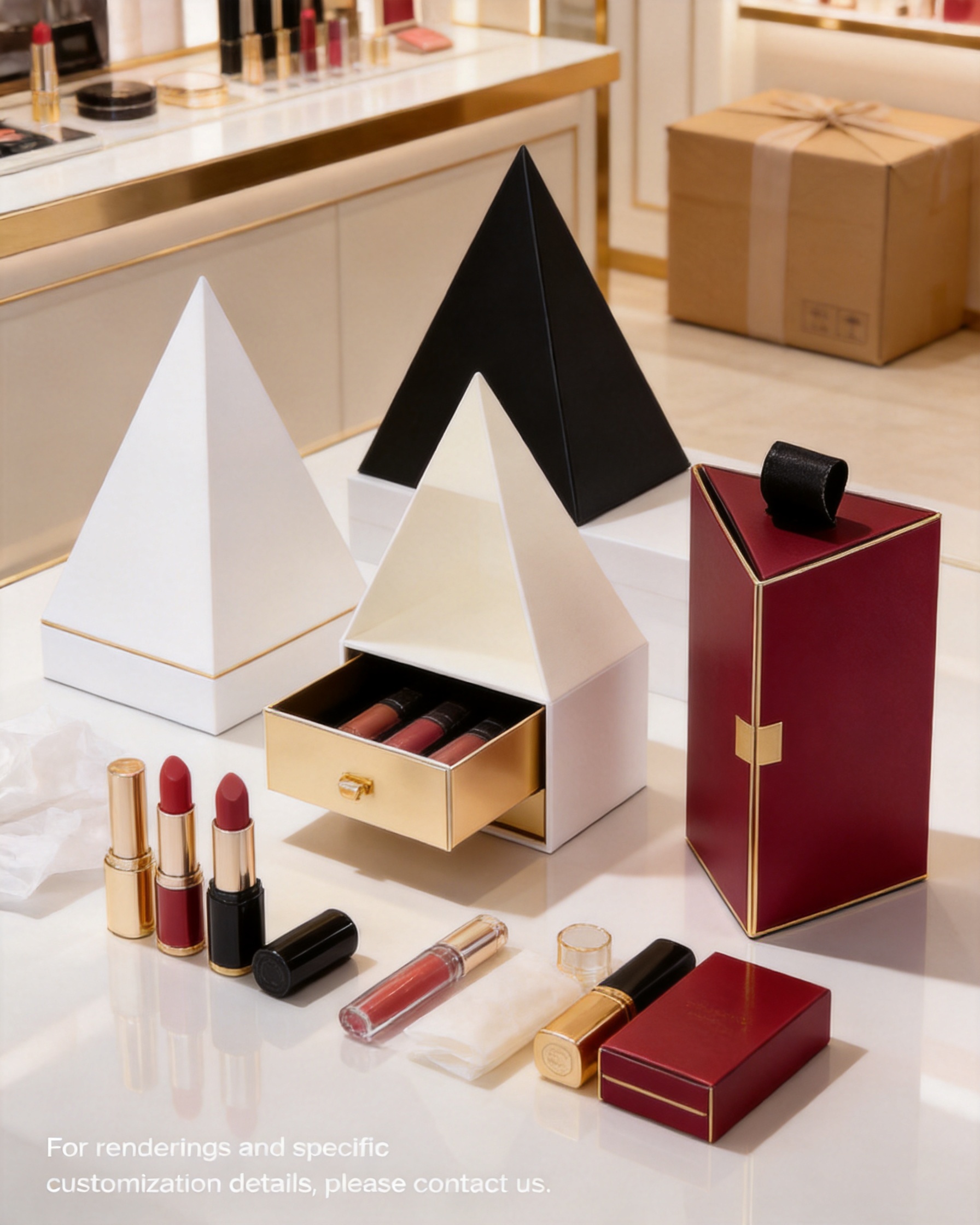
The box is suitable for a single lipstick, lip gloss, lip balm, mini makeup item, or selected combinations of small cosmetics. A custom insert can be developed for one or multiple products. The final suitability should be confirmed using the actual product dimensions.
Yes. The rigid gray board structure provides stability during handling, stacking, and transportation. However, the complete shipping configuration should include the final insert, product, inner protection, master carton, and pallet arrangement. Shipping tests are recommended for large commercial orders.
Yes. The outer panels can be customized with logos, product names, patterns, illustrations, and campaign messages. Hot stamping, spot UV, lamination, and custom printed papers can be used to create different brand effects.
The listed options include black ABS plastic and hard cardboard covered with black film. The suitable choice depends on the desired appearance, load-bearing requirement, sustainability preference, and project budget.
The standard design uses black, but alternative colors may be possible depending on the selected material, production method, and order requirements. Color and material feasibility should be confirmed during the quotation and sampling stage.
The main opening method is a pull-out opening. The inner section slides outward through the designed structure, creating a drawer-style unboxing experience.
Yes. The internal insert can be customized for single or multiple lipsticks, lip gloss, mini makeup products, or other small cosmetic items. A product sample or accurate technical drawing is recommended for insert development.
Available processes include matte or glossy lamination, gold or silver hot stamping, black and gold foil effects, spot UV printing, and textured paper options. The final combination should be evaluated for material compatibility and design clarity.
Yes. Its unusual shape, rigid construction, pull-out opening, and top handle make it suitable for holiday gifting, seasonal promotions, limited editions, and high-end cosmetic gift sets.
Yes. The firm construction can help protect the product, while the distinctive unboxing experience can support customer satisfaction and social media content. The package should be tested in its shipping carton before launch.
Buyers should provide the product type, product dimensions, quantity per box, estimated order volume, artwork requirements, preferred materials, finishing processes, destination, and target delivery date. Product samples are helpful for accurate structural evaluation.
Zhejiang Shihao Gift Packaging Co., Ltd. is an export-oriented manufacturer serving Europe, the United States, the Middle East, and other regions. International order details, documentation, packaging requirements, and delivery terms should be confirmed directly during project discussion.
The company has passed BSCI and FSC certifications. Customers should confirm the certification scope and documentation requirements for their specific project, especially when certified paper or board claims are required.
Customers should provide approved physical samples or precise color standards, use consistent material specifications, and confirm the finishing process before production. Retaining an approved reference sample can help support quality comparison during repeat orders.
The rigid construction may allow customers to reuse the box for storage or presentation, depending on the product configuration and consumer preference. Reusability can be encouraged through durable materials, strong construction, and a design that remains attractive after the cosmetic product is removed.
The SHC-01 triangular prism-shaped pull-out lipstick gift box combines distinctive design with practical cosmetic packaging performance. Its three-sided profile helps products stand out from conventional rectangular cartons, while the black top handle adds both visual contrast and carrying convenience. The pull-out structure creates a more engaging unboxing experience, and the rigid gray board construction provides stability for handling, stacking, and transportation.
Its customization potential is another important advantage. Brands can select matte or glossy lamination, gold or silver hot stamping, black and gold foil, spot UV printing, textured paper, custom colors, and tailored internal inserts. These options allow the same structural concept to serve minimalist, luxury, seasonal, natural, youthful, or limited-edition cosmetic collections.
The manufacturing strengths of Zhejiang Shihao Gift Packaging Co., Ltd. further support the product’s commercial potential. With more than 15 years of industry experience, a 20,000-square-meter facility, approximately 300 employees, advanced equipment, a stated daily capacity of about 5,000 gift box sets, international export experience, and BSCI and FSC certifications, the company is positioned to manage customized packaging programs for different markets.
For cosmetic brands seeking packaging that protects the product while creating a memorable presentation, this triangular prism pull-out box offers a compelling balance of structure, aesthetics, functionality, and customization. Proper sampling, product-fit testing, finishing approval, and shipping evaluation will help ensure that the final package meets both brand expectations and distribution requirements.
1. Zhejiang Shihao Gift Packaging Co., Ltd. Product specification information for the SHC-01 triangular prism-shaped pull-out lipstick gift box.
2. Zhejiang Shihao Gift Packaging Co., Ltd. Corporate information concerning manufacturing capacity, facilities, export markets, certifications, and product development.
3. General principles of rigid paperboard packaging design, structural stability, insert development, and cosmetic product protection.
4. General practices for hot stamping, lamination, spot UV printing, specialty papers, and premium packaging finishing.
5. General considerations for cosmetic packaging logistics, retail presentation, e-commerce shipping, and gift-oriented unboxing experiences.
Recommended Products

Contact Us

No. 15, Xiayang Road, Huangzhai Town, Jinhua, Zhejiang, China

(+86) 579-84230069

(+86) 13085675766


Products

Gift Box Packaging Manufacturer
 English
 Français
 Español
 عربى