2026-09-30
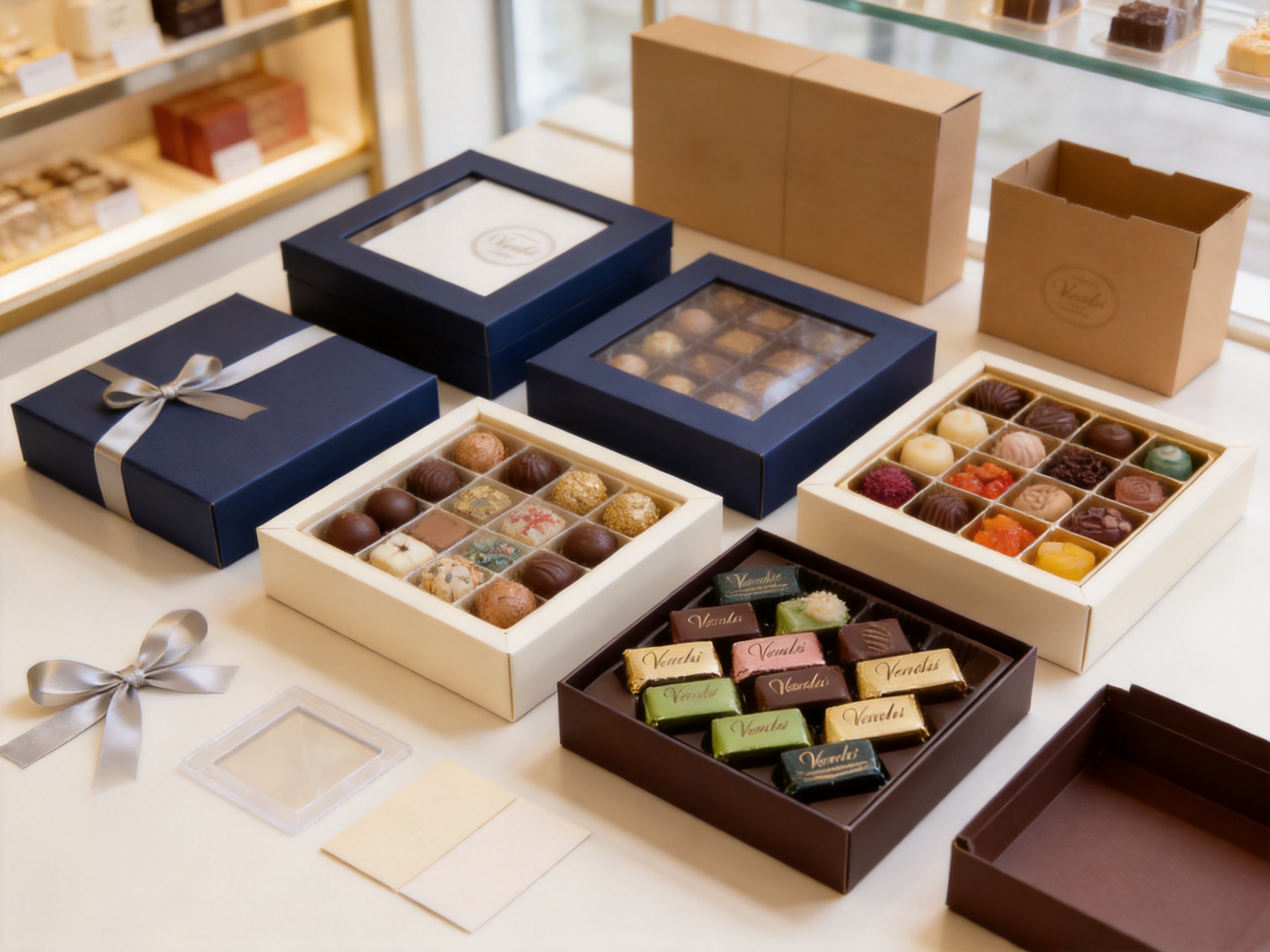
Premium chocolate packaging must do more than protect delicate confectionery. It must create anticipation, communicate quality, organize multiple flavors, support efficient handling, and give recipients a memorable opening experience. The SH-08 Multi-Compartment Transparent-Lid Square Chocolate Gift Box is designed around these requirements. It combines a rigid cardboard structure, deep blue matte presentation, a transparent PET window, a fitted multi-compartment insert, and a practical flip-top opening to create a packaging solution for high-end chocolates, desserts, business gifts, and seasonal collections.
Unlike a basic chocolate carton that simply holds products in one undivided space, SH-08 treats the gift box as part of the product experience. Its transparent lid allows the colors and arrangement of the chocolates to become part of the presentation before the box is opened. Its custom inner tray helps prevent movement and separates individual pieces, while its rigid construction offers greater structural stability than lightweight folding cartons. These features work together to support both visual appeal and practical performance.
The box is also suitable for customization. Dimensions, internal compartments, printed graphics, branding elements, and product configurations can be adjusted for different chocolate sizes and market requirements. This flexibility enables confectionery brands, dessert manufacturers, retailers, corporate gift suppliers, and seasonal promotion companies to develop packaging that reflects their own positioning without sacrificing reliable production standards.
Consumers often encounter the packaging before they experience the chocolate. The color, texture, structure, and opening method establish an immediate expectation about the product inside. A premium chocolate set placed in a thin, unstable, or poorly fitted box may appear less valuable, even when the confectionery itself is carefully made. Conversely, a strong and elegant box can reinforce the impression of craftsmanship and help transform a group of individual chocolates into a cohesive gift set.
SH-08 is designed to create this first impression through a coordinated visual system. The deep blue exterior communicates restraint, sophistication, and luxury without relying on excessive decoration. The matte finish reduces glare and gives the surface a refined tactile quality. A simple brand logo can be positioned on the lid or another visible panel, allowing the packaging to remain distinctive while keeping the focus on the chocolate presentation.
The square format supports a balanced layout and provides a broad upper surface for visual communication. It can accommodate a centered logo, a seasonal message, a minimal pattern, or a carefully arranged combination of typography and decorative elements. Because the box has a clean geometric profile, it can suit modern chocolate collections, traditional holiday designs, premium dessert assortments, and corporate gifting programs.
In many competitive packaging formats, the external artwork is expected to carry the entire burden of presentation. SH-08 adds another layer of communication through the transparent lid. The recipient can see the assortment before opening the box, which helps create curiosity and gives the chocolate arrangement an immediate visual role. For retailers, this also means that the product can communicate its variety while displayed on a shelf, counter, gift table, or online product photograph.
The main design concept of SH-08 is the integration of display and protection. The lid includes a square transparent window made from PET material. This window reveals the chocolates while the surrounding rigid paperboard continues to provide structure. The result is a presentation surface that offers visibility without turning the entire package into a fragile transparent container.
The transparent window is especially useful for chocolates with varied colors, toppings, fillings, or decorative finishes. A mixed collection can show its diversity immediately. Dark chocolate, milk chocolate, white chocolate, fruit-filled pieces, nut-coated pieces, and seasonal designs can be arranged as a visual composition. The box therefore helps the contents become part of the packaging design rather than hiding them until the moment of opening.
The internal tray has a second important function. It is custom-made to hold individual pieces or separately packaged chocolates in defined positions. Each compartment can be designed according to the dimensions and shape of the product. This prevents pieces from sliding into one another during transportation and reduces the chance of surface damage caused by unnecessary contact.
Clear separation also improves product identification. When different flavors are placed in individual sections, recipients can understand the assortment more easily. This is valuable for gift boxes containing multiple varieties, where the experience depends on discovering differences among the pieces. The organized layout gives the product a curated appearance and helps the collection feel intentional rather than randomly assembled.
The box is described as having a top and bottom lid opening, with the lid incorporating the transparent window. This flip-top arrangement makes access straightforward. It can be opened without removing a separate cover or struggling with a tight sleeve. For repeated access, the hinged structure offers a convenient user experience while maintaining the visual identity of a premium gift box.

SH-08 Multi-Compartment Transparent-Lid Square Chocolate Gift Box
The foundation of SH-08 is a rigid cardboard structure composed of a grey cardboard base covered with dark blue matte art paper. This construction provides more body and resistance than ordinary lightweight paper packaging. It helps the box maintain its shape during filling, storage, transportation, and presentation.
Structural stability is particularly important for chocolate packaging because the product is sensitive to pressure, impact, and temperature changes. A box that bends easily may allow the contents to shift or become compressed. A rigid base distributes handling pressure more effectively and supports a more orderly internal layout. It also gives the recipient a stronger physical impression when the box is lifted and opened.
Compared with a simple folding carton, the rigid format can deliver a more substantial unboxing experience. Folding cartons are efficient for many applications, but they may not provide the same premium weight, firmness, or shelf presence. SH-08 is better suited to products positioned as gifts, collections, corporate presents, or limited-edition assortments where the package itself contributes to perceived value.
The outer layer uses dark blue matte art paper. This surface treatment creates a controlled, non-glossy appearance that complements the transparent window. A high-gloss box can sometimes compete with the contents by reflecting surrounding light. The matte surface is quieter and allows the viewer’s attention to move naturally toward the chocolates visible through the lid.
Dark blue is also adaptable across different design directions. It can support gold or silver foil for a formal luxury look, white typography for a modern appearance, pastel accents for seasonal designs, or simple monochrome branding for a minimalist collection. This makes the color suitable for both established confectionery brands and emerging businesses seeking a polished identity.
The matte texture has a tactile benefit as well. Gift packaging is often handled before it is opened, and the surface contributes to the recipient’s first physical impression. A smooth matte finish can make the box feel more refined and less disposable. When combined with accurate cutting and clean assembly, it reinforces the sense that the package has been deliberately engineered rather than mass-produced without attention to detail.
The transparent lid window is made from PET material. PET is widely used for clear packaging components because it offers transparency, light weight, and practical forming characteristics. In SH-08, the window is precisely cut and fitted into the lid to create a clean viewing area.
The window provides a direct product display without requiring the recipient to open the package. This is valuable for retail environments, where the box may remain closed while customers assess the assortment. It is also useful for gift selection because the purchaser can confirm the visual presentation and product arrangement before giving the box to someone else.
In comparison with a fully open-top presentation, the PET window offers a more controlled balance between visibility and enclosure. It helps keep the chocolates associated with the box’s organized interior while reducing exposure to handling, dust, and accidental contact. The clear panel also supports product photography because the chocolates can be shown in their actual arrangement rather than represented only through printed illustrations.
The inner lining uses a custom-made blister tray. The tray is designed to fit the selected chocolate pieces or individual packages and can be adapted to the required number of compartments. The exact configuration may vary according to product shape, dimensions, flavor assortment, and the desired visual layout.
A fitted tray offers several advantages over loose paper dividers or a single open cavity. Separate positions can reduce movement, keep the assortment evenly spaced, and preserve the appearance of each piece. It also helps production teams arrange the products consistently. When every chocolate has a designated position, packing becomes more systematic and quality inspection becomes easier.
The tray can be developed for square, rectangular, round, or specially shaped chocolates, subject to product requirements. This is important for brands that use different molds or create seasonal designs. Rather than forcing every product into a standard compartment, customized internal packaging can be developed around the actual confectionery.
The market includes many types of chocolate packaging, including folding cartons, drawer boxes, sleeve boxes, magnetic boxes, window cartons, tins, and simple paper trays. Each format has its own cost and application advantages. SH-08 distinguishes itself by combining several desirable characteristics in one structure: rigid construction, a visible top display, a multi-compartment interior, a premium surface, and a practical flip-top opening.
| Packaging Feature | SH-08 Multi-Compartment Gift Box | Basic Folding Carton | Open Tray with Sleeve |
| Structural Stability | Rigid cardboard construction provides a firm body | Generally lighter and more flexible | Tray may be stable, but sleeve and tray can separate |
| Product Visibility | Transparent PET window displays the assortment while closed | Often depends on printed images or a small cutout | Contents may be visible, but protection can be limited |
| Internal Organization | Custom multi-compartment insert for individual pieces | May use a simple cavity or paper divider | Depends on tray design and may offer less enclosure |
| Opening Experience | Convenient flip-top opening with integrated display lid | Usually requires opening flaps or assembling the carton | Often requires removing a sleeve before access |
| Premium Presentation | Deep blue matte surface, rigid feel, and organized arrangement | Can be attractive but may feel less substantial | Can look premium, though the structure may be less unified |
| Customization Potential | Dimensions, tray layout, printing, and branding can be customized | Printing is flexible, but structure may be more limited | Tray configuration and sleeve size may constrain the design |
This comparison does not mean that one format is suitable for every product. Basic cartons can be efficient for large-volume retail sales, while tins may be preferred for long-term reuse. However, for chocolate collections that need to look premium, remain organized, and display their contents before opening, SH-08 offers a particularly balanced solution.
Its principal competitive advantage is integration. The transparent window is not an isolated decorative feature; it works with the insert and the color scheme. The rigid body is not merely stronger; it supports the flat presentation of the lid and the stable placement of the inner tray. The matte paper is not only a surface choice; it frames the visible chocolates and creates contrast. This coordinated design can help a product appear more valuable than packaging that combines features without a unified concept.
Successful premium packaging begins before materials reach the production line. The structure must be planned according to the product dimensions, the number of compartments, the required opening method, the window size, and the expected transport conditions. For SH-08, the structural development process involves coordinating the rigid box body with the lid, PET window, and internal tray.
At the design stage, the product dimensions are considered within an approximate range of 18–22 centimeters in length, 12–16 centimeters in width, and 5–7 centimeters in height. These dimensions are customizable. The final size should account for the number and shape of chocolates, the thickness of the insert, the clearance needed for opening, and the amount of protection required around the contents.
Structural planning also determines how the transparent window will be placed. The window must be large enough to show the chocolates clearly while leaving sufficient paperboard around the edges to preserve lid strength. Its position should align with the internal arrangement so that the most important product features are visible from above.
Material preparation involves selecting the appropriate grey cardboard, art paper, PET sheet, adhesive materials, and tray components. The rigid board must offer adequate stiffness for the chosen box size. The art paper must be suitable for printing, wrapping, and matte lamination. The PET window must provide clear visibility and be compatible with the assembly method.
Material consistency is important because differences in thickness, moisture content, surface quality, or color can affect the final appearance. A professional packaging manufacturer therefore needs a controlled process for receiving, storing, inspecting, and preparing materials. The surface of the art paper should be clean and uniform before printing or lamination, while board sheets should remain flat to support accurate cutting and wrapping.
For chocolate packaging, material selection also needs to consider the intended use environment. The box is not itself a substitute for food-contact protection around unwrapped products, and the appropriate inner packaging should be selected according to the chocolate product and applicable market requirements. When chocolates are individually wrapped or placed in suitable food-safe components, the gift box can function as the protective and presentational outer package.
The deep blue visual identity can be produced through controlled printing on the art paper. Brand marks, product names, flavor information, seasonal graphics, and other design elements can be added according to the customer’s requirements. The printing method and ink selection should be evaluated according to the artwork, order quantity, color expectations, and surface finish.
After printing, matte lamination is applied to the box body. This process helps create the low-reflection appearance associated with the SH-08 design. Lamination can also support surface durability by adding a protective layer against minor scuffing and handling marks. Accurate application is essential because wrinkles, bubbles, or uneven edges can reduce the premium appearance of the finished product.
The matte surface should be checked under different lighting conditions. A box that looks uniform under one light source may reveal inconsistencies under retail lighting or photographic illumination. Quality inspection can include color comparison, surface review, edge examination, and confirmation that the printed graphics remain correctly aligned after wrapping.
The transparent window requires precise cutting and fitting. The lid opening must match the PET component closely enough to produce a clean border, while the surrounding paperboard must retain its intended strength. Inaccurate cutting may result in uneven edges, visible gaps, or misalignment between the window and the printed artwork.
Precision cutting is also necessary for the rigid board panels and wrapping paper. The parts must be cut according to the structural design so that corners meet neatly and the lid opens smoothly. Consistent dimensions help ensure that the finished boxes can be stacked, packed, and displayed without noticeable variation.
The PET window is secured during the assembly stage. Its placement must be checked from both the exterior and interior sides. From the exterior, the window should appear centered and clean. From the interior, it should not interfere with the chocolates or the movement of the lid. A strong and neat bond helps maintain product integrity during normal handling.
Following cutting, printing, lamination, and window preparation, the rigid components are assembled. The outer paper is wrapped around the grey cardboard structure, and the lid is formed according to the flip-top design. The edges and corners receive particular attention because they are highly visible and frequently handled.
The tray is then fitted into the internal cavity. Its position must be stable, and the compartments should align with the available space. If the tray is too loose, it may shift during transportation. If it is too tight, it may create pressure against the box walls or complicate product insertion. Proper fitting provides a balance between stability, accessibility, and protection.
Assembly quality affects the user experience directly. A well-made lid should open smoothly and close without excessive force. The transparent window should remain firmly in place. The box should sit level on a display surface, and the tray should maintain its position when the box is carried or gently moved.
Quality control can be performed at several stages rather than only after final assembly. Incoming materials may be checked for dimensions and surface condition. Printed sheets may be inspected for color and artwork accuracy. Cut components may be reviewed for edge quality and dimensional consistency. Finished boxes may be tested for structure, window placement, opening performance, and overall appearance.
Common final inspection points include the following:
First, the box dimensions should match the approved specifications. This includes length, width, height, lid alignment, and internal cavity size.
Second, the deep blue surface should be even and free from visible contamination, wrinkles, excessive scratches, or lamination defects.
Third, the PET window should be clear, securely attached, correctly positioned, and free from significant distortion or visible adhesive residue.
Fourth, the internal tray should sit correctly and provide the intended number of usable compartments.
Fifth, the flip-top lid should open and close smoothly, with no unacceptable looseness or stiffness.
Sixth, logos, text, and other printed details should be legible and correctly aligned with the structure.
These controls help reduce variation between samples and mass-produced units. They also support more predictable packing and presentation for customers who may order the same design repeatedly for seasonal campaigns or recurring corporate gifts.
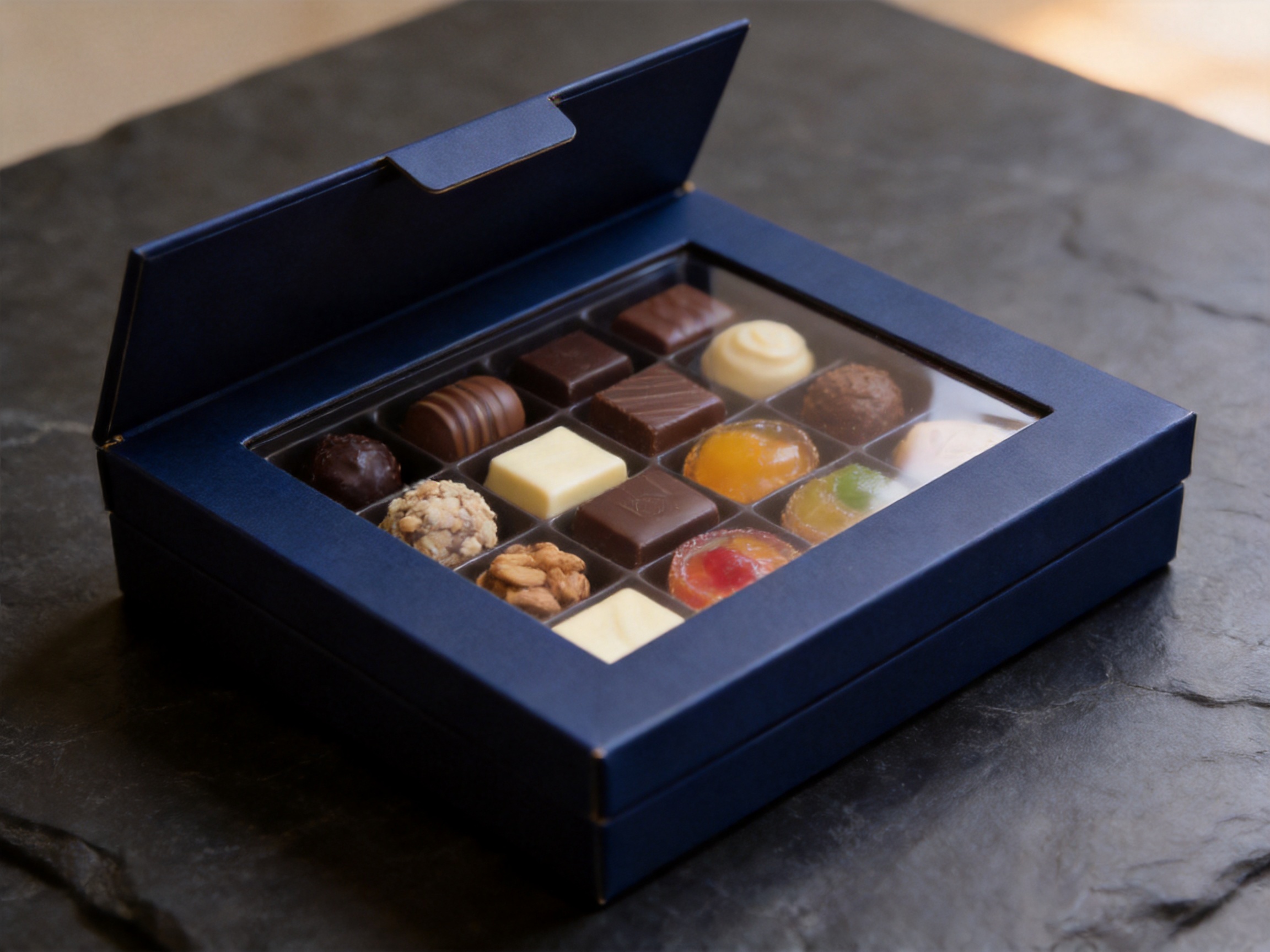
Packaging can support price positioning by creating a visible distinction between an everyday product and a giftable product. SH-08 has a firm structure, refined color palette, and organized interior that can help a chocolate collection occupy a higher-value category. The packaging does not need excessive ornamentation to communicate quality. Instead, it uses proportion, material contrast, and orderly presentation.
For boutique chocolatiers, the box can provide a professional outer format while allowing the chocolate itself to remain the visual focus. For established brands, the deep blue background can be adapted to existing identity systems through logo placement and customized artwork. For corporate gifting, a simple logo and message can turn the same structural format into a branded presentation without making the packaging look overly promotional.
The transparent window gives retailers an immediate display advantage. Customers can see the assortment without opening the package, which can be important where product hygiene or store policies limit handling. The window can show the quantity, color variety, and arrangement of the chocolates, helping consumers understand what they are purchasing.
Visibility is also useful for seasonal collections. Holiday chocolates often include distinctive colors and decorative shapes. A visible arrangement can attract attention on a crowded gift shelf or counter. The box may also be placed in a way that allows the lid to face shoppers, turning the package into a compact product display.
The custom compartment tray helps maintain the original arrangement of the assortment. This is especially valuable for chocolates with delicate coatings, toppings, embossed patterns, or decorative surfaces. When pieces move freely, they may rub against one another, become difficult to identify, or appear untidy when the recipient opens the box. Defined compartments reduce these risks.
The tray can also make the packing process more repeatable. Workers can place each piece into a known location, making it easier to check whether the box is complete. This reduces the likelihood of empty spaces, incorrect assortments, or inconsistent visual layouts during order fulfillment.
SH-08 can serve several commercial channels. It can be used in physical retail stores, specialty chocolate boutiques, hotel gift shops, corporate gift programs, holiday promotions, dessert brands, and direct-to-consumer sales. Its rigid structure and organized interior are suitable for presentation, while the customizable format allows the box to be adapted to different product assortments.
For e-commerce, the box can function as the primary gift presentation inside a suitable shipping carton. The rigid construction offers a stronger base for secondary packaging, although transport testing should always be completed for the final product configuration. For offline retail, the transparent window and deep blue exterior can help the product stand out without requiring a large display fixture.
Chocolate brands frequently release products for holidays, anniversaries, weddings, business events, and cultural celebrations. A customizable gift box can support these short-term campaigns without requiring a completely different structural concept every time. The artwork, logo treatment, insert arrangement, and external message can be adjusted while retaining the proven box format.
A seasonal design may use metallic printing, ribbons, special stickers, printed greetings, or a themed insert. A wedding version may use lighter colors and elegant typography. A corporate edition may feature company colors and a formal message. The underlying structure remains practical, while the surface design changes to meet the event.
The listed dimensions of approximately 18–22 centimeters in length, 12–16 centimeters in width, and 5–7 centimeters in height provide a general reference rather than a fixed limitation. Exact dimensions should be developed around the product. A collection of small pralines may require more compartments, while larger dessert pieces may need fewer and deeper positions.
The number of compartments can be adjusted to create four-piece, six-piece, eight-piece, twelve-piece, or other configurations. The tray may be arranged in rows, grids, offset patterns, or a central-and-surrounding composition. The ideal layout depends on how the chocolates should be viewed through the window and how the recipient is expected to explore the assortment.
The external artwork can also be customized. Options may include brand logos, product names, flavor descriptions, origin statements, preparation stories, gift messages, seasonal illustrations, or minimal geometric designs. The deep blue base can remain as a signature element, or the paper color can be adapted to a different brand strategy.
Finishing options may include matte lamination, selected glossy details, foil accents, embossing, debossing, textured paper, stickers, sleeves, ribbons, or custom labels. Each added process should be evaluated in relation to production quantity, budget, lead time, and the desired visual effect. A restrained design often achieves a more premium result than adding too many decorative techniques.
The transparent window can be sized and positioned according to the visual objectives of the collection. A large window emphasizes the full assortment, while a smaller window can create a framed view with more space for branding. The window shape may also be considered during structural development, provided that the required strength and assembly performance are maintained.
Responsible packaging design involves more than selecting a single material. It includes efficient sizing, material reduction where appropriate, durability, responsible sourcing, manufacturing control, and the possibility of appropriate recovery or recycling after use. SH-08 uses paperboard as the primary structural material, which can support a paper-based packaging strategy when the final construction and local waste systems are considered.
The company information identifies FSC and BSCI certifications among its credentials. FSC-related sourcing can support responsible forestry objectives when the relevant materials are covered by the applicable certification chain. BSCI relates to social compliance and responsible workplace practices within the supply chain. Customers should confirm the exact scope, validity, and documentation requirements for their specific order.
The rigid format also has a potential reuse advantage. Recipients may reuse a strong gift box for keepsakes, accessories, stationery, photographs, or small household items. Continued use can extend the practical life of the package beyond the initial chocolate presentation. The deep blue appearance and multi-compartment structure make it suitable for secondary storage after the chocolates have been consumed.
At the same time, responsible design should consider the PET window, adhesives, coatings, and mixed-material construction. Local recycling systems differ, and a laminated paperboard box with a plastic window may require separation of components in some regions. Brands that prioritize sustainability can request material information, evaluate alternative window solutions, and provide disposal guidance appropriate to their target markets.
A visually attractive sample is only one part of a successful packaging project. Buyers also need confidence that a supplier can reproduce the design consistently, manage customized specifications, meet delivery requirements, and support future orders. This is especially important for chocolate brands that depend on seasonal launch dates or recurring gift programs.
Zhejiang Shihao Gift Packaging Co., Ltd. is described as an export-oriented manufacturer specializing in paper gift packaging boxes. The company has more than 15 years of experience and operates across approximately 20,000 square meters with around 300 employees. Its reported average daily production capacity is about 5,000 sets of gift boxes.
This scale can provide several practical benefits. A dedicated workforce can support separate functions such as design development, material preparation, printing, cutting, assembly, inspection, and order coordination. Production capacity can help the manufacturer handle larger campaigns, while established processes can make repeat orders more predictable.
The company also reports advanced equipment and strong research and development capabilities. For a product such as SH-08, equipment quality matters because the design requires several coordinated operations: rigid board cutting, paper wrapping, matte lamination, window cutting, PET fitting, tray production, and final assembly. Equipment and process control must work together to maintain dimensional accuracy.
An in-house design team is another useful strength. The company reports updating dozens of products weekly and offering customized packaging solutions for different markets. This suggests that customers can approach development as a collaborative process rather than selecting only from fixed catalog designs. Packaging teams can discuss product dimensions, visual direction, market expectations, and production constraints before finalizing the structure.
Export experience is valuable because packaging orders may need to meet different labeling, shipping, material, and commercial requirements. The company reports exports to Europe, the United States, the Middle East, and other regions. International experience can help with communication, documentation, production scheduling, and coordination across long-distance supply chains, although buyers should still confirm the requirements of their own destination markets.
The most direct application is a multi-flavor chocolate gift set. The individual compartments can correspond to different flavor categories, such as caramel, hazelnut, fruit, coffee, sea salt, dark cocoa, or seasonal fillings. The transparent window lets the recipient see the variety, while the insert helps preserve separation among the pieces.
Beyond chocolate, the format may be considered for selected confectionery and dessert products that fit the compartment dimensions. Small cookies, coated snacks, candies, or individually packaged dessert bites may be suitable after product testing. The rigid box and deep blue exterior support premium presentation for boutique food brands and specialty retailers.
Corporate gifting requires packaging that looks professional and is easy to brand. SH-08 can carry a company logo, a thank-you message, or a campaign theme while maintaining a refined appearance. The transparent lid can make the gift feel generous and complete before it is opened, which is useful for business events, client appreciation programs, employee recognition, and conference gifts.
Seasonal chocolate assortments benefit from strong visual presentation. The exterior can be customized for holiday colors, greetings, and motifs, while the internal tray can accommodate seasonal shapes. The box can also be used for limited editions that need a more distinctive format than standard year-round packaging.
New brands can use the box to establish a premium visual identity from the beginning. The combination of visible product, clear organization, and customizable printing can help communicate product quality in a competitive market. Promotional sets may include different flavors or samples, with each compartment supporting a guided tasting experience.
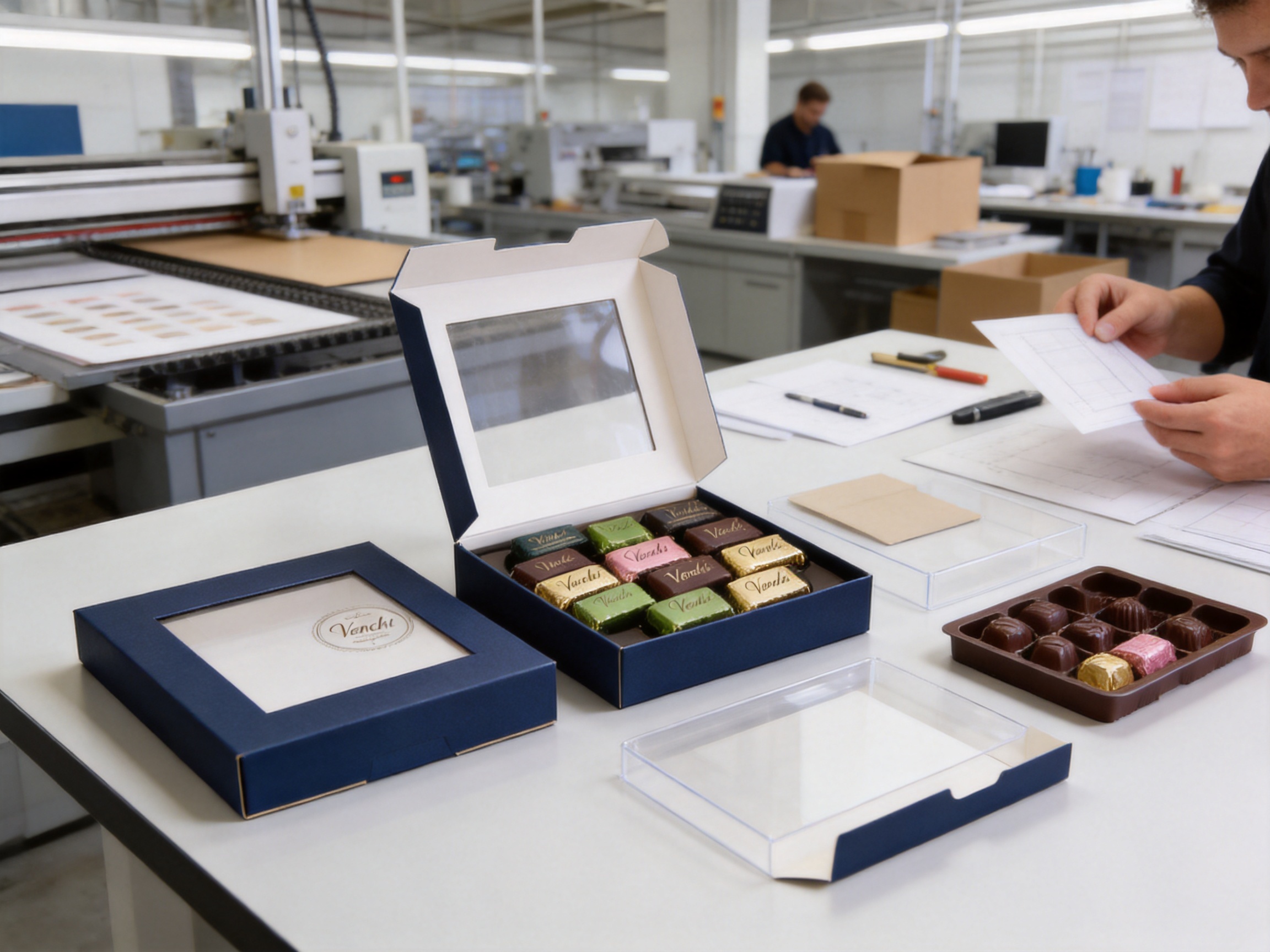
Before production, brands should prepare accurate product samples or technical drawings. Measurements should include length, width, height, shape irregularities, wrappers, and any protective materials that will be placed around the chocolates. Small differences in product dimensions can affect the fit of the tray and the clearance of the lid.
The desired quantity and arrangement should also be confirmed early. A six-piece set, for example, will create a different visual balance from a ten-piece set. The brand should decide whether all pieces should be identical in shape, whether flavors should be grouped, and how the assortment should appear through the window.
Artwork should be supplied according to the manufacturer’s specifications. Logos, text, colors, and finishing effects need to be checked against the final structural template. It is advisable to review a physical sample before mass production because paper texture, matte lamination, window reflection, and color perception can differ from digital screen images.
Transport testing should be considered for the complete product, not only the empty box. The filled package should be evaluated under expected handling conditions, including stacking, movement, vibration, and temperature exposure where relevant. The final shipping carton should also provide appropriate support around the gift boxes.
Food-related requirements should be addressed according to the product configuration and destination market. If chocolates are unwrapped, the contact layer must be suitable for food use. If the chocolates are individually wrapped, the rigid gift box and tray can be designed as secondary packaging. Labels, allergen information, ingredient details, and other required information should be handled by the brand in accordance with applicable regulations.
The transparent PET window allows the chocolates to remain visible while the box is closed. It supports retail display, helps purchasers assess the assortment, and creates anticipation before opening. It also allows the arrangement and colors of the chocolates to contribute to the package design.
Yes. The internal tray and overall dimensions can be customized according to the size and shape of the chocolates. Buyers should provide accurate product samples or technical measurements so that the compartments can be developed with suitable clearance and support.
The custom tray gives each chocolate a defined position and helps reduce movement during handling and transportation. It also separates different pieces, supports a neat arrangement, and makes the assortment easier to inspect and pack consistently.
Yes. The deep blue matte appearance is a key design direction for SH-08, but the paper color, printed graphics, logo, messages, and finishing details can be customized. The final options depend on the brand’s artwork, order quantity, budget, and production requirements.
The reference dimensions are approximately 18–22 centimeters in length, 12–16 centimeters in width, and 5–7 centimeters in height. These dimensions are customizable and should be confirmed after the chocolate assortment and tray configuration have been finalized.
The main construction uses dark blue matte art paper combined with grey cardboard. The lid window uses PET material, and the internal lining uses a custom-made blister tray. Specific material details should be confirmed for each order and destination market.
The box uses a top and bottom lid opening, with the lid incorporating the transparent window. Its flip-top structure is designed to make opening convenient while maintaining a unified presentation.
Yes. The rigid construction, refined color scheme, visible assortment, and customizable branding make it suitable for business gifts, client appreciation programs, employee gifts, events, and promotional campaigns.
Yes. The format can be adapted for holiday and festival collections through seasonal artwork, messages, colors, inserts, and chocolate arrangements. The transparent window is particularly useful for displaying festive shapes and varied decorative finishes.
Buyers should request structural drawings, material specifications, artwork templates, sample approval, tray details, production timing, packing information, and quality requirements. They should also confirm the intended chocolate dimensions and any market-specific packaging obligations.
The manufacturer reports more than 15 years of experience, approximately 20,000 square meters of operating space, around 300 employees, advanced equipment, an in-house design team, international export experience, BSCI and FSC certifications, and an average daily capacity of about 5,000 gift box sets. These capabilities support customized development and larger-scale production.
The SH-08 Multi-Compartment Transparent-Lid Square Chocolate Gift Box is designed for brands that want packaging to perform several jobs at once. It protects the assortment, separates individual chocolates, displays the contents, supports premium positioning, and creates a convenient opening experience. Its deep blue matte exterior gives the package a restrained luxury, while the PET window adds immediate visual communication.
Its strongest advantage over simpler competitors is the way its features are integrated. The rigid cardboard body provides stability, the fitted tray organizes the products, the transparent lid highlights the assortment, and the flip-top opening makes access simple. Together, these elements create a packaging experience that is both attractive and practical.
For buyers, the product is also supported by a manufacturer with reported experience in paper gift packaging, customized design, export production, modern equipment, substantial capacity, and responsible business certifications. This combination is important because premium packaging must be consistent not only in concept but also in repeated production.
Whether used for multi-flavor chocolates, high-end desserts, business gifts, holiday collections, or promotional sets, SH-08 offers a flexible platform for creating a memorable presentation. With accurate product measurements, thoughtful artwork, suitable material selection, and careful quality control, it can help transform a chocolate assortment into a complete and elevated gift experience.
1. Product specification and descriptive materials for the SH-08 Multi-Compartment Transparent-Lid Square Chocolate Gift Box.
2. Packaging development principles for rigid paperboard gift boxes, including structural design, material selection, window integration, and insert fitting.
3. General industry guidance on premium confectionery packaging, product presentation, compartmentalized inserts, and retail display requirements.
4. Forest Stewardship Council, general guidance on responsible forest-based material sourcing and chain-of-custody principles.
5. Business Social Compliance Initiative, general guidance on social responsibility and supply-chain workplace practices.
6. General packaging quality-control practices covering printing, lamination, die cutting, adhesive application, assembly, dimensional inspection, and transport evaluation.
Recommended Products

Contact Us

No. 15, Xiayang Road, Huangzhai Town, Jinhua, Zhejiang, China

(+86) 579-84230069

(+86) 13085675766


Products

Gift Box Packaging Manufacturer
 English
 Français
 Español
 عربى