2026-08-17
Gift packaging has evolved from a simple protective layer into an important part of the product experience. Customers increasingly judge a gift by the quality of its presentation, the usefulness of its packaging, and the sustainability of the materials used. For brands, retailers, event organizers, and distributors, the right gift box must therefore combine appearance, durability, efficient storage, customization, and reliable manufacturing support.
The 813 Cylindrical Velvet Fabric Storage Gift Box is designed to meet these combined requirements. Its rounded cylindrical profile creates an immediately recognizable visual identity, while its velvet fabric covering delivers a soft, refined, and tactile surface. Unlike disposable packaging that is often discarded after opening, this box can continue to serve as a storage container for accessories, crafts, keepsakes, cosmetics, stationery, and other personal items.
Produced by Zhejiang Shihao Gift Packaging Co., Ltd., the 813 series reflects the capabilities of an established paper gift packaging manufacturer with more than 15 years of industry experience. The company combines product development, structural design, material selection, printing, finishing, assembly, quality management, and export services in one manufacturing system. This integrated approach helps customers obtain consistent packaging at commercial quantities while still retaining opportunities for customization.
The following article examines the design advantages, construction, applications, customization options, manufacturing strengths, logistics details, and purchasing considerations associated with the 813 cylindrical velvet gift box.
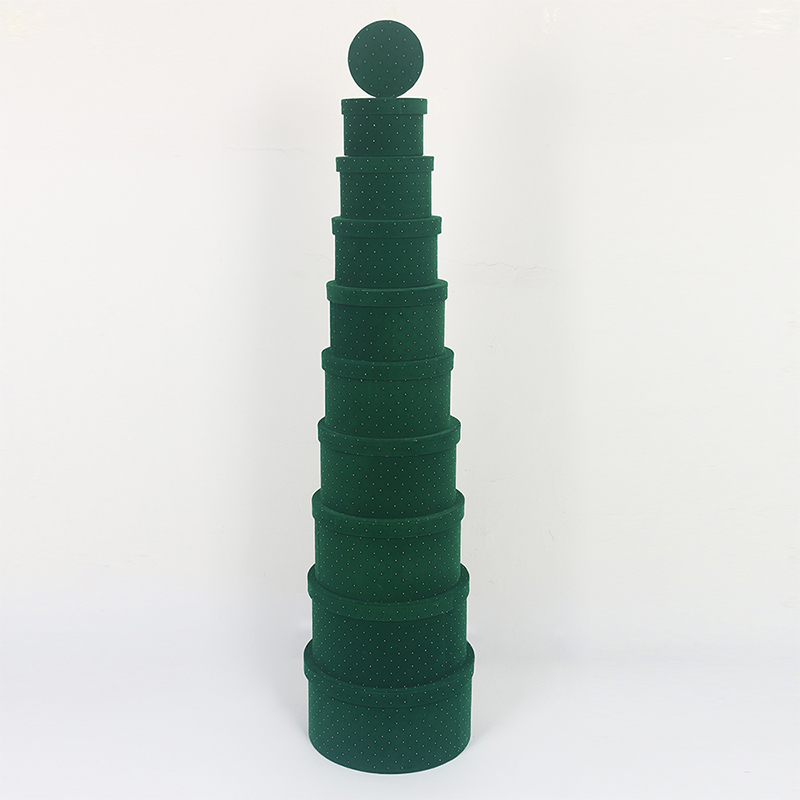
813 Cylindrical Velvet Fabric Storage Gift Box
The 813 Cylindrical Velvet Fabric Storage Gift Box is a premium reusable package built around a cylindrical structure. Its shape offers a departure from conventional square and rectangular gift boxes, helping products stand out on shelves, in display cabinets, and during gift presentation. The rounded form is especially suitable for products that benefit from an elegant, soft, or lifestyle-oriented presentation.
The box is available in a set configuration, with the listed packaging specification indicating three pieces per set. Three different size options are identified in the product information:
| Item | Specification |
|---|---|
| Project number | 813# |
| Product type | Cylindrical velvet fabric storage gift box |
| Available sizes | 1#: 18 × 17 cm; 2#: 16 × 15 cm; 3#: 13.5 × 13.5 cm |
| Set configuration | 3 pieces per set |
| Color options | CMYK, Pantone colors, and custom colors |
| Minimum order quantity | 300 sets |
| Application | Gift packaging, storage, gifts, and crafts |
| Standard carton quantity | 24 sets per carton |
| Carton dimensions | 74 × 38 × 55 cm |
| Approximate carton volume | 0.155 CBM |
| Typical port | Ningbo, or another port according to customer requirements |
The three-size set can be arranged as a coordinated group, allowing different products to be presented together. It can also provide customers with several storage options after the original gift has been opened. Depending on the project, the sizes may be used individually or as a nested collection, subject to final structural confirmation and product dimensions.
Most standard gift boxes use square or rectangular geometry because these shapes are familiar and easy to manufacture. However, a cylindrical box can provide stronger visual differentiation. The absence of sharp corners gives the 813 series a softer and more decorative appearance, making it particularly suitable for premium retail, seasonal collections, hospitality gifts, and personal keepsakes.
On a retail shelf, products compete for attention within a limited visual field. A cylindrical package introduces curved lines that contrast with the straight edges of many competing boxes. This difference can make a product easier to recognize and more memorable to customers. The shape may also support a more cohesive display when several boxes are arranged by size or color.
The cylindrical profile is well suited to vertical placement. When displayed upright, it can create a clean and orderly arrangement in retail stores, gift counters, hotel rooms, event venues, and home interiors. The form also makes the package easy to carry by hand, especially when the contents are compact and lightweight.
A cylindrical package can accommodate many products that do not require a large rectangular footprint. Potential examples include candles, scarves, small textiles, beauty accessories, confectionery, handmade crafts, ornaments, keepsakes, and selected stationery products. The final application depends on the internal dimensions, insert design, closure arrangement, and product protection requirements.
The cylindrical structure supports a second life after the gift is removed. Consumers may use it to hold jewelry, hair accessories, sewing supplies, photographs, small toys, office materials, or decorative objects. This extended use gives the package greater perceived value than a single-use carton and can improve the customer’s emotional connection with the brand.
The most noticeable feature of the 813 gift box is its velvet fabric exterior. Velvet is widely associated with softness, comfort, luxury, and careful presentation. When used on gift packaging, it creates a sensory experience that begins before the box is opened. The customer can see the surface, touch it, feel its texture, and associate that experience with the value of the enclosed product.
The fabric surface also diffuses light in a distinctive way. Rather than appearing flat or overly reflective, velvet can create subtle changes in tone as the box is moved. This quality helps colors appear richer and can make a simple cylindrical form look more sophisticated.
A smooth paperboard package may look attractive but can feel ordinary in the hand. Velvet adds a warmer and softer tactile response. This is useful for products positioned around comfort, celebration, beauty, personal care, fashion, home decoration, and emotional gifting.
The surface texture of velvet creates depth that printed paper alone may not provide. It can be used as a complete covering or combined with other decorative elements, depending on the customer’s design concept. A logo, label, ribbon, metal accent, printed sleeve, or other accessory can be added to create a stronger visual hierarchy.
The product information describes the velvet material as wear-resistant, durable, and relatively easy to clean and maintain. As with all fabric-covered packaging, the precise performance depends on the selected fabric, backing, adhesive, handling conditions, and cleaning method. Customers should approve a physical sample before mass production, particularly when the box will be exposed to frequent handling or transportation.
For repeated use, basic care is recommended. Dust should be removed gently, moisture should be avoided where possible, and abrasive cleaning tools should not be used. Clear care guidance can help retailers and end users preserve the appearance of the box over a longer period.
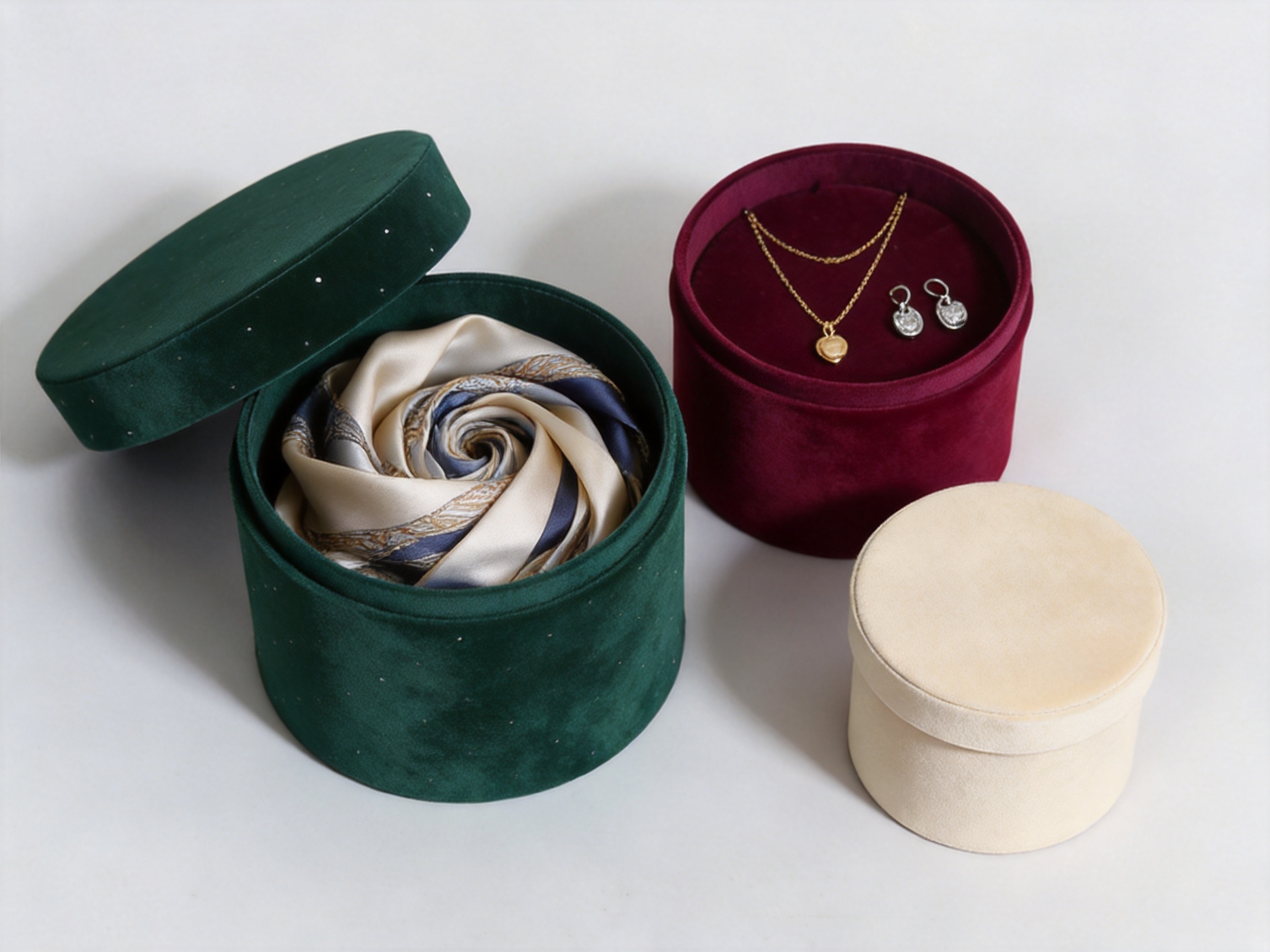
The listed material specification refers to an art paper-coated cardboard surface, while the product description identifies a velvet fabric exterior. These descriptions can be understood as referring to different layers or construction options within the package. A premium cylindrical box commonly uses a rigid paperboard or cardboard structure for strength, with an outer decorative covering applied over the structural body. The exact material build-up should be confirmed during quotation, sampling, and technical approval.
The structural board provides shape retention and helps the box withstand normal handling. The outer velvet covering supplies the visible finish and tactile character. Depending on the design, additional layers may include lining paper, protective board, internal trays, dividers, inserts, lids, or cushioning components.
A properly engineered paperboard body helps the cylindrical form remain stable. It reduces the risk of deformation during packing, transportation, and display. The board thickness, rolling method, seam treatment, and edge finishing all influence the final result. For products with greater weight or higher protection requirements, the structural specifications should be adjusted accordingly.
The quality of the adhesive process is important for fabric-covered packaging. The velvet should remain smooth and firmly attached without visible bubbles, loose edges, wrinkles, or excessive adhesive marks. Consistent application is especially important around the curved body, the top and bottom edges, and any seam or joint.
Cylindrical packaging requires accurate alignment between the body, lid, base, and decorative covering. If the lid is too loose, the product may not feel secure. If it is too tight, opening may become inconvenient and the fabric or board may be damaged. Professional assembly and inspection help maintain a balanced opening experience.
When the package is used for delicate goods, an internal insert can improve both presentation and protection. Inserts may be made from paperboard, foam, molded pulp, fabric, or other approved materials. They can hold the product in position, prevent movement, and create a more organized unboxing experience. Insert design should be based on the product’s shape, weight, fragility, and required display position.
The 813 series competes not only with other velvet boxes but also with ordinary folding cartons, rigid rectangular boxes, plastic containers, and disposable paper packages. Its advantages become clearer when appearance, function, durability, and brand experience are considered together.
| Evaluation area | 813 cylindrical velvet box | Basic disposable carton |
|---|---|---|
| Visual differentiation | Rounded silhouette and textured surface create a distinctive premium look | Often relies mainly on printed graphics |
| Tactile experience | Soft fabric surface provides a warm, refined feel | Usually smooth paper or paperboard |
| Post-purchase use | Can be reused as a storage container | Commonly discarded after opening |
| Display potential | Suitable for coordinated size and color displays | More conventional shelf presentation |
| Brand positioning | Supports premium, lifestyle, craft, and luxury-oriented products | Suitable for economical or short-term packaging |
| Customization | Fabric colors, printing, design, and structural options may be customized | Usually focused on printed carton specifications |
| Customer experience | Combines visual appeal, touch, opening, and continued storage use | Primarily provides protection and initial presentation |
Compared with plastic containers, the 813 box can provide a more traditional gift-oriented appearance and may support a paper-based packaging strategy. Compared with low-cost paper cartons, it offers greater physical presence and a more memorable tactile experience. Compared with ordinary rigid rectangular boxes, its cylindrical form provides differentiation while maintaining practical storage value.
It is important to recognize that no package is ideal for every product. A cylindrical box may require different internal arrangements than a rectangular carton, and it may not be the best option for large, irregular, or very heavy items. The strongest use cases are products where premium presentation, compact storage, and emotional appeal are important purchasing factors.
Sustainable packaging is increasingly evaluated according to its entire use cycle. Material selection remains important, but packaging longevity, reusability, production efficiency, and responsible sourcing also affect the overall environmental profile. The 813 cylindrical velvet box has a practical sustainability advantage because it can remain useful after the original gift has been removed.
When consumers reuse a package as a storage box, the useful life of the material is extended. It may replace the need to purchase a separate small container or prevent the immediate disposal of the original package. Reusability is particularly valuable for a gift box with a durable structural body and an attractive exterior, because the recipient has a reason to keep it visible and continue using it.
Customers seeking a more environmentally responsible packaging solution can discuss paperboard sources, fabric composition, coatings, adhesives, inks, inserts, and shipping materials during product development. The appropriate choices depend on the target market, certification requirements, product positioning, and local regulations.
Zhejiang Shihao Gift Packaging Co., Ltd. has reported FSC and BSCI certifications. FSC certification is associated with responsible forest management and controlled paper supply chains, while BSCI participation relates to social compliance and responsible working conditions within supply networks. Certification scope and validity should be confirmed for the specific order and material selection.
A package that becomes a storage container may provide practical value beyond the initial sale. Consumers can use the box for small personal items, craft materials, stationery, accessories, or household objects. This function supports a more circular product experience by encouraging continued use rather than immediate disposal.
To maximize reusability, the box should be manufactured with a strong body, clean edges, reliable adhesion, and a surface that can withstand normal handling. A timeless color or adaptable design may also increase the likelihood that the recipient will continue using it. Customers should consider whether the external decoration remains attractive even after the original product branding is no longer relevant.
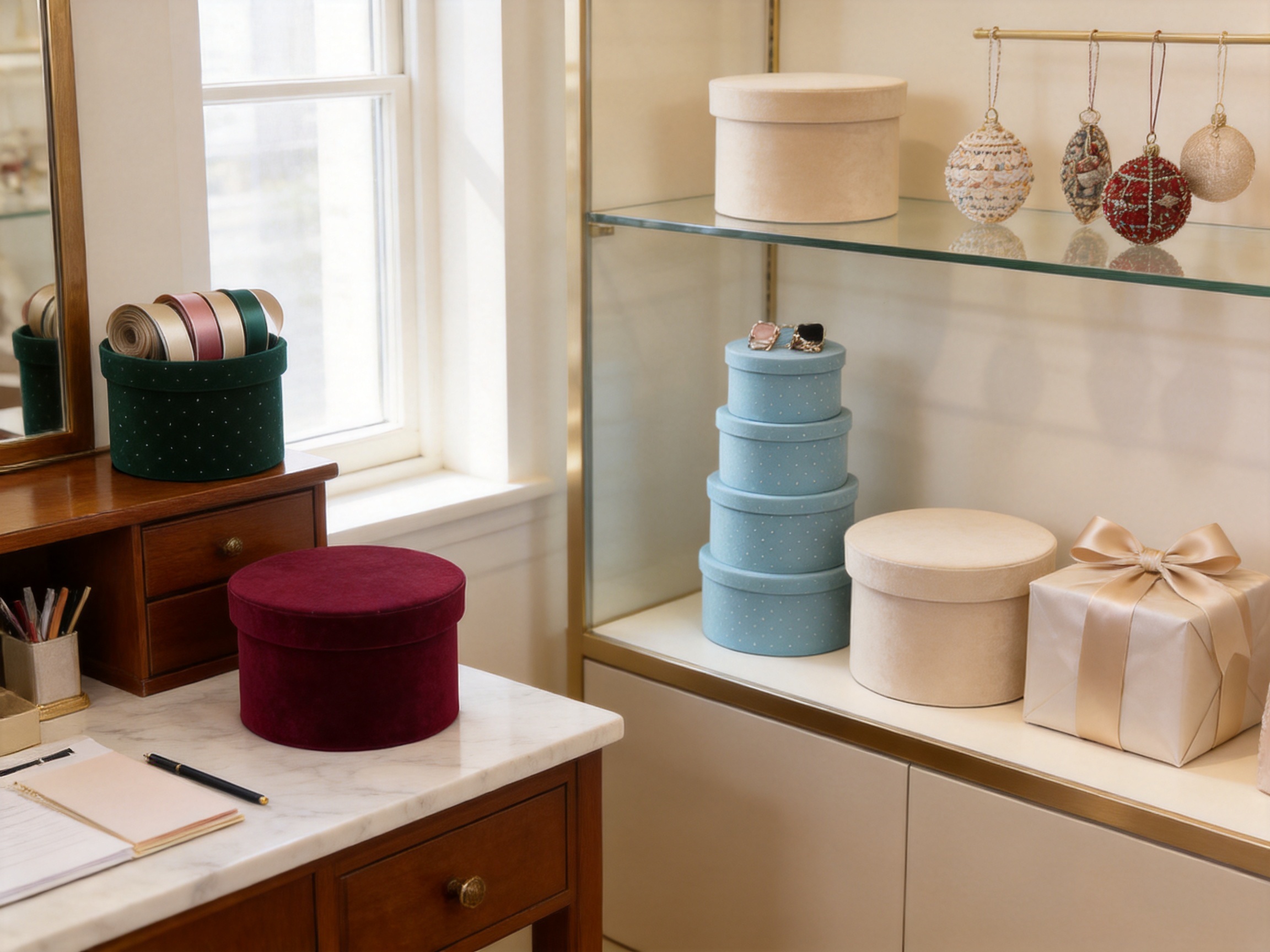
The 813 gift box can be adapted to a broad range of commercial and personal applications. Its final suitability depends on the product dimensions and the internal structure, but its visual language is flexible enough for both traditional gifting and modern lifestyle packaging.
The box is suitable for holiday gift programs, anniversary packaging, wedding favors, festival collections, birthday gifts, and corporate appreciation programs. Seasonal color selections can help support specific campaigns, while neutral velvet shades can be used throughout the year.
Beauty accessories, skincare sets, fragrance-related products, bath items, and personal care gifts often benefit from a soft, elegant package. Velvet can support a sense of indulgence and create a stronger connection between the package and the self-care experience.
The cylindrical form may be suitable for selected jewelry, scarves, hair accessories, small leather goods, and fashion details. An internal insert can be developed to prevent movement and improve presentation. For jewelry or other high-value products, customers should request appropriate lining, protection, security, and quality control requirements.
Artisans and craft brands often need packaging that feels personal and distinctive. The fabric surface can complement handmade candles, ornaments, textile products, decorative accessories, and limited-edition creations. A custom color or small printed mark can reinforce the handmade identity of the product.
The product category includes stationery storage boxes, making the package relevant to pens, cards, clips, ribbons, small notebooks, craft tools, and other desktop materials. Once the original product has been used, the recipient can continue using the box to organize a workspace or creative area.
Hotels, restaurants, event agencies, and corporate procurement teams can use custom cylindrical boxes for welcome gifts, employee recognition programs, conference materials, and promotional collections. Customized colors and graphics can align the package with an institution’s visual identity.
The three available sizes can support a coordinated collection. Retailers may present them as a family of products or use different sizes for different gift sets. A consistent shape combined with varied colors can create a visually organized display while giving customers options at different price points.
Customization is a central advantage of working with a professional packaging manufacturer. The 813 product can serve as a starting structure, while the final packaging may be adjusted to fit a customer’s product, brand identity, market, and budget.
The listed color options include CMYK, Pantone colors, and custom colors. CMYK is generally used for process printing, while Pantone references can help achieve more controlled color matching. Velvet fabric may display color differently from smooth printed paper because its pile direction and surface texture influence how light is reflected.
For this reason, color approval should be based on a physical material sample whenever accurate appearance is important. Digital screens and standard paper proofs may not represent the final velvet surface precisely. A customer should evaluate the actual fabric, lighting, and surrounding decorative elements before approving mass production.
Brand marks, product names, decorative patterns, seasonal artwork, and promotional messages may be incorporated into the design. Depending on the selected surface and production method, possible techniques can include printing, labels, foil accents, embossing, debossing, ribbons, tags, or applied decorative components.
Customers may discuss changes to the lid, base, internal insert, lining, divider, handle, closure, or set arrangement. Structural changes can improve product fit and protection, but they should be assessed against tooling, production time, minimum order quantity, and shipping requirements.
The manufacturer offers professional design advice through an in-house design team. Custom design files can be supplied in commonly used professional formats, including Artificial Intelligence and CorelDRAW files. Final file requirements should be confirmed with the production team before artwork is prepared.
A complete design package should normally include dimensions, artwork placement, color references, logo usage rules, finishing instructions, fabric references, insert drawings, and any required regulatory information. Clear documentation reduces the possibility of interpretation errors during sampling and production.
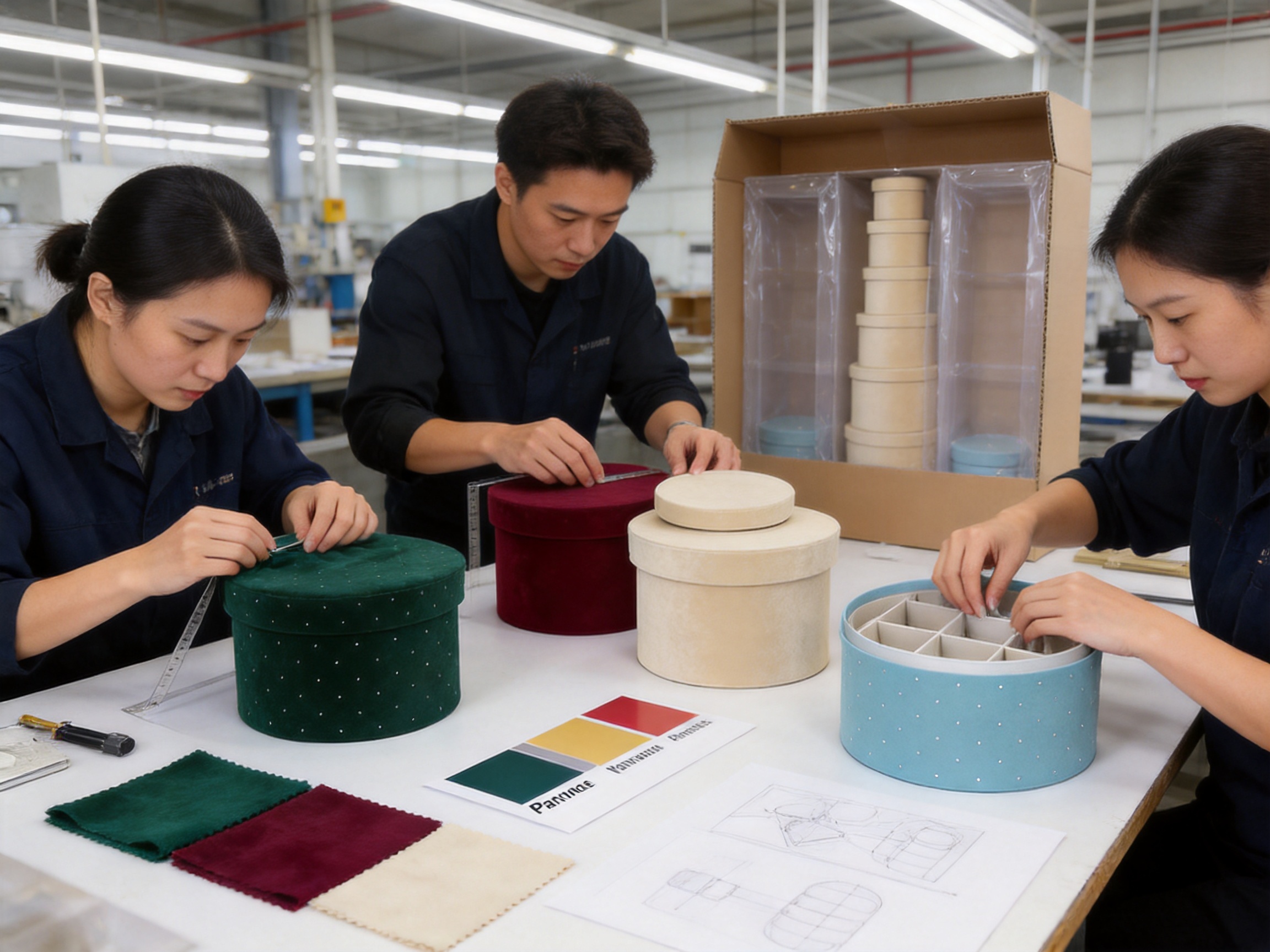
The quality of a premium gift box depends on more than the final appearance. Consistent commercial production requires coordinated control of materials, machinery, labor, design, assembly, inspection, and logistics. Zhejiang Shihao Gift Packaging Co., Ltd. describes itself as an export-oriented manufacturer specializing in the production, research and development, and sales of paper gift packaging boxes.
The company’s reported operating history of more than 15 years provides experience in handling different packaging categories and customer requirements. Its facility covers approximately 20,000 square meters and employs around 300 people. These resources support larger-scale production while allowing specialized teams to manage design, manufacturing, quality, and export processes.
An in-house design team allows the manufacturer to participate earlier in the development process. Instead of receiving only a finished drawing, customers can obtain advice about structure, material use, decoration, assembly, and production feasibility. Early technical input is valuable because a design that looks attractive on screen may need adjustments to work efficiently on a curved fabric-covered surface.
The company reports the use of advanced equipment and an average daily production capacity of approximately 5,000 sets of gift boxes. Production capacity alone does not guarantee quality, but it indicates that the manufacturer is equipped to handle organized commercial programs rather than only small workshop orders. Capacity planning can also support seasonal demand when production schedules are established in advance.
Quality control for the 813 product should cover raw materials, board thickness, fabric color, surface cleanliness, cutting, rolling, bonding, edge finishing, lid fit, dimensional accuracy, set completeness, carton packing, and final appearance. A structured inspection process helps identify defects before products are packed and shipped.
Typical inspection points may include checking whether the velvet is evenly applied, confirming that the cylindrical body is not visibly distorted, ensuring that seams are neat, verifying that the lid opens and closes correctly, and confirming that the correct quantity of boxes is included in each set. Customers with specialized standards may establish an inspection checklist or approved sample for reference.
The company exports to Europe, the United States, the Middle East, and other regions. International experience can help with communication, packaging documentation, production scheduling, shipment coordination, and the practical expectations of overseas buyers. Customers should still communicate their destination-market requirements clearly, including labeling, carton marks, testing, material declarations, and import documentation where applicable.
The company reports updating dozens of products weekly. A broad product development program can give buyers access to new shapes, materials, and decoration ideas. It may also make it easier to adapt an existing structure rather than developing every package from the beginning, potentially reducing development time for suitable projects.
A professional packaging project generally progresses through several coordinated stages. The exact process may vary according to the customer’s artwork, material selection, order quantity, and structural requirements, but the following sequence provides a useful overview.
The manufacturer first reviews the product dimensions, weight, fragility, quantity, delivery market, preferred colors, branding, budget, and intended use. For the 813 series, this stage also determines whether the standard sizes are suitable or whether a custom diameter and height are required.
Engineers assess the cylindrical body, lid, base, internal insert, and set arrangement. They consider how the product will be inserted, removed, displayed, and stored. The structure should balance protection with material efficiency and convenient assembly.
The customer selects the exterior fabric, board, lining, printing materials, adhesive system, and optional decorative elements. Velvet color selection should be reviewed under appropriate lighting, and a physical swatch or sample is recommended for commercial projects.
The design team prepares dielines, artwork layouts, surface placements, and production instructions. Curved surfaces require particular attention because logos and patterns may appear differently when wrapped around a cylinder. Design elements must be positioned to avoid seams, overlaps, and areas of high mechanical stress.
A prototype or pre-production sample allows the customer to evaluate dimensions, color, tactile quality, opening force, insert fit, visual balance, and overall workmanship. Sampling is also the opportunity to identify problems that may not be visible in computer drawings.
Once the sample and specifications are approved, the manufacturer organizes raw materials, production scheduling, printing or decoration, structural forming, fabric application, assembly, and packing. Process control is important because a small variation in fabric tension or adhesive placement can affect the appearance of a curved package.
Finished sets are checked against the approved requirements. The boxes are then arranged in cartons according to the agreed packing method. Carton dimensions and loading plans should be reviewed when freight cost or container utilization is a major consideration.
The goods are shipped through Ningbo or another agreed port. The supplier and buyer can coordinate shipping marks, export documents, production photographs, inspection reports, and delivery schedules. Clear communication after shipment is also valuable for repeat orders and future product improvements.
The listed minimum order quantity is 300 sets. This quantity can suit retailers, distributors, promotional agencies, event planners, and growing brands that need a commercial run without committing to extremely large volumes. The final minimum may vary if the customer requests special fabric, custom tooling, unique inserts, or unusual finishing.
The standard packing information indicates three pieces per set and 24 sets per carton. With an approximate carton size of 74 × 38 × 55 centimeters and a listed volume of 0.155 cubic meters, buyers can begin estimating warehouse and freight requirements. The actual shipping calculation should be confirmed using the final packed dimensions and the carrier’s measurement method.
The stated delivery period is approximately 7 to 45 days or according to customer requirements. The actual schedule may depend on artwork approval, sample confirmation, raw material availability, production quantity, packaging complexity, inspection arrangements, and shipping conditions. Buyers should establish a written timeline that distinguishes sample time, production time, and transit time.
Because velvet surfaces can be affected by dust, abrasion, moisture, and compression, the inner and outer packing method should be chosen carefully. Individual protective wrapping, dividers, tissue, or other safeguards may be considered where necessary. Cartons should be stacked in a way that limits crushing and maintains the shape of the cylindrical boxes.
Before placing an order, buyers should provide the destination country, preferred delivery term, required port, product dimensions, packaging instructions, labeling requirements, and any compliance documentation. A detailed purchase specification can reduce delays and help ensure that the shipment meets the buyer’s receiving standards.
Premium appearance is subjective, but many quality points can be evaluated objectively. A buyer reviewing a sample or production batch should examine the following areas.
The diameter, height, lid fit, and set arrangement should remain consistent from one unit to another. Small variations can affect shelf presentation and the customer’s perception of quality, especially when several boxes are displayed together.
The velvet should be evenly attached without obvious wrinkles, exposed board, loose fibers, stains, bubbling, or visible adhesive. The fabric direction should be consistent across the batch unless a deliberate design requires otherwise.
Edges should appear neat and securely finished. Seams should be positioned consistently and should not interfere with the primary logo or visual design. Excessive overlap or uneven trimming can make the package look unfinished.
The lid should provide an appropriate level of resistance. It should not fall off during ordinary handling, yet it should be easy enough for the recipient to open without damaging the box. If an insert is included, it should not interfere with the lid.
Color should be checked against the approved physical sample or agreed color reference. Velvet may show variations according to lighting direction and pile orientation, so the approval process should take the real material into account.
The finished box should be free from visible dust, marks, excessive glue, and unpleasant odors. This is especially important for gift packaging because recipients often handle the package closely and may store it indoors after opening.
Recommended Products

Contact Us

No. 15, Xiayang Road, Huangzhai Town, Jinhua, Zhejiang, China

(+86) 579-84230069

(+86) 13085675766


Products

Gift Box Packaging Manufacturer
 English
 Français
 Español
 عربى