2026-08-16
Valentine’s Day is strongly associated with romance, affection, and thoughtful presentation. While candy remains one of the most popular gifts for the occasion, the packaging surrounding that candy often determines how the gift is first perceived. A beautifully designed box can make a simple assortment of chocolates, sweets, or confectionery feel more personal, more luxurious, and more appropriate for a special celebration.
The 1001 Decorative Cardboard Valentine’s Day Heart-Shaped Candy Box is designed for this exact purpose. Combining a romantic heart-shaped frame with sturdy decorative cardboard construction, the box provides a distinctive packaging solution for candy, small toys, jewelry, and other gifts. Its visual appeal supports the emotional character of Valentine’s Day, while its practical construction helps protect products during handling, storage, transportation, and presentation.
Unlike ordinary rectangular candy cartons, this heart-shaped gift box uses its silhouette as part of the message. The heart is immediately recognizable as a symbol of love and care, allowing the packaging to communicate meaning before the recipient opens it. This makes the product suitable not only for individual gift-givers, but also for confectionery brands, retailers, wholesalers, florists, event organizers, and businesses seeking seasonal packaging with a strong emotional identity.
The box is available in ten sizes, ranging from approximately 33 × 32.3 × 14 centimeters for size 1 to approximately 11 × 10 × 5 centimeters for size 10. This size range allows businesses to select an appropriate format for different candy quantities, gift combinations, and retail price points. Size and color can also be customized according to customer requirements, creating opportunities for private-label packaging, coordinated seasonal collections, and brand-specific presentation.
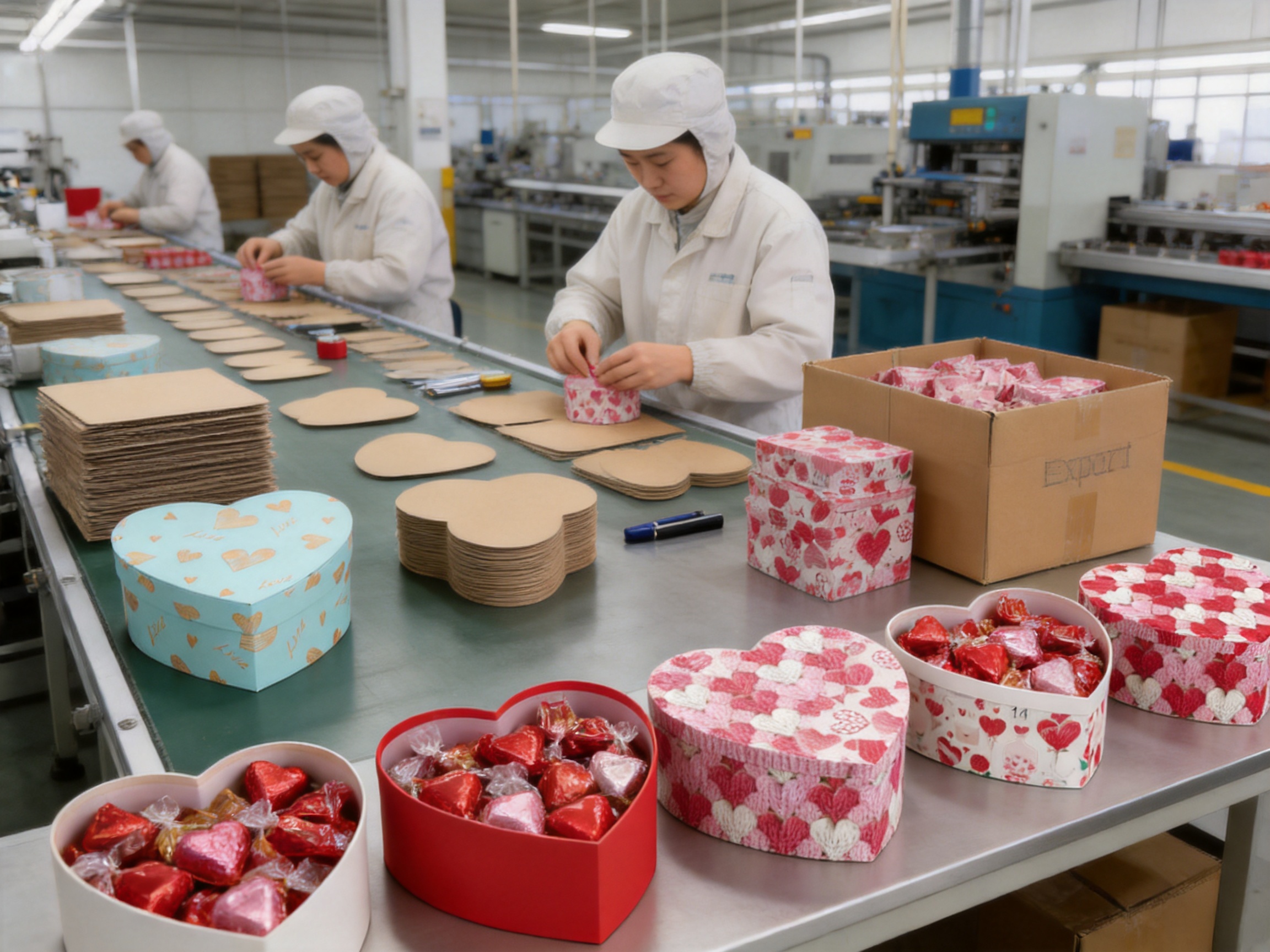
Manufactured by Zhejiang Shihao Gift Packaging Co., Ltd., the product benefits from the capabilities of an export-oriented paper packaging manufacturer with more than 15 years of experience. The company operates a production facility covering approximately 20,000 square meters, employs around 300 people, and has an average daily production capacity of about 5,000 gift box sets. These capabilities support both product development and large-volume manufacturing for international customers.
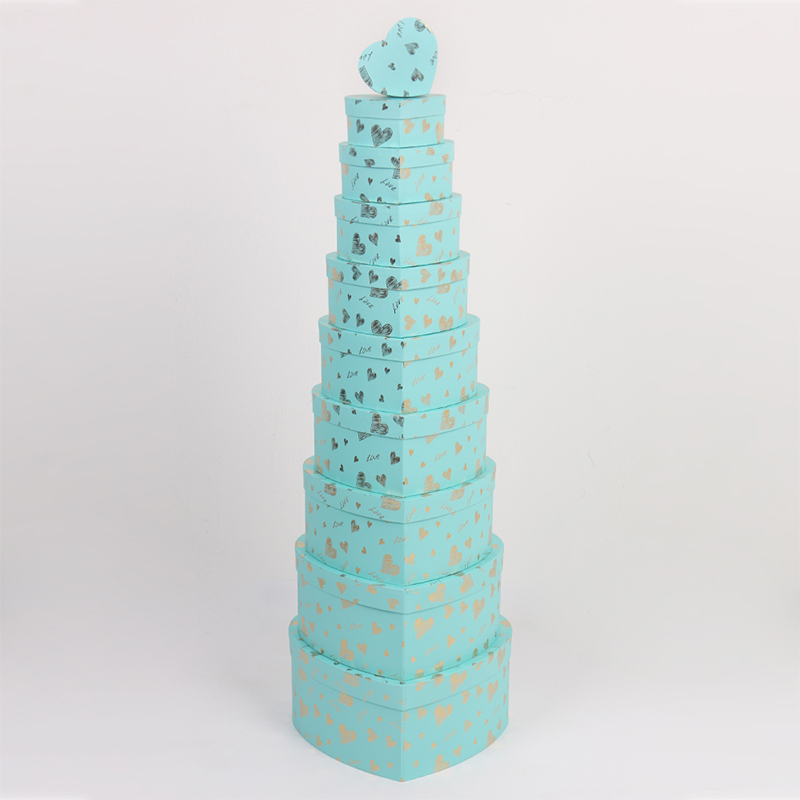
1001 Decorative Cardboard Valentine's Day Heart-Shaped Candy Box
The 1001 box is a decorative cardboard gift box created primarily for Valentine’s Day candy and confectionery packaging. Its central design feature is a heart-shaped framed structure that gives the box a romantic appearance and helps distinguish it from conventional candy packaging. The format can be used for filled chocolate assortments, individually wrapped sweets, truffles, caramels, cookies, small snack gifts, and other lightweight products.
The box is also suitable for items beyond candy. Its range of dimensions makes it adaptable to jewelry, small toys, accessories, keepsakes, and other compact presents. Retailers can therefore use the same product family for multiple seasonal campaigns rather than limiting it to one type of confectionery. For example, a smaller format may hold a bracelet or pendant, while a larger size may accommodate a mixed candy selection or a small combination gift.
Although the design is associated with Valentine’s Day, the heart-shaped format can also be used for birthdays, wedding anniversaries, engagement celebrations, wedding favors, romantic events, Mother’s Day promotions, and relationship-themed marketing campaigns. With changes to color, print, insert design, and finishing, the packaging can be adapted to different occasions while retaining its recognizable heart silhouette.
| Product Feature | Specification or Benefit |
|---|---|
| Product number | 1001 |
| Primary category | Valentine’s Day gift boxes and decorative paper packaging |
| Main material | Decorative cardboard |
| Shape | Heart-shaped framed design |
| Available sizes | Ten sizes |
| Size range | Approximately 33 × 32.3 × 14 cm to 11 × 10 × 5 cm |
| Customization | Size and color customization available |
| Recommended applications | Candy, sweets, toys, jewelry, and other presents |
| Minimum order quantity | 500 sets |
| Outer packing information | Approximately 64 × 34 × 45 cm, with six sets in cardboard boxes |
The heart shape is one of the most universally understood symbols of love. In packaging design, it provides an immediate emotional cue without requiring extensive text or graphic explanation. A heart-shaped box can make a product feel warmer and more personal than a standard geometric package, particularly when the contents are intended as a romantic gift.
For Valentine’s Day merchandise, this symbolic value is commercially important. Consumers often make quick decisions based on color, shape, and presentation. The heart-shaped frame helps the product communicate its purpose instantly on store shelves, online product pages, gift displays, and promotional photographs. It also makes the package more recognizable when grouped with other seasonal products.
The design supports both sentimental and premium positioning. A candy brand may use it to create an affordable seasonal gift, while a specialty retailer may fill it with higher-value chocolates and present it as an upscale romantic collection. The same structural concept can therefore serve different market segments depending on the selected material finish, color palette, printing, internal arrangement, and contents.
Many candy packages rely on rectangular cartons, window boxes, pillow boxes, or simple folding sleeves. These formats are efficient and familiar, but they may not provide a strong emotional or seasonal identity. The heart-shaped framed design offers a more distinctive alternative, helping retailers create a display that feels specifically connected to Valentine’s Day.
Compared with generic packaging, the 1001 design has several competitive advantages. First, its shape supports immediate occasion recognition. Second, it creates a memorable unboxing experience. Third, it provides an opportunity for brands to communicate romance through structure rather than relying only on printed graphics. Fourth, it can be adapted for different product sizes, allowing a coordinated family of packages across multiple price points.
Distinctive packaging can also encourage sharing and word-of-mouth visibility. Recipients may photograph the box, place it on a desk or shelf, or reuse it for storing small items. When the packaging remains visible after the candy has been consumed, the design continues to provide brand exposure and emotional recall.
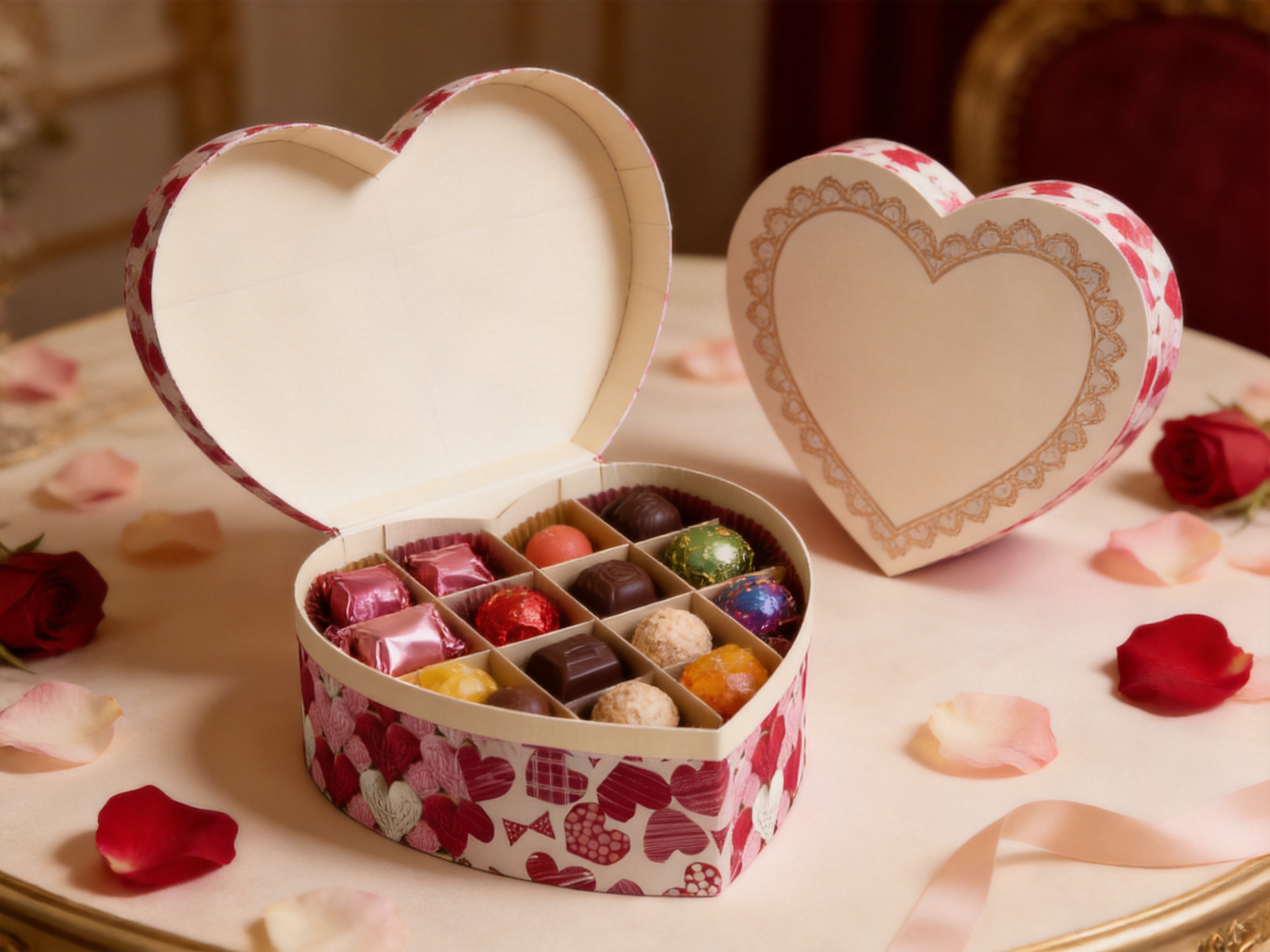
Decorative cardboard provides a useful balance between presentation and functionality. It is light enough to support efficient handling and shipping, yet sufficiently firm for many candy and small-gift applications. When properly assembled, the material helps maintain the shape of the package and reduces the risk of crushing the contents during normal transportation and carrying.
This protective function is particularly valuable for seasonal orders. Valentine’s Day products are often distributed through multiple channels, including supermarkets, specialty candy shops, department stores, e-commerce fulfillment centers, gift stores, and direct-to-consumer shipping. Packaging must withstand movement through warehouses, delivery systems, retail displays, and customer handling. A sturdy cardboard structure helps provide an additional layer of protection compared with thin paper sleeves or loosely assembled wrapping.
The box is appropriate for packaged candy and other products that do not require a rigid wooden or metal container. This allows businesses to achieve an attractive gift presentation without adding unnecessary weight. Lower package weight can support more efficient carton utilization and may contribute to lower handling costs, depending on the final configuration and shipping method.
Cardboard is highly adaptable to decorative printing and surface treatment. Customers can request colors and visual directions suited to their brand identity, seasonal campaign, or target market. Traditional Valentine’s Day colors such as red, pink, white, and burgundy can create a familiar romantic impression, while softer pastels, metallic-inspired designs, or contemporary color combinations can support a more modern retail concept.
Customization may include brand marks, greetings, patterns, decorative borders, product information, campaign messages, or coordinated artwork. The heart-shaped structure itself provides a strong design foundation, while printing can be used to distinguish one customer’s packaging from another. This is particularly useful for confectionery producers and gift companies that want seasonal products to remain consistent with their existing visual identity.
Color customization also supports different regional preferences and marketing strategies. A retailer may choose bright colors for mass-market displays, muted tones for premium chocolates, or a clean minimalist style for jewelry and boutique gifts. The structure remains consistent while the visual language changes.
Cardboard is widely recognized as a practical paper-based packaging material with recycling potential. The use of recyclable cardboard can support businesses that are seeking alternatives to more difficult-to-recycle packaging materials. It also aligns with consumer interest in sustainable purchasing and responsible packaging choices.
Sustainability performance depends on the complete product design, including coatings, adhesives, inks, inserts, and local recycling systems. For this reason, buyers should confirm the exact material composition and finishing requirements when placing a customized order. Nevertheless, a cardboard-based gift box provides a strong foundation for an environmentally conscious packaging program.
The manufacturer has passed FSC certification requirements, which supports responsible sourcing considerations within its production system. Buyers can discuss applicable certification documentation, material specifications, and customer-market requirements during the development process.
One of the most practical advantages of the 1001 product is its availability in ten sizes. The stated range extends from approximately 33 × 32.3 × 14 centimeters to approximately 11 × 10 × 5 centimeters. This allows customers to select a box that is proportionate to the contents rather than using one oversized format for every product.
Size variety can improve the efficiency of a seasonal product line in several ways. A small box can support an entry-level candy assortment, sample pack, promotional gift, or small jewelry item. Medium formats can hold a standard chocolate selection, individually wrapped confectionery, or a combination of candy and greeting card. Larger formats can accommodate premium assortments, multiple product compartments, or a gift set containing candy and another small item.
Using several sizes also helps retailers create a visible price ladder. For example, a small heart-shaped box may be positioned as an impulse purchase, while a larger version can be marketed as a premium gift. Customers can choose according to their budget without leaving the product family. This approach encourages consistent visual merchandising across shelves, display tables, online listings, and seasonal catalogs.
Correct sizing is also important for reducing unnecessary empty space. A box that is too large for its contents may require additional filler and may appear less premium if the product moves inside. A box that is too small may create pressure on the contents or make assembly difficult. The ten-size range gives buyers more opportunities to match the packaging to the product dimensions and presentation objectives.
| Potential Size Positioning | Typical Application | Retail or Marketing Role |
|---|---|---|
| Small formats | Single gift item, small candy portion, jewelry, or sample pack | Impulse purchase, favor, or promotional gift |
| Small-to-medium formats | Compact chocolate assortment or wrapped sweets | Affordable Valentine’s Day gift |
| Medium formats | Standard confectionery assortment or mixed small presents | Mainstream seasonal gift |
| Large formats | Premium candy collection or multi-item gift set | Premium retail positioning |
The exact internal capacity will depend on the selected size, the thickness of the cardboard, the internal structure, and the shape of the product being packed. Buyers should provide product dimensions and weight during quotation and sampling so the manufacturer can recommend the most appropriate version.
The primary application is Valentine’s Day candy packaging. The box can be used for chocolates, truffles, hard candy, soft candy, caramels, gummies, cookies, and other confectionery products when the contents are suitably wrapped or separated according to food-packaging requirements. The heart shape enhances the emotional appeal of the contents and creates a stronger gift impression than ordinary transport packaging.
For chocolate brands, the box can serve as a seasonal limited-edition package. A brand may use a special color and printed design for February campaigns, then introduce a coordinated assortment for anniversaries or romantic celebrations. The package can also support gift bundles that combine different flavors or product varieties.
The available smaller sizes may be suitable for jewelry, including earrings, bracelets, pendants, or other compact accessories, provided that an appropriate internal insert is used. A heart-shaped outer package can complement the emotional significance of jewelry gifts and provide a more distinctive presentation than a plain carton.
Jewelry retailers can use customized colors and printing to match their brand identity. The box may be incorporated into engagement, anniversary, wedding, or proposal campaigns. For these applications, an internal tray, fabric lining, foam insert, or molded support may be required. Such details should be discussed during product development.
The product description identifies toys as another suitable application. Small toys, novelty items, collectible products, and children’s accessories can be packaged in the heart-shaped box for Valentine’s Day or other celebrations. For children’s products, buyers should confirm the relevant safety, labeling, and material requirements for the intended market.
The emotional symbolism of the heart is not limited to February 14. The box can be used for birthday gifts, anniversary celebrations, wedding favors, engagement events, bridal showers, romantic dinners, and corporate campaigns centered on appreciation or relationships. A change in artwork can transform the same structural design from a Valentine’s Day package into a general celebration box.
Event planners may use small formats for table favors, guest gifts, or promotional giveaways. Larger formats can be used for curated gift sets. Because the box is available in multiple sizes, event organizers can create a consistent visual theme while accommodating different contents.
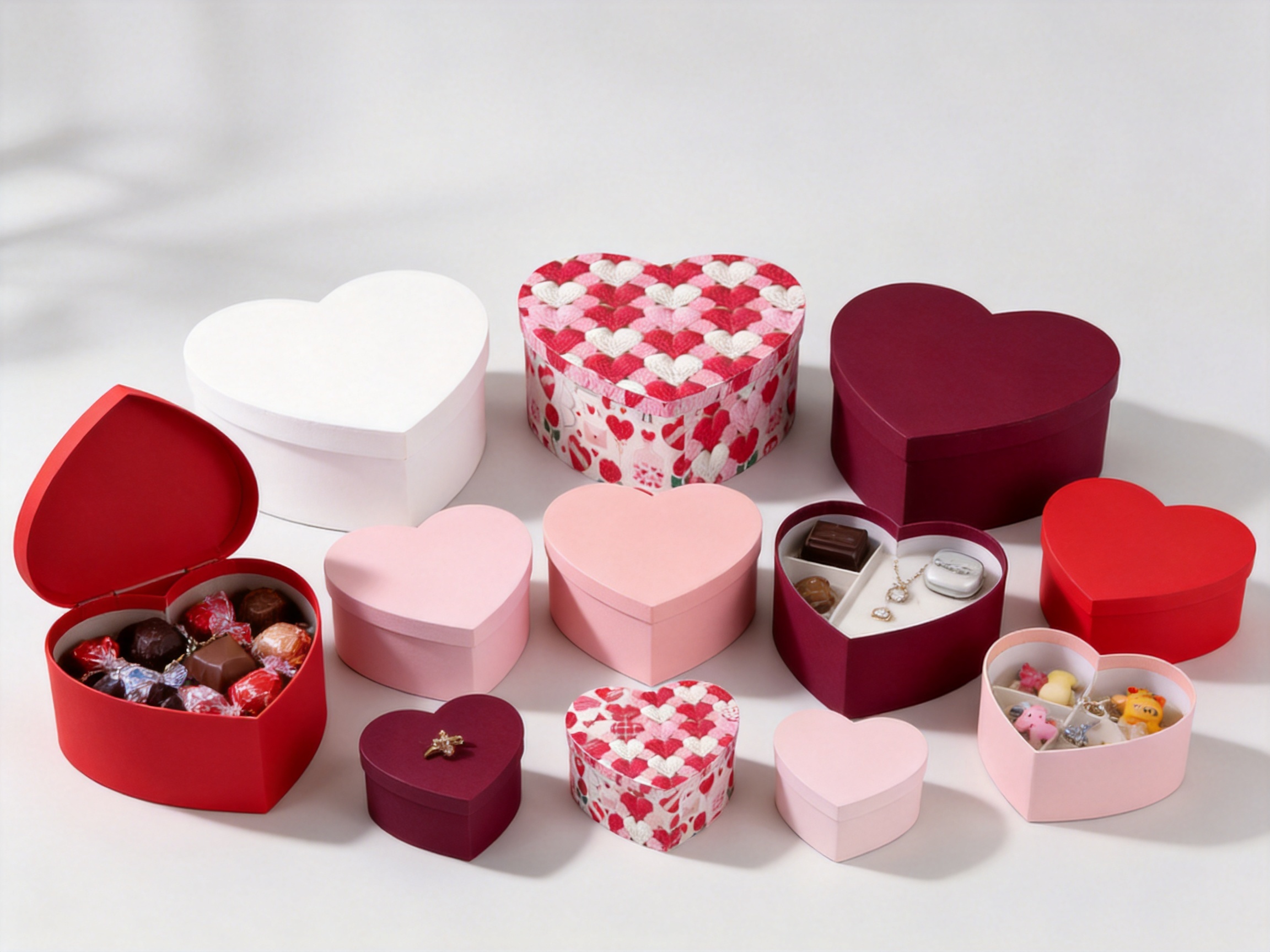
Color is one of the most visible customization elements. Customers can request colors that correspond to their logo, existing packaging range, seasonal campaign, or retail environment. A consistent color system helps consumers identify related products across different sizes and product categories.
Graphic customization may include logos, slogans, romantic messages, decorative patterns, illustrations, ingredient information, barcode areas, recycling marks, and handling instructions. The heart-shaped frame can be emphasized through contrasting color, line work, foil-style effects, or printed borders, subject to the selected production process and material specifications.
Retailers and wholesalers can use the 1001 box as the foundation for a private-label Valentine’s Day collection. By combining several sizes with coordinated graphics, a business can offer small, medium, and premium gift options under one brand. This helps create a more organized shelf presence and supports cross-selling between candy, flowers, greeting cards, jewelry, and other seasonal products.
Private-label packaging can also differentiate a retailer from competitors selling similar candy products. The contents may be comparable, but a memorable heart-shaped presentation can make the item easier to identify and more attractive as a ready-to-give present. This is especially useful when customers are shopping quickly for a gift and prefer packaging that already communicates the occasion.
Depending on the project, buyers may request adjustments related to size, closure, internal support, compartmentalization, or product arrangement. The available ten-size range provides a starting point, but the final design should be evaluated against the packed product’s dimensions and weight.
For confectionery, customers may need an internal divider, paper tray, or protective arrangement to prevent pieces from shifting. For jewelry, an insert can hold the item in place. For toys and accessories, an internal structure can improve presentation and reduce movement. Any internal component should be reviewed for compatibility with the intended contents and market requirements.
Sampling is an important stage before mass production. A physical sample allows the buyer to evaluate the heart shape, color, print quality, assembly method, fit, internal capacity, and overall appearance. It also gives the manufacturer an opportunity to identify potential production issues before the order is finalized.
Zhejiang Shihao Gift Packaging Co., Ltd. has specialized in paper gift packaging for more than 15 years. This experience is valuable for products that combine structural design, decorative printing, hand or semi-automated assembly, and seasonal delivery requirements. Long-term experience can help a manufacturer manage material selection, production scheduling, quality control, packaging, and export documentation more effectively.
The company’s product range includes kits, storage boxes, folding boxes, jewelry boxes, and gift boxes. This broader category experience supports the development of packaging for different product types and market segments. Knowledge gained from jewelry packaging, for example, may be relevant when developing internal protection for small gifts, while experience with folding boxes can support efficient structural solutions.
The manufacturer operates a facility of approximately 20,000 square meters and employs around 300 people. This scale provides dedicated resources for production, quality management, product development, order coordination, and export operations. For buyers, a structured organization can be important when managing customized packaging with multiple sizes, artwork versions, and delivery deadlines.
A workforce of this size also supports the production of varied packaging formats. Some gift boxes require precise folding, gluing, framing, surface finishing, or assembly. Having personnel with experience in paper packaging allows the company to handle both standardized products and customized projects according to agreed specifications.
The company reports an average daily production capacity of approximately 5,000 gift box sets. This capacity is relevant for seasonal programs, in which orders must often be completed before a fixed promotional date. Valentine’s Day campaigns have a relatively narrow selling window, so production planning and early confirmation are essential.
Capacity does not eliminate the need for advance scheduling. Customized artwork, sampling, material procurement, approvals, printing, assembly, inspection, and export packing all require time. Buyers should provide forecasts as early as possible, especially when several sizes or complex finishes are involved. Early planning helps reduce the risk of production congestion during the seasonal peak.
The company maintains its own design team and updates dozens of products weekly. This indicates an active product development approach rather than reliance solely on fixed catalog items. For customers, access to design support can be useful when adapting the heart-shaped box to new colors, themes, target markets, or product categories.
A manufacturer with in-house design resources can help identify practical relationships between appearance and production. For example, a design may look attractive on a screen but require adjustment to account for folding lines, frame alignment, print direction, closure points, or assembly tolerances. Early technical review can improve the likelihood that the final product matches the approved concept.
The company exports products to Europe, the United States, the Middle East, and other regions. International export experience can assist with order communication, packaging requirements, carton preparation, production documentation, and coordination with overseas buyers. It may also help the manufacturer understand the different expectations of importers, distributors, retail chains, and private-label customers.
International buyers should still confirm all product-specific requirements for their destination market. These may include material declarations, food-contact considerations, labeling, recycling marks, carton markings, pallet requirements, language requirements, and testing documentation. Clear communication at the beginning of a project helps prevent avoidable changes later.
The manufacturer has passed BSCI and FSC certifications. BSCI is associated with social compliance expectations in supply chains, while FSC relates to responsible forest-based material sourcing. These certifications can be relevant to buyers whose customers, retailers, or internal procurement policies require evidence of responsible manufacturing and material sourcing.
Certification status should be confirmed against the specific order, material, facility, and documentation required by the buyer. Different markets and customers may request different records. Nevertheless, the presence of recognized certification systems demonstrates that the manufacturer has established processes related to social responsibility and responsible paper sourcing.
Heart-shaped boxes require attention to details that may be less critical in simple rectangular formats. The two upper curves, central indentation, pointed lower section, frame alignment, folding accuracy, and surface appearance all influence the final presentation. Quality checks should confirm that the shape is symmetrical and that the assembled box maintains its intended form.
Other important inspection points include color consistency, print registration, edge condition, adhesive strength, structural stability, dimensional accuracy, and the fit between the lid and base where applicable. If the box is supplied as a kit requiring assembly, the buyer should also verify that the components are complete and that the assembly sequence is clear.
For candy applications, buyers should review the packaging configuration carefully. The box itself may be an outer gift package rather than a direct food-contact container. Individually wrapped candy, inner bags, trays, liners, or other suitable barriers may be necessary. The final configuration should meet the requirements of the contents and the destination market.
Seasonal packaging is often ordered in large quantities, making consistency essential. Differences in color, shape, dimensions, or finishing can affect shelf presentation and customer perception. A controlled production process, approved sample, standardized materials, and documented specifications can help maintain consistency across batches.
For orders containing multiple sizes, each size should be approved and identified separately. Artwork files, color references, structural drawings, carton information, and packing counts should be clearly documented. This reduces the possibility of mixing components or producing the wrong version during a complex seasonal project.
The strongest advantage of the 1001 box is its emotional differentiation. Generic boxes often depend on printed hearts or seasonal text to communicate romance. This product uses the physical shape of the package to deliver the same message. Structural symbolism can be more powerful because it remains visible from multiple angles and does not depend entirely on a specific printed language.
The heart silhouette also creates a more gift-like appearance. A conventional carton may look like a product container, while a decorative heart-shaped box can feel like part of the gift itself. This distinction is important for consumers who want a ready-to-present item rather than candy that still needs to be wrapped.
Competitor products may be available in only one or two standard sizes. The ten-size range provides more flexibility for assortment planning and reduces the need to force different products into the same package. It also supports multiple retail price levels, from compact promotional gifts to larger premium collections.
For wholesalers and distributors, a range of sizes can increase the number of potential customers. A small confectionery producer may need a compact box, while a large retailer may want several formats for a complete seasonal display. A single product family can therefore support different business models and market requirements.
Customization gives brands a way to achieve a more distinctive result than an off-the-shelf seasonal package. The ability to customize size and color is especially useful for companies that want to match existing brand standards or create exclusive seasonal designs. Customers can discuss further specifications, such as printing and internal arrangements, during the quotation and sampling stages.
Premium-looking packaging does not always need to be heavy, rigid, or expensive. Decorative cardboard can provide a visually attractive surface and useful structural support while remaining suitable for efficient handling. This balance may offer an advantage over packaging that is either too plain for gifting or unnecessarily heavy for the product inside.
The manufacturer’s experience, design team, production capacity, international export background, and certification systems provide additional advantages compared with suppliers that only trade standard packaging. A capable manufacturer can contribute to the complete process, from concept development and sampling to mass production and export packing.
Buyers should begin by identifying the contents, target market, sales channel, expected retail price, and planned quantity. The manufacturer needs to know whether the box will hold wrapped candy, boxed chocolates, jewelry, toys, or another product. Contents influence the required size, internal support, material specification, and handling precautions.
The ten available sizes provide a starting point for selection. Buyers should measure the packed product, not only the individual item. Allowance may be needed for inner bags, dividers, trays, tissue paper, or protective inserts. Overfilling can distort the box, while excessive empty space may reduce presentation quality.
Artwork should be supplied in the format requested by the manufacturer and should include the correct dimensions, bleed areas, print colors, logo proportions, and text. Color references should be approved before production. If the design includes multiple sizes, each version should be labeled clearly.
A sample should be checked for structure, appearance, size, fit, assembly, print quality, and overall suitability. If the box will be used for food-related products, the buyer should also verify the complete inner packaging arrangement. Changes should be completed before mass production approval.
The minimum order quantity is 500 sets. The stated outer packing information is approximately 64 × 34 × 45 centimeters, with six sets in cardboard boxes. Buyers should confirm whether the packing quantity refers to the final customized configuration, as changes in size, assembly, or product arrangement may affect carton packing.
Valentine’s Day orders should be planned well in advance because the selling season is time-sensitive. Production scheduling should account for sample approval, artwork confirmation, material preparation, printing, assembly, inspection, export packing, and transportation. Importers should also allow time for customs clearance and domestic distribution after arrival.
The box can be positioned as a ready-to-gift product, reducing the effort required from the consumer. Retailers may fill the box with a carefully selected candy assortment and display it alongside greeting cards, flowers, candles, or romantic accessories. The heart shape makes the product easy to identify as a Valentine’s Day gift even when displayed among many other items.
Using several sizes, a retailer can create a tiered collection. Small boxes may be labeled as token gifts or budget-friendly choices. Medium boxes can represent the main assortment, while larger formats can contain premium chocolates or combination gifts. Consistent colors and graphics help consumers understand that the products belong to one collection.
Distinctive shapes can perform well in online product photography because they are easy to recognize in thumbnails and search results. Photographs may show the box closed, open, filled, and displayed as part of a larger Valentine’s Day arrangement. The silhouette can help the product stand out from standard rectangular packages in digital catalogs.
Businesses can use customized heart-shaped boxes for employee appreciation, customer gifts, partner promotions, and event campaigns. Branding can be applied in a tasteful manner so that the package remains attractive while still communicating the organization’s identity. Small formats may be particularly suitable for large promotional programs.
Although the box is designed for decorative presentation, buyers should evaluate the final product according to its intended use. Candy should generally be protected by suitable inner packaging, especially when the cardboard includes decorative printing, coatings, or finishing. Buyers should also confirm whether the box is intended for direct food contact or for use as an external gift package.
Storage conditions should be considered as well. Paper packaging should be kept in a clean, dry environment away from excessive humidity, heat, and direct sunlight. Proper storage helps preserve the shape, color, surface quality, and assembly performance before the products reach the customer.
For export orders, shipping cartons should be reviewed for protection during transportation. The provided packing information offers a reference, but the final carton dimensions and quantities may change according to the selected size and customization. Buyers should request final packing details for freight calculations and warehouse planning.
When evaluating total cost, businesses should consider more than the unit price. Important factors include sampling, printing, customization, internal inserts, assembly, cartons, inspection, freight, import charges, and seasonal inventory risk. A package that creates stronger sales appeal may provide better overall value even if it costs more than a plain standard carton.
The main use is packaging for Valentine’s Day candy, chocolates, sweets, and romantic gifts. It can also be used for jewelry, toys, accessories, birthday gifts, anniversaries, wedding favors, and other small presents.
The product is made from decorative cardboard. The material provides a balance of visual appeal, light weight, structural support, and recycling potential. The exact board grade, finishing, and inner components should be confirmed for each customized project.
The product is available in ten sizes. The stated dimensions range from approximately 33 × 32.3 × 14 centimeters to approximately 11 × 10 × 5 centimeters. Buyers should select the size according to the dimensions and weight of the packed contents.
Yes. Color customization is available. Buyers can discuss brand colors, seasonal color schemes, printed artwork, and other visual requirements with the manufacturer during the development process.
The listed product family includes ten sizes, and customized dimensions may be discussed according to the project requirements. The manufacturer should review the product dimensions, expected quantity, internal arrangement, and structural needs before confirming a custom size.
The minimum order quantity is 500 sets. The final commercial terms should be confirmed with the manufacturer because customization, printing, size selection, and internal components may influence the quotation.
The box is described as decorative cardboard gift packaging. For candy and confectionery, the contents should be appropriately wrapped or placed in a suitable inner bag, tray, or liner unless the complete packaging configuration has been specifically approved for direct food contact. Buyers should confirm food-packaging requirements for their destination market.
Yes, smaller sizes may be suitable for jewelry and other compact accessories. A suitable internal insert may be needed to hold the item securely and improve presentation. The required insert should be discussed during sampling.
The heart-shaped frame provides stronger emotional and seasonal recognition. It communicates romance through the structure itself, creates a more distinctive shelf appearance, and supports a memorable gift-opening experience. Standard rectangular boxes may offer efficiency, but they generally do not provide the same symbolic presentation.
Cardboard is a paper-based material with recycling potential and is commonly selected for more sustainable packaging programs. Actual environmental performance depends on the complete package, including coatings, inks, adhesives, inserts, and local recycling infrastructure. Buyers should confirm the final material composition and certification documentation.
Yes. The manufacturer is an export-oriented company whose products are shipped to Europe, the United States, the Middle East, and other regions. Buyers should provide destination-market requirements early so that documentation, labeling, materials, and packing can be reviewed before production.
Sampling allows buyers to evaluate the heart shape, dimensions, color, printing, assembly, internal fit, and overall appearance before approving mass production. It is especially important when the product includes customized artwork, multiple sizes, inserts, or special finishing.
Yes. The heart-shaped design is suitable for birthdays, anniversaries, engagements, weddings, romantic events, appreciation gifts, and promotional campaigns. Changing the artwork and color can make the same structure appropriate for different occasions.
The 1001 Decorative Cardboard Valentine’s Day Heart-Shaped Candy Box combines symbolic design, practical cardboard construction, and flexible customization in one seasonal packaging solution. Its heart-shaped frame immediately communicates love and care, making it especially suitable for Valentine’s Day candy, chocolates, jewelry, toys, and other compact gifts.
The product offers several advantages over generic packaging options. Its distinctive shape improves emotional recognition, its decorative cardboard provides a balance of presentation and protection, and its ten available sizes support different products and price levels. Customizable colors and potential artwork adaptations allow retailers, wholesalers, confectionery brands, and private-label businesses to create packaging that is more closely aligned with their own market identity.
Behind the product is an experienced paper packaging manufacturer with more than 15 years of industry experience, a facility of approximately 20,000 square meters, a workforce of around 300 employees, an average daily capacity of about 5,000 gift box sets, and an in-house design team. Its BSCI and FSC certifications, export experience, and broad product range further support its ability to serve international packaging programs.
For the best result, buyers should begin with accurate product measurements, select the most appropriate size, define the desired color and artwork, review the complete inner packaging arrangement, approve samples, and schedule production well before the Valentine’s Day selling period. With careful planning, this heart-shaped box can transform ordinary candy into a more appealing, memorable, and commercially valuable gift experience.
1. Product specification and product description for Decorative Cardboard Valentine’s Day Heart-Shaped Candy Box, item 1001.
2. Company profile and manufacturing information supplied by Zhejiang Shihao Gift Packaging Co., Ltd.
3. General packaging design principles concerning shape recognition, seasonal merchandising, gift presentation, and consumer perception.
4. General paper packaging guidance concerning cardboard structure, recyclability, storage, transport, and customization.
5. General supply-chain references concerning FSC responsible material sourcing and BSCI social compliance practices.
Recommended Products

Contact Us

No. 15, Xiayang Road, Huangzhai Town, Jinhua, Zhejiang, China

(+86) 579-84230069

(+86) 13085675766


Products

Gift Box Packaging Manufacturer
 English
 Français
 Español
 عربى