2026-07-25
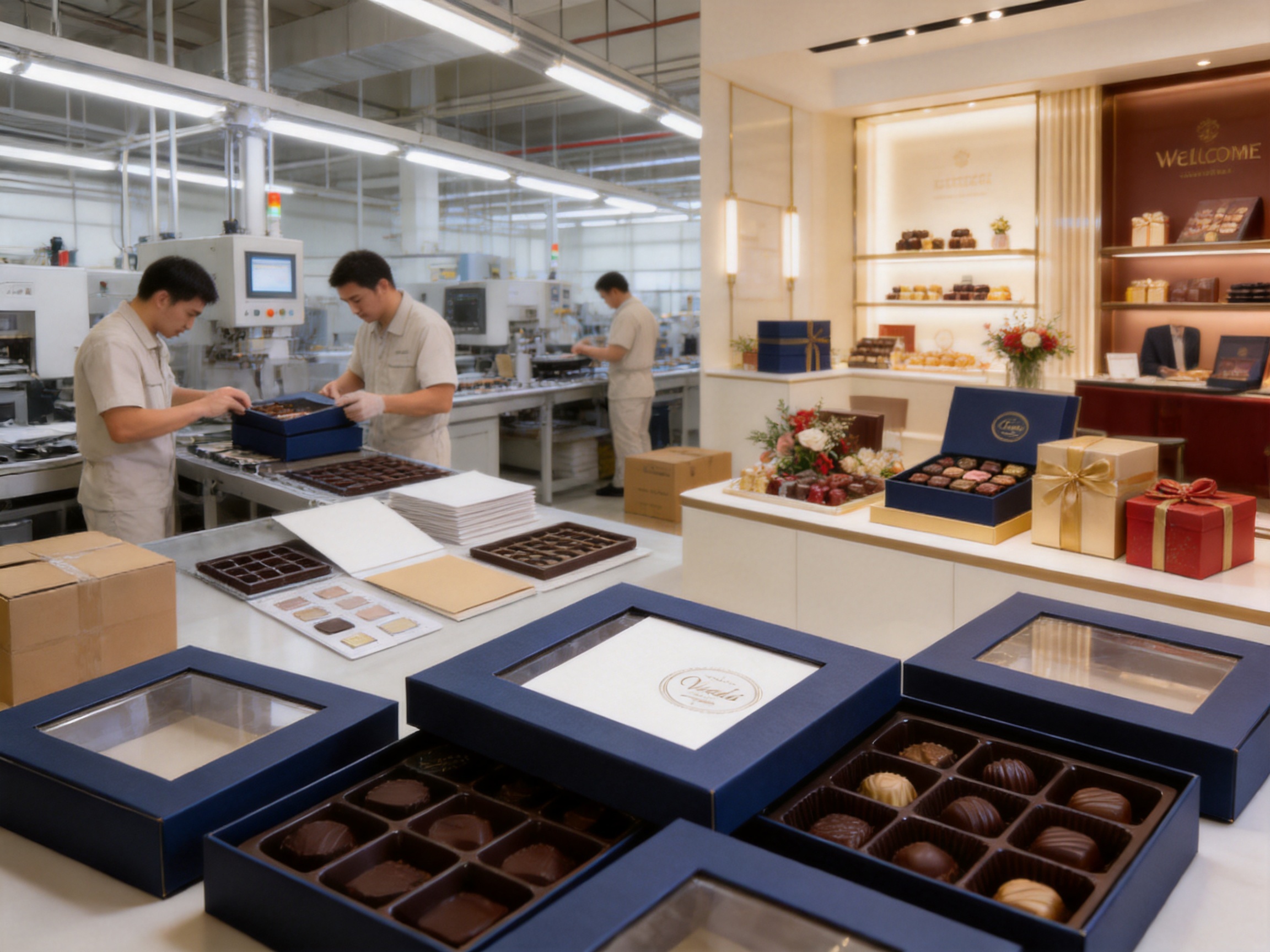
Chocolate packaging must accomplish far more than protecting a delicate product during storage and transportation. It must present the chocolates attractively, communicate quality at a glance, organize multiple flavors, and create a memorable opening experience for the recipient. The SH-08 Multi-Compartment Transparent-Lid Square Chocolate Gift Box is designed to meet these requirements through a combination of rigid construction, a refined deep blue appearance, a transparent display window, and a precisely fitted interior tray.
Designed for premium chocolates, dessert assortments, business gifts, holiday collections, and customized confectionery programs, this square gift box balances visual appeal with practical performance. Its transparent lid allows the product to become part of the packaging presentation, while the flip-top opening makes the box convenient to use. Inside, the custom multi-compartment insert keeps individually packaged chocolates separated and securely positioned.
The result is a packaging format that supports both product protection and brand storytelling. Rather than placing chocolates in a plain carton or an unorganized container, the SH-08 format presents each piece as part of a carefully arranged collection. This makes the box suitable for brands that want to emphasize craftsmanship, flavor variety, gifting value, and premium positioning.
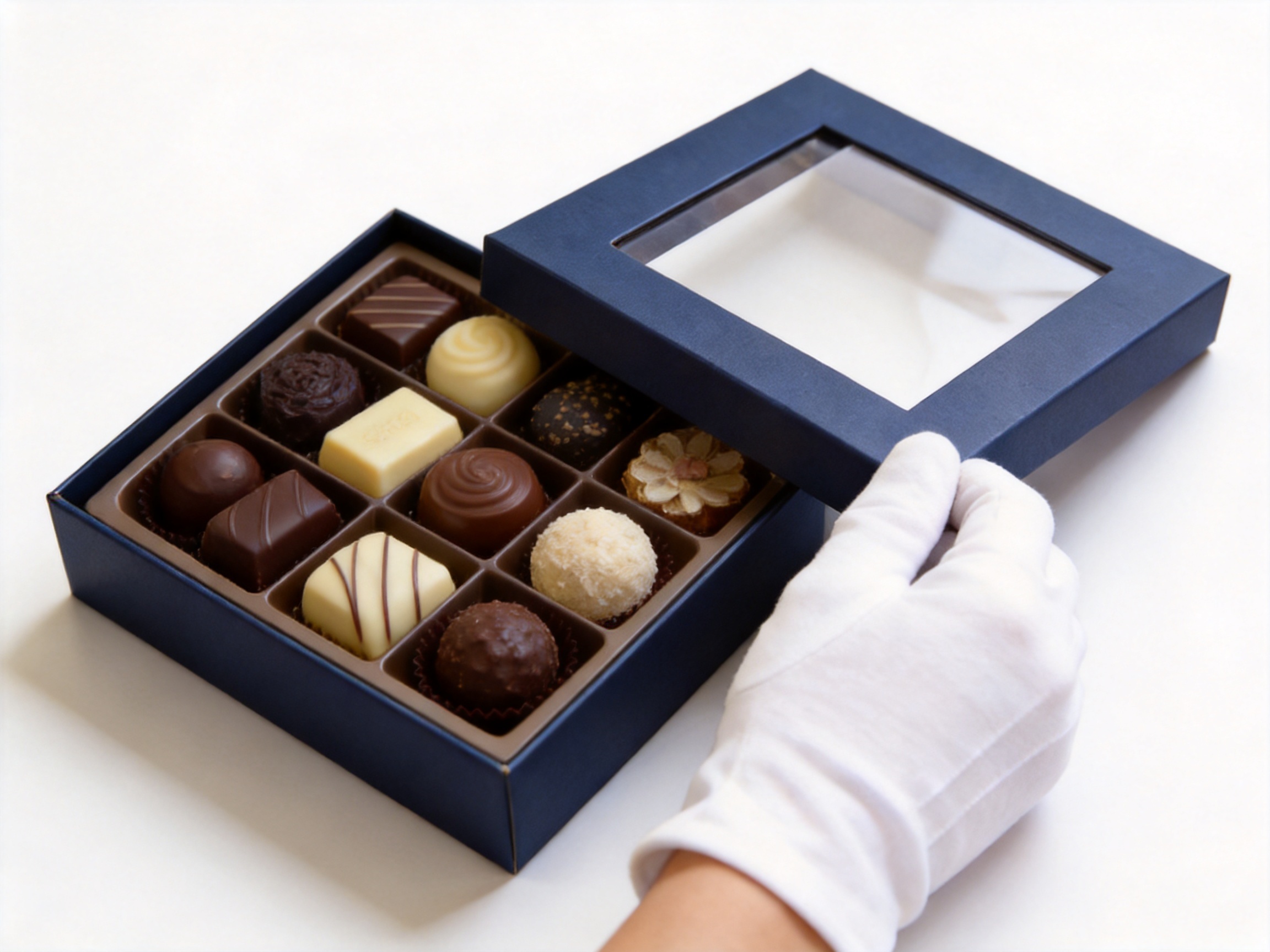
The SH-08 is a square chocolate gift box with a transparent viewing window integrated into the top lid. Its deep blue color scheme creates a sophisticated and understated appearance, while the clean surface and simple logo area provide room for customized branding. The design is especially suitable for chocolates that differ in color, shape, filling, or flavor because the transparent window allows the assortment to be seen without opening the package.
The box uses a top-and-bottom lid opening structure. The top lid functions as both a protective cover and a display panel. When closed, it helps preserve the contents and gives the package a finished appearance. When opened, it provides direct access to the chocolates while maintaining the familiar feel of a premium gift box.
The interior is equipped with a custom-made blister tray or compartment insert. Each cavity can be developed according to the dimensions and shape of the chocolate pieces. This arrangement prevents the chocolates from moving excessively inside the package and makes it easier for the recipient to identify and remove individual pieces.
Although the standard dimensions are approximately 18–22 centimeters in length, 12–16 centimeters in width, and 5–7 centimeters in height, the structure is customizable. The dimensions, number of compartments, insert layout, window size, printing, finishing, and internal clearance can be adjusted according to the product specification and the intended market.
| Item | Specification |
| Product model | SH-08 |
| Product type | Multi-compartment chocolate gift box |
| Shape | Square or customized rectangular format |
| Approximate dimensions | 18–22 cm × 12–16 cm × 5–7 cm |
| Opening method | Top-and-bottom lid opening with transparent window |
| Outer materials | Dark blue matte art paper and grey cardboard |
| Window material | PET transparent sheet |
| Interior structure | Custom-made blister tray or fitted compartment insert |
| Surface treatment | Matte lamination on the box body |
| Typical applications | Multi-flavor chocolates, desserts, business gifts, seasonal collections, and premium food packaging |
A transparent lid changes the role of the package from a simple container into a product display. In conventional closed boxes, the recipient must open the package before seeing the assortment. This can be appropriate for products that depend on surprise, but it does not take full advantage of chocolates with attractive colors, decorative toppings, varied shapes, or carefully arranged compositions.
The SH-08 transparent window gives the contents immediate visual presence. Customers, gift recipients, and purchasing managers can see the assortment before opening the box. This is particularly useful in retail environments, corporate gifting programs, hospitality applications, and seasonal displays where packaging must attract attention quickly.
Visibility also improves communication. When a box contains several flavors, the arrangement itself can suggest variety and abundance. A combination of dark, milk, and white chocolates, for example, can create a visually balanced presentation. Fruit-filled pieces, nut chocolates, truffles, pralines, and decorated squares can each contribute to the overall appearance of the gift set.
The transparent panel can also support product differentiation. A brand may use color-coded chocolates to represent different flavors, or arrange pieces in a specific sequence that matches a tasting guide. Because the box permits the contents to be viewed while closed, the package can communicate the character of the product without relying only on printed text.
Compared with packaging that hides the entire assortment, a display window may shorten the decision-making process for buyers. It helps answer basic questions immediately: What is inside? How many pieces are included? Are the chocolates arranged neatly? Does the assortment look appropriate for gifting? This practical transparency can improve perceived value and purchase confidence.
Color is one of the most influential visual elements in packaging. The deep blue surface used for the SH-08 design conveys stability, elegance, and restraint. It avoids the excessive brightness associated with mass-market novelty packaging and instead creates an atmosphere appropriate for premium confectionery.
The dark blue background also provides a strong contrast with colorful chocolate pieces visible through the transparent lid. This contrast helps the contents appear more vivid while allowing the printed logo and other graphic elements to remain clear. The effect is especially useful when the brand identity requires a professional, modern, or luxury-oriented appearance.
Matte lamination further supports the design direction. A matte surface reduces distracting reflections on the printed area and gives the box a soft, refined tactile quality. It can also help minimize the visibility of minor fingerprints during handling. For a gift box that may be passed between retailers, sales representatives, corporate buyers, and final recipients, this contributes to a more consistently presentable appearance.
The restrained design allows the box to serve different market segments. It can be customized with a simple logo for an understated brand presentation, or enhanced with additional graphics for seasonal campaigns. Gold, silver, white, metallic, or embossed details can be considered according to the required visual language, production method, and budget.
Compared with overly complicated packaging, a deep blue matte box may offer greater versatility. It can be used for Christmas assortments, wedding favors, corporate thank-you gifts, anniversary collections, luxury dessert sets, and premium retail launches without requiring a completely different structural concept for each campaign.

SH-08 Multi-Compartment Transparent-Lid Square Chocolate Gift Box
The structural foundation of the box is high-quality rigid cardboard combined with a wrapped outer layer of dark blue matte art paper. This construction gives the package greater stiffness than a lightweight folding carton. The rigid format is important for chocolate gifts because the package may be transported, stacked, displayed, carried by hand, or placed inside a larger shipping carton.
Rigid cardboard helps the box resist ordinary compression and deformation. It also gives the lid and base a more substantial feel when opened and closed. This tactile strength influences how customers evaluate the product. A box that feels stable and carefully made can reinforce the impression that the chocolates inside are equally well considered.
The external paper covering provides the printable surface, while the grey cardboard gives the package its core structure. This layered construction allows the manufacturer to combine appearance and strength without making the box excessively complicated. The materials can be processed to create clean edges, accurate corners, and a smooth surface suitable for premium presentation.
Protection does not depend only on the outer wall. The internal tray plays an equally important role. By holding individual chocolate pieces in their own compartments, the insert reduces lateral movement and helps prevent pieces from colliding with one another. This is valuable when the chocolates have delicate decorations, dusted surfaces, thin coatings, or irregular toppings.
The appropriate level of protection depends on chocolate dimensions, wrapper style, filling, transport conditions, and the required shelf life. For this reason, the internal structure should be developed using actual product samples whenever possible. A customized compartment design can provide better results than a generic insert because the cavity depth, width, spacing, and clearance are matched to the finished pieces.
The insert is one of the most important advantages of the SH-08 format. A multi-compartment tray converts the interior into an organized presentation system. Each chocolate has an allocated position, which helps maintain the original arrangement from packing through delivery and final opening.
Compartment design can be adapted to the number of pieces in the collection. The box may hold a compact assortment of premium truffles or a larger series of bite-size chocolates. The layout may use rows, grids, alternating shapes, or a central feature arrangement. The final configuration depends on the product size and the desired visual balance beneath the transparent lid.
A fitted insert also improves operational efficiency. During packing, workers can place each piece in a clearly defined cavity. This reduces the possibility of confusing different products or creating an uneven presentation. For collections that include flavor labels, fillings, or color sequences, a standardized layout can support consistent packing procedures.
From the consumer’s perspective, compartmentalization creates order. It makes the assortment easier to understand and can encourage a gradual tasting experience. Each piece remains visually distinct, and the recipient can remove one chocolate without disturbing the others. This is especially useful for premium gift sets intended to be enjoyed over several occasions.
The insert may be developed as a custom blister tray or another fitted lining solution according to the product requirements. Material selection should consider food-contact suitability, dimensional stability, visual appearance, and compatibility with the chocolate’s primary wrapping. If the chocolate is directly exposed to the insert, the packaging specification must be reviewed carefully to ensure the appropriate barrier and compliance requirements are addressed.
In comparison with a loose-fill interior or a single open cavity, a custom insert gives the product a more controlled and premium appearance. It can reduce empty space, make the number of pieces easier to understand, and support a consistent arrangement across production batches.
The flip-top opening is another defining feature of the design. It makes the box easy to open while preserving the visual continuity of the lid. A hinged or connected top structure can be more convenient than a fully removable cover, particularly when the box is used repeatedly or when the recipient wants to close it after taking one or two chocolates.
The opening experience contributes directly to perceived product quality. The recipient sees the deep blue exterior, lifts the top, and discovers an organized chocolate assortment beneath the viewing panel. This sequence creates a simple but effective unboxing moment. The package feels deliberate rather than disposable, which can strengthen the emotional value of the gift.
The lid must be designed with appropriate tolerances. It should close securely without crushing the contents or placing excessive pressure on the internal tray. At the same time, it should open smoothly and remain visually aligned with the base. Accurate cutting, scoring, folding, wrapping, and assembly are therefore essential to the finished result.
The top-and-bottom lid construction can also support storage after opening. If the box contains chocolates intended for gradual consumption, the recipient may close the lid between uses. The transparent window continues to show the remaining pieces, while the rigid structure helps the box retain its shape.
The quality of a premium gift box depends on the coordination of multiple production stages. The SH-08 design combines printed paper, grey cardboard, PET window material, precision cutting, surface finishing, structural forming, insert production, and final assembly. Each stage contributes to the appearance and function of the finished package.
Production begins with the selection and preparation of the outer art paper, grey cardboard, and PET window sheet. The paper must have a suitable surface for printing and lamination. Its color consistency, coating condition, and moisture stability influence the appearance of the finished box.
The grey cardboard must provide the required thickness and rigidity. Its specification affects wall strength, edge quality, lid performance, and overall weight. Material preparation may include cutting sheets to production size, checking for surface defects, and organizing the materials according to the production order.
The PET sheet used for the window must be sufficiently clear for product viewing and compatible with the cutting and attachment process. Its thickness should balance transparency, flexibility, and resistance to ordinary handling. The window area must remain clean during assembly so that dust, adhesive marks, and scratches do not interfere with display quality.
The deep blue design is applied to the outer art paper using the selected printing process. Color management is important because large dark areas can reveal inconsistencies more easily than small graphic elements. Sample approval and production monitoring help maintain uniformity between batches.
Brand logos, product names, flavor information, seasonal graphics, regulatory text, and other printed elements can be incorporated into the artwork. The design should consider the location of the transparent window, folding lines, edges, and areas that will be covered during wrapping. Proper prepress preparation prevents important information from being hidden or distorted.
After printing, matte lamination is applied to the box body. Lamination helps protect the printed surface from ordinary scuffing and gives the package a consistent tactile finish. It can also improve the visual depth of the deep blue color by reducing unwanted gloss. The lamination process must be controlled to avoid bubbles, wrinkles, silvering, or uneven adhesion.
Rigid cardboard components and printed paper coverings are cut according to the structural design. Accuracy is essential because small dimensional errors can affect the alignment of the lid, the fit of the base, and the position of the transparent window.
The transparent window requires particular attention. The opening in the lid must be cut cleanly, with smooth edges and accurate corner geometry. The PET sheet must be sized to cover the opening properly while remaining flat and securely attached. Any misalignment can be immediately visible because the window is a prominent feature of the package.
Precision cutting also affects the interior tray. The cavities must correspond closely to the planned chocolate dimensions. If the compartments are too tight, the chocolates may be difficult to insert or remove. If they are too loose, the pieces may shift during handling. Prototyping and sample testing help establish the correct balance.
After cutting, the grey cardboard components are formed into the base, lid, and related structural parts. The printed art paper is then wrapped around the cardboard to create the finished exterior. The process requires controlled adhesive application, accurate positioning, and careful pressing around corners and edges.
Clean corners are particularly important for premium packaging. Uneven wrapping, exposed cardboard, excessive adhesive, or lifted edges can reduce the perceived quality even when the overall structure is strong. Experienced operators and suitable equipment help maintain consistency across large production runs.
The lid and base are assembled so that the opening movement is smooth and the transparent window remains correctly positioned. The hinge area must be sufficiently secure for repeated opening while maintaining the intended appearance. The final structure is checked for squareness, alignment, lid closure, and surface condition.
The custom blister tray or interior insert is produced according to the approved layout. Its dimensions must be coordinated with the inner dimensions of the rigid box. The tray should sit securely without excessive movement, but it should also be removable or serviceable if the packaging program requires it.
Assembly staff place the insert into the box and verify its orientation. The finished chocolate samples are then used to test each cavity. This step confirms that the products fit correctly, remain visible through the window, and do not interfere with the lid.
For commercial production, assembly procedures can include instructions for cavity sequence, product orientation, protective films, separators, and final inspection. Standardized procedures are useful when the gift set includes many flavors or when several packaging lines are working on the same order.
Finished boxes are inspected for printing accuracy, color consistency, matte surface quality, corner condition, window clarity, lid operation, insert fit, and general cleanliness. Samples may also be checked for dimensional accuracy and resistance to ordinary handling.
Quality control is especially important for transparent-lid packaging because visual defects are easy to notice. Scratches on the PET, adhesive residue near the window, dust under the transparent panel, or a crooked insert can affect the appearance of the entire gift set. Inspection before shipping reduces the likelihood of avoidable presentation problems at the customer’s facility.
After inspection, the boxes are packed in a manner that limits compression, abrasion, and moisture exposure during storage and transportation. Protective cartons and appropriate internal spacing help preserve the rigid structure until the packaging reaches the chocolate manufacturer, retailer, or final distribution point.
Zhejiang Shihao Gift Packaging Co., Ltd. is an export-oriented manufacturer specializing in paper gift packaging. The company has more than 15 years of experience in production, research and development, and sales. Its facilities cover approximately 20,000 square meters and employ around 300 people.
This manufacturing scale supports the production of different packaging categories, including gift boxes, folding boxes, jewelry boxes, storage boxes, kits, and other paper products. The breadth of its product range allows the company to apply experience from multiple packaging applications to chocolate box development.
The company reports an average daily production capacity of approximately 5,000 sets of gift boxes. This capacity is valuable for brands that require reliable output for seasonal launches, retail programs, promotional campaigns, or export orders. Large-scale production capability can also help maintain continuity when a packaging design moves from sampling to regular manufacturing.
An internal design team supports product development and customization. The team updates numerous products weekly and can help adapt packaging structures to different markets. For the SH-08 box, customization may include dimensions, compartment layouts, artwork, finishing options, window proportions, and packaging configurations.
Research and development capability is important because gift packaging is not simply a matter of reproducing a standard carton. The manufacturer must consider the relationship between the chocolate size, insert geometry, lid clearance, window position, material thickness, printing area, and shipping requirements. A design team that understands these interactions can help reduce trial-and-error during development.
The company has passed BSCI and FSC certifications according to the supplied company information. BSCI relates to social compliance and responsible business practices, while FSC certification is associated with responsible forest-based material sourcing within the applicable certified supply chain. Buyers should confirm the current scope and documentation relevant to each order and material specification.
A fully enclosed box conceals the chocolate assortment until the moment of opening. The SH-08 transparent window allows the contents to contribute to the package’s visual impact before opening. This can be beneficial in retail displays and gift-giving situations where the appearance of the product influences purchase decisions.
A custom multi-compartment insert offers more control than a loose interior. Chocolates remain separated, and each piece has a defined location. This improves presentation and reduces the risk of products becoming mixed or damaged through unnecessary movement.
Rigid cardboard provides a substantial feel that is generally associated with higher-value packaging. The sturdy base, structured lid, and matte surface create a more refined experience than a thin folding carton designed primarily for low-cost distribution.
The dark blue surface supports understated luxury but can also be customized for different campaigns. The design can accommodate simple logo placement, seasonal artwork, flavor information, or market-specific graphics. This flexibility allows a single structural concept to support several product lines.
The flip-top structure is easy to open and can be closed again after use. This is useful when the chocolates are intended to be consumed gradually. A removable lid may be suitable for some products, but a connected flip-top can offer more convenience in repeated use.
The packaging is appropriate for holiday gifts, business gifts, premium desserts, seasonal chocolate assortments, and special events. Its visual neutrality allows the same basic structure to be adapted to different occasions through artwork, ribbon accessories, inserts, or printed messages.
Customization begins with the dimensions. The box can be adjusted to the number and size of chocolate pieces, provided that the new dimensions remain structurally practical. A shallow box may be appropriate for flat pralines, while a deeper format may be needed for tall truffles or individually wrapped products.
The compartment layout can be developed around the flavor strategy. Equal-sized cavities are suitable for uniform chocolate pieces. Mixed-size cavities can be used for collections containing bars, truffles, filled squares, or signature pieces. A central cavity may be enlarged for a special product while smaller cavities surround it.
Graphics can include a logo, product name, flavor descriptions, ingredient information, serving suggestions, brand story, or seasonal message. The transparent window should remain visually clear, so printed elements are best positioned around the viewing area or on selected interior and exterior panels.
Surface finishes may include matte lamination as a standard direction, with other options considered according to the required appearance. Foil stamping, embossing, spot effects, textured papers, or special color treatments may be evaluated during sampling. Each added process should be assessed for compatibility with the material, production quantity, cost, and delivery schedule.
Additional accessories may include paper sleeves, ribbons, stickers, cards, tasting guides, flavor labels, or protective outer cartons. These elements can make the same box suitable for corporate gifting, retail collections, subscription programs, and limited-edition releases.
The SH-08 format is particularly suitable for assortments containing several flavors. The transparent lid provides an immediate view of the variety, while the insert maintains separation. A printed flavor map can be added to help recipients understand the tasting sequence or identify specific fillings.
Truffles often have delicate coatings and decorative finishes. Individual cavities help protect their surfaces and preserve the arrangement. The deep blue exterior provides a contrasting backdrop that can make dusted, glazed, or decorated truffles appear more distinctive.
Premium chocolates are frequently used as business gifts, client appreciation items, employee rewards, and event packages. The restrained appearance of the SH-08 box is suitable for professional environments. Customized logos and messages can be incorporated without making the design appear excessively promotional.
Holiday collections benefit from packaging that combines gift appeal with clear product presentation. The basic deep blue structure can be adapted with seasonal artwork, metallic details, printed greetings, or themed inserts. This allows a confectionery brand to create limited-edition packaging while retaining a proven structural format.
High-end hotels, restaurants, and catering companies may use chocolate gift boxes for welcome amenities, event favors, room upgrades, or special celebrations. The rigid construction gives the package a formal appearance, while the custom insert supports clean product presentation.
The box can also be considered for selected dessert products when the dimensions and food-contact specifications are appropriate. Small confectionery assortments, praline collections, coated nuts, and other individually protected treats may be presented using a similar structure.
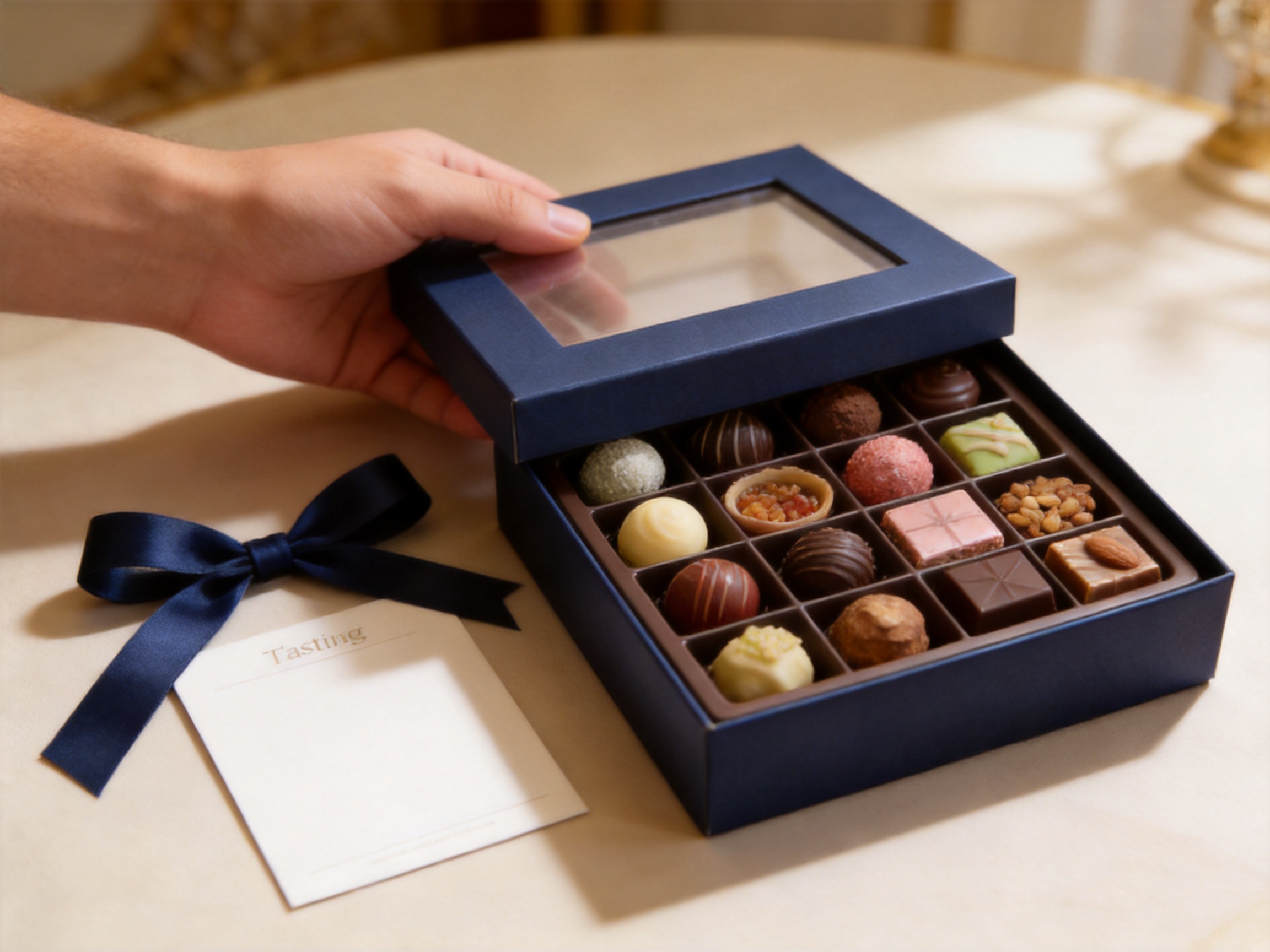
Before mass production, the product dimensions should be confirmed using the actual chocolate pieces and their primary packaging. Even small differences in wrapper thickness or product height can affect the insert and lid clearance. A physical prototype is recommended to test the complete assembly.
The transparent window should be positioned to show the most attractive portion of the assortment. If the chocolates are arranged in rows, the window should provide a balanced view without hiding the outer pieces. If the assortment includes a central feature, the opening may be designed to emphasize it.
Internal clearance must be managed carefully. The lid should not touch the chocolate or press against raised decorations. At the same time, excessive empty space may allow movement and reduce the visual impression of fullness. The insert and lid should be developed as one integrated system.
Weight is another consideration. Rigid packaging is intentionally more substantial than a folding carton, but the final weight affects shipping costs and handling. The appropriate board thickness should balance durability, premium feel, and logistics efficiency.
Stacking and outer-carton packing should be evaluated for export orders. The box should be protected from compression and abrasion while in transit. The manufacturer and buyer can review the number of units per shipping carton, carton dimensions, protective materials, and pallet arrangement as part of the order planning process.
Food packaging compliance must also be considered. The chocolate’s primary contact layer, the interior tray, adhesives, printing inks, and any coatings should be reviewed according to the destination market and intended use. The exact compliance documentation depends on the materials and sales region.
Premium packaging must increasingly address environmental considerations as well as appearance and performance. The SH-08 design uses paper-based rigid board and an art paper exterior, which can support responsible material planning when appropriate paper sources and production practices are selected.
The reported FSC certification is relevant to buyers seeking responsibly sourced forest-based materials. However, certification details should be verified for the specific materials and order. Buyers may request documentation, chain-of-custody information, and material specifications during the procurement process.
Material efficiency can be improved through accurate structural design. A box that fits the chocolates closely may reduce unnecessary empty space and limit the amount of material used for each unit. At the same time, the package must remain strong enough to protect the product. Reducing material without considering damage risk may create greater waste through rejected or damaged goods.
The box may also have a second-use value. Because the rigid structure and flip-top opening create a durable container, recipients may reuse it for small personal items, stationery, keepsakes, or additional treats. Reuse can extend the useful life of the packaging beyond the original chocolate product.
Sustainable development should be considered as a complete system. Paper selection, PET usage, printing, adhesive choice, production yield, shipping efficiency, recyclability, and consumer disposal instructions all contribute to the environmental profile. A packaging supplier with design and manufacturing capabilities can help evaluate these factors together rather than treating them separately.
Consistent quality begins with approved specifications. The buyer and manufacturer should confirm the final dimensions, materials, color references, printing artwork, window size, insert layout, closure behavior, and packing requirements before production begins.
During printing, color samples should be compared with the approved reference. Deep blue surfaces can vary depending on paper characteristics, ink coverage, drying conditions, and finishing. A controlled approval process helps reduce differences between the approved sample and the production batch.
Structural inspection should examine the squareness of the base, the alignment of the lid, the quality of wrapped edges, and the strength of the hinge area. The box should open and close without excessive resistance, looseness, or deformation.
The window should be checked for clarity and cleanliness. It should be securely attached, free from visible creases, and properly aligned with the cut opening. Because the window is central to the product concept, its quality should receive particular attention.
The insert should be tested with real chocolate samples. Inspectors can check whether each piece fits correctly, whether the cavities maintain the intended arrangement, and whether the lid closes without contact. These tests are more reliable than inspecting the empty package alone.
Final inspection may include visual checks, random dimensional measurements, closure tests, surface checks, and carton-packing verification. The exact inspection plan can be agreed according to order quantity, product sensitivity, destination market, and customer quality standards.
A typical project begins with a product brief. The buyer provides information about the chocolate dimensions, number of pieces, individual wrapping, target market, preferred style, expected quantity, and delivery requirements. Product images or physical samples can help the manufacturer understand the desired appearance.
The manufacturer then evaluates the structural concept and proposes suitable dimensions, materials, and insert arrangements. If the buyer already has artwork, the design team can review how it will fit around the window, edges, lid, and base. If artwork is not available, a customized visual direction can be developed.
Sampling is an important stage. A prototype allows the buyer to assess the tactile quality, lid movement, window appearance, insert fit, and overall proportion. It also provides an opportunity to identify practical improvements before tooling and mass production.
After sample approval, the production specification should be documented. It may include material thickness, paper type, color references, finishing, window material, insert dimensions, tolerance requirements, packing method, and inspection criteria.
Mass production can then proceed through the manufacturer’s coordinated printing, cutting, forming, wrapping, window assembly, insert production, inspection, and packing processes. Communication at each stage helps keep the final result aligned with the approved sample.
The SH-08 is suitable for individually packaged or individually protected chocolates, including assorted pralines, truffles, filled chocolates, chocolate squares, and other confectionery products that can be placed securely into the custom compartments. The final insert should be developed using actual product samples.
Yes. The internal tray can be designed according to the number, shape, and dimensions of the chocolate pieces. Equal-size compartments, mixed-size cavities, and special layouts can be considered during the sampling stage.
The standard design uses a sophisticated deep blue appearance, but the printed exterior can be customized. Buyers can discuss alternative colors, seasonal graphics, logo treatments, and finishing options according to the desired market positioning.
The supplied specification identifies PET as the material for the transparent lid window. The exact thickness and processing details should be confirmed according to the final design and destination-market requirements.
Yes. The approximate standard dimensions are 18–22 centimeters in length, 12–16 centimeters in width, and 5–7 centimeters in height, but the format is customizable. Dimensional changes should be assessed together with board thickness, insert design, lid clearance, and shipping requirements.
The transparent lid forms part of the rigid outer package and helps protect the contents from ordinary handling. Product protection also depends on the primary chocolate wrapping, insert fit, box structure, shipping carton, and transport conditions. Testing with the actual product is recommended.
Yes. Its deep blue matte appearance, organized interior, and customizable logo area make it suitable for business gifts, client appreciation packages, employee rewards, and event-related chocolate assortments.
The rigid structure and flip-top opening may allow the recipient to reuse the box for small items or additional treats. Reuse depends on the condition of the package after opening and the user’s preferences.
Useful information includes the chocolate dimensions, number of pieces, individual wrapping details, desired box size, insert layout, artwork, material preferences, quantity, destination market, delivery schedule, and any required certifications or compliance documents.
Sampling verifies the relationship between the chocolate pieces, insert, lid, window, and outer structure. It can reveal problems with fit, clearance, alignment, color, closure, or appearance before mass production begins.
Zhejiang Shihao Gift Packaging Co., Ltd. has more than 15 years of experience in paper gift packaging and operates a facility of approximately 20,000 square meters with around 300 employees. The company also reports advanced equipment, design and research capabilities, and an average daily production capacity of approximately 5,000 gift box sets.
The company is described as export-oriented, with products shipped to Europe, the United States, the Middle East, and other regions. Buyers should confirm current export arrangements, documentation, shipping terms, and market-specific requirements for each project.
The SH-08 design addresses several common weaknesses found in ordinary chocolate packaging. It does not force the buyer to choose between visibility and protection, because the PET window provides product display while the rigid structure and internal insert offer organization and support.
It also avoids the visual disorder that can occur when chocolates are placed in a single cavity or loosely packed tray. Each compartment contributes to a deliberate presentation. This arrangement can make a modest assortment look more considered and can help a larger collection appear orderly rather than crowded.
The box is also practical for customization. The deep blue exterior establishes a refined base, but the structure can be adapted through dimensions, printing, finishing, insert design, and accessories. This makes it useful for brands that need a premium appearance without developing an entirely new box structure for every campaign.
Manufacturing capability is equally important. The quality of a transparent-lid rigid box depends on precise cutting, clean wrapping, reliable window attachment, accurate insert production, and careful inspection. A supplier with experience in these processes can support a smoother transition from concept to finished packaging.
For chocolate producers, importers, retailers, hotels, corporate buyers, and gift-product distributors, the SH-08 offers a balanced combination of presentation, protection, convenience, and customization. It is especially well suited to products whose colors, shapes, and flavor variety deserve to be seen before the box is opened.
The SH-08 Multi-Compartment Transparent-Lid Square Chocolate Gift Box is a premium packaging solution designed around the complete gifting experience. Its transparent lid displays the chocolate assortment, its deep blue matte exterior creates a sophisticated visual identity, and its rigid cardboard construction provides a substantial and protective structure.
The custom multi-compartment insert is central to the product’s performance. It keeps individual chocolates separated, supports a consistent arrangement, and improves the presentation of multi-flavor collections. The flip-top opening adds convenience and allows the package to be closed again after opening.
Compared with conventional closed cartons, loose-fill boxes, or generic single-cavity containers, this design offers stronger visual communication and more controlled product organization. It can be customized for different chocolate sizes, seasonal themes, business applications, and market requirements.
Behind the product is a manufacturer with more than 15 years of paper gift packaging experience, a sizeable production facility, an internal design team, reported daily output of approximately 5,000 gift box sets, and experience serving export markets. Its capabilities in material preparation, printing, matte lamination, precision cutting, PET window assembly, rigid box forming, insert production, and quality inspection support the requirements of premium packaging projects.
For brands seeking a memorable presentation for chocolates and other high-value confectionery products, this packaging format provides a practical foundation for customization. It turns the box into part of the product experience, helping the assortment remain protected, organized, visible, and ready to make a strong impression.
1. Product specification sheet for the SH-08 Multi-Compartment Transparent-Lid Square Chocolate Gift Box.
2. Supplied company profile of Zhejiang Shihao Gift Packaging Co., Ltd.
3. General packaging engineering principles for rigid paperboard gift boxes and fitted confectionery inserts.
4. General guidance on packaging quality control, sampling, dimensional verification, and transport preparation.
5. General information concerning FSC-certified forest-based materials and responsible packaging supply chains.
Recommended Products

Contact Us

No. 15, Xiayang Road, Huangzhai Town, Jinhua, Zhejiang, China

(+86) 579-84230069

(+86) 13085675766


Products

Gift Box Packaging Manufacturer
 English
 Français
 Español
 عربى