2026-08-22
Packaging is often the first part of a gift that a customer, guest, or recipient experiences. Before the box is opened, its shape, color, materials, and decorative details already communicate quality, care, and occasion. The 80101 Round Transparent Window Candy Gift Box is designed to make that first impression memorable. Combining a distinctive round silhouette, a transparent viewing window, a decorative ribbon bow, and convenient rope handles, it offers a balanced solution for presenting candy, flowers, cosmetics, jewelry, and other small items.
Unlike ordinary rectangular cartons that conceal their contents until opening, this gift box creates immediate visual interest. The transparent window gives the recipient a preview of the carefully selected contents while preserving the anticipation of the unboxing experience. The ribbon bow adds a refined decorative feature, while the cardboard structure provides a practical balance between strength, appearance, and sustainability.
For retailers, event planners, confectionery brands, florists, gift shops, and importers, the product can serve as both a packaging container and a marketing tool. A well-designed package can help products stand out on shelves, improve gift presentation, support seasonal campaigns, and reinforce a premium brand image. The 80101 model is particularly suitable for applications where appearance and convenience must work together.
Manufactured by Zhejiang Shihao Gift Packaging Co., Ltd., an export-oriented paper packaging producer with more than 15 years of experience, the product benefits from organized production capabilities, dedicated research and development resources, and experience serving international markets. The company operates across approximately 20,000 square meters, employs around 300 people, and has an average daily production capacity of about 5,000 sets of gift boxes. These capabilities support both regular wholesale supply and customized packaging projects.
The 80101 Round Transparent Window Candy Gift Box is a decorative paperboard box created for attractive presentation and practical carrying. Its round form differentiates it from conventional square or rectangular candy boxes. The lid incorporates a transparent circular window, allowing the contents to remain visible without requiring the recipient to open the package. The exterior is finished with a ribbon bow, and rope handles make the box easier to transport.
Although the product is categorized as a candy gift box, its use is not limited to confectionery. Its structure and presentation style make it suitable for flower packaging, party favors, small beauty products, jewelry, accessories, keepsakes, and general organization. The design can be used for birthdays, weddings, holidays, retail promotions, corporate gifting, festivals, and other occasions that call for an attractive presentation.
The box is available in several color options, including passionate red, serene blue, understated gray, and soft pink. This range allows buyers to coordinate packaging with a brand identity, seasonal theme, event color scheme, or product category. Custom sizing is also available, enabling customers to request dimensions that are better suited to their contents or sales channels.
| Product Feature | Specification or Benefit |
|---|---|
| Product number | 80101 |
| Product type | Round transparent window candy gift box |
| Primary material | Cardboard and paper-based packaging materials |
| Product size | 14 x 14 x 11.5 cm |
| Quantity per carton | 96 pieces |
| Carton measurement | 87 x 59 x 49 cm |
| Gross/net weight | 11.5 kg / 10 kg |
| Decorative details | Ribbon bow and transparent round window |
| Carrying feature | Rope handles |
| Color availability | Red, blue, gray, pink, and other options |
| Customization | Custom sizes and packaging solutions available |
The stated dimensions of 14 x 14 x 11.5 centimeters provide a compact yet useful format for small gifts. The 96-piece carton quantity is convenient for wholesale distribution, retail replenishment, event orders, and packaging programs that require consistent stock. Buyers can use the carton information to estimate warehouse space, transportation requirements, and inventory planning.
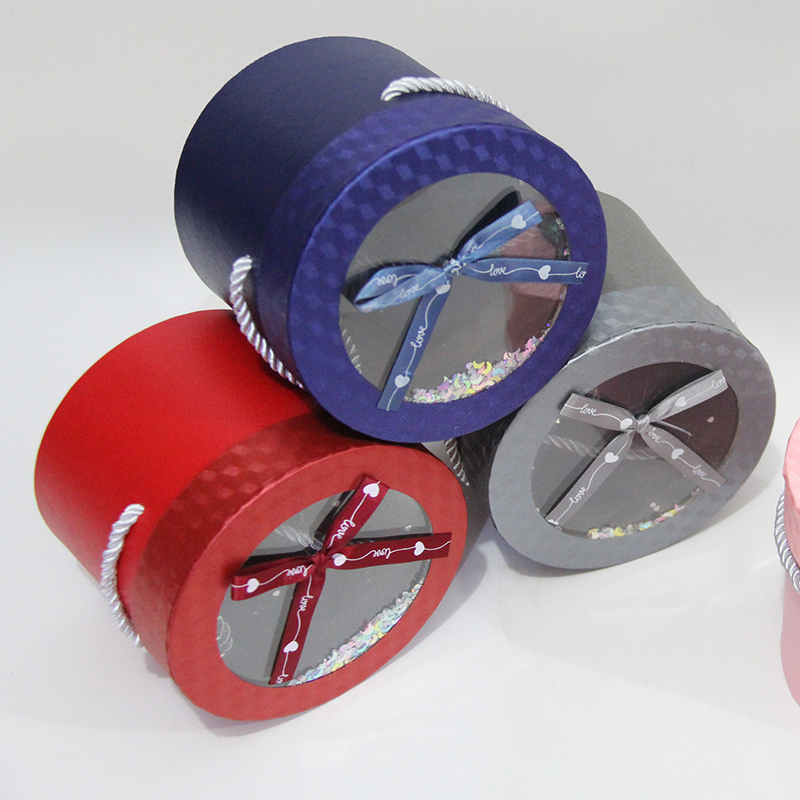
80101 Round Transparent Window Candy Gift Box Decorated With A Ribbon Bow
The primary visual advantage of the 80101 model is its transparent window. A package that displays its contents can attract attention more quickly than a fully closed box, especially in retail environments. Candy colors, floral arrangements, and carefully assembled gift sets become part of the package design rather than remaining hidden inside.
The window also allows a seller to communicate product quality before purchase. Customers can see the arrangement, color, and approximate quantity of the contents without opening the box. This is particularly useful for confectionery products, where appearance is an important part of perceived freshness and value. A transparent window can also reduce uncertainty for buyers selecting gifts for others.
For florists and flower retailers, the window can highlight a small arrangement, preserved flower, artificial flower, or compact bouquet. The round form creates a softer visual effect than a standard rectangular flower carton. When the ribbon bow is coordinated with the flowers, the complete package can appear ready for presentation immediately after purchase.
The decorative ribbon bow contributes another layer of visual distinction. A bow can communicate celebration, generosity, and refinement without requiring additional wrapping paper. Depending on the selected color and material, it can support different market positions. A bright red bow may be appropriate for festive promotions, while soft pink may suit weddings, baby-related gifts, or romantic occasions. Blue and gray can provide a calmer or more contemporary appearance.
Competitors may offer simple paper boxes that provide basic containment but little decorative value. The 80101 design integrates presentation features into the package itself. This can reduce the need for separate wrapping and help sellers offer a more complete gifting experience. The result is packaging that is not merely functional but also contributes to product differentiation and customer satisfaction.
Shape is an important but sometimes overlooked factor in packaging design. Rectangular boxes are efficient and widely used, but their familiarity can make them less memorable. A round box creates a different visual rhythm on a retail shelf, a display table, or a gift presentation counter. It can help a product occupy a distinct position among conventional cartons.
The round profile is especially appropriate for products associated with celebration, sweetness, flowers, and personal care. Its softer geometry can appear welcoming and decorative. It also complements the circular transparent window, creating a coordinated design rather than a collection of unrelated features.
For event planners, round packaging can support table styling and coordinated visual themes. Boxes can be displayed individually as favors or arranged in groups to create a balanced presentation. For retailers, the unusual silhouette can make a product easier to notice from different viewing angles. For brands, it creates an additional opportunity to develop a recognizable packaging shape.
Shape customization can also help buyers adapt the design for different contents. While the standard product has a compact format, custom dimensions may be considered for specific candy assortments, floral arrangements, promotional sets, or accessory collections. The ability to discuss different sizes with the manufacturer is useful for businesses that require a consistent packaging family across several product lines.
The box is made from cardboard and paper-based packaging materials. Cardboard is widely used in gift packaging because it can provide an effective combination of structural support, printability, surface finishing, and manageable weight. It can be shaped into decorative forms while remaining suitable for folding, assembling, and transport.
For gift packaging, material selection must address several requirements at once. The box must be strong enough to protect its contents, attractive enough to support presentation, and light enough to avoid unnecessary transportation costs. Cardboard is well suited to this balance. It can provide a firm outer structure without the excessive weight associated with some rigid materials.
Paper-based packaging also offers a surface that can support color coordination and decorative development. Buyers can select colors and ribbon treatments that match their brand or event. In customized projects, the outer surface may be developed according to the intended market, product identity, or seasonal campaign, subject to project specifications and production review.
The use of paper-based materials is also consistent with growing interest in more responsible packaging choices. The company reports FSC and BSCI certifications, reflecting attention to responsible material sourcing and social compliance standards. Buyers should confirm the exact certification scope, material specification, and recycling requirements for each customized order, but the company’s existing certification background provides a useful foundation for sustainability-focused packaging programs.
Compared with packaging that relies heavily on plastic structures, cardboard gift boxes can support a more natural and tactile presentation. This is valuable for brands that want to communicate craftsmanship, warmth, or environmental awareness. The transparent window remains useful for product visibility while the main structure retains a paper-based appearance.
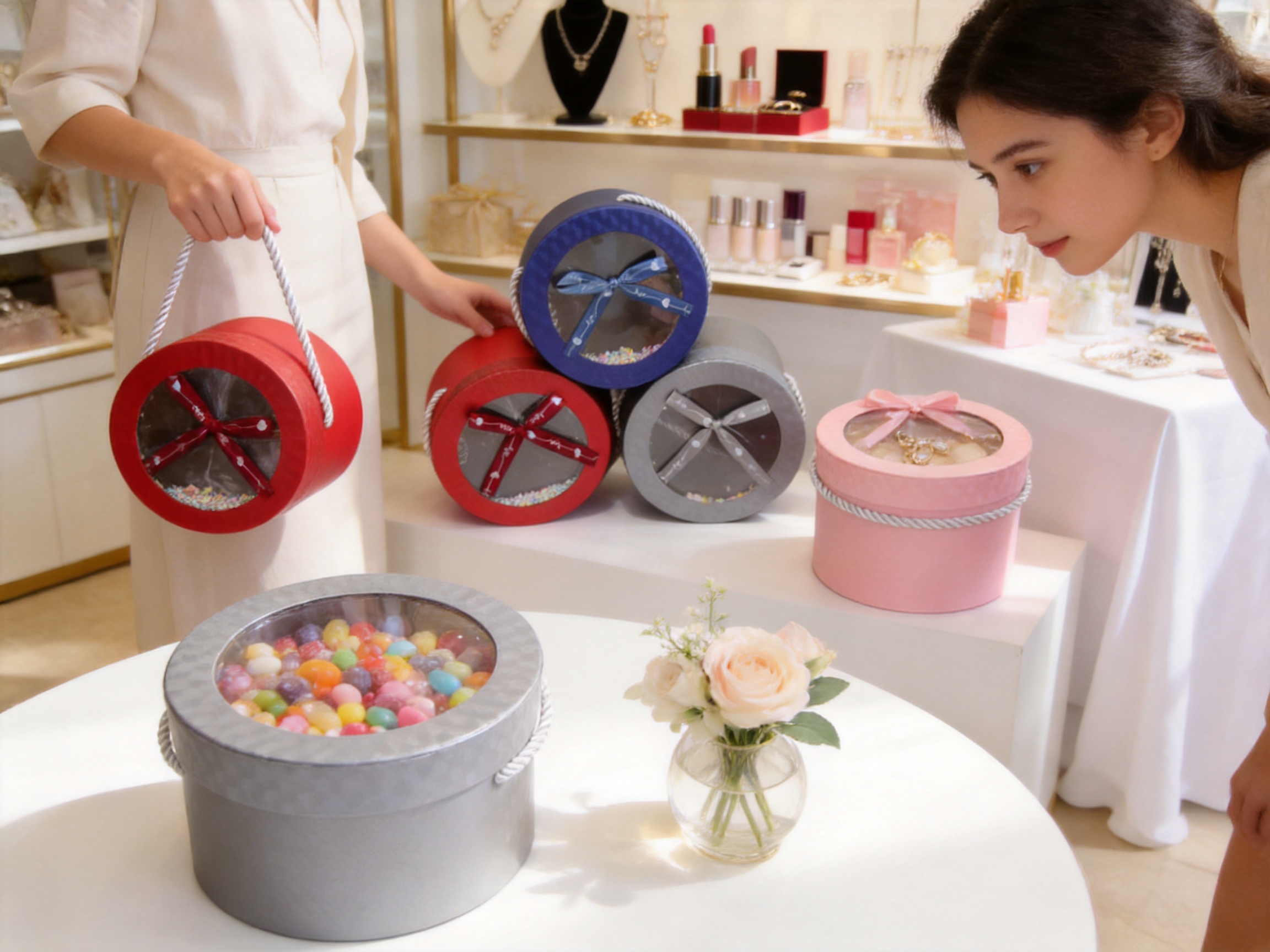
A gift box should be easy to carry after purchase. The 80101 model includes rope handles that provide a practical grip for customers, event guests, and recipients. This feature is useful when the box is transported from a retail store to a home, from a party venue to a vehicle, or from a reception area to another location.
Rope handles also contribute to the overall visual character of the package. When selected to coordinate with the bow or exterior color, they can appear as part of the design rather than as an added functional component. This integration helps maintain a polished appearance.
For florists, handles are especially useful because customers may need to carry the packaged flowers carefully. For candy and gift retailers, the handles can make the box feel more like a complete gift bag while retaining the stable structure of a box. For event organizers, handles can simplify distribution to guests and help prevent awkward handling of decorated packages.
In comparison with boxes that must be carried from the bottom or placed inside a separate shopping bag, a handled design can offer greater convenience. It may also reduce the need for additional outer packaging in certain applications. The appropriate carrying capacity depends on the contents and the final customized structure, so buyers should confirm loading requirements before placing a large order.
The most direct application is the packaging of candy, chocolate, cookies, wrapped sweets, and other small confectionery products. The window can reveal the colors and arrangement of the sweets, while the bow gives the box a ready-to-gift appearance. Retailers can use the package for holiday assortments, limited editions, wedding favors, birthday gifts, and seasonal promotions.
The compact size can be appropriate for curated assortments rather than large-volume family packs. A seller may use the box for premium selections, mixed candies, handmade confectionery, or sample collections. The round structure can also support a product story centered on celebration, sharing, or special occasions.
The product description specifically identifies flower packaging as a suitable use. Small flower arrangements, preserved flowers, decorative petals, and artificial floral gifts can benefit from visible presentation. The box can function as both a protective package and a display element.
Florists can coordinate the ribbon color with the flowers, wrapping paper, store identity, or event theme. A soft pink version may support romantic or wedding arrangements, while red may be appropriate for festive or anniversary products. Blue and gray can be selected for modern, understated, or corporate floral gifts.
The box can also be used to organize and present small cosmetics, skincare products, beauty accessories, or personal care items. The transparent window allows the contents to be identified quickly, which may be useful for gift sets containing bottles, compact products, brushes, or small accessories.
Beauty brands can use the box for promotional bundles, influencer packages, holiday gift sets, and customer loyalty programs. A coordinated ribbon and box color can reinforce a brand’s visual language. Custom dimensions may be considered when the standard size does not provide the desired fit.
Jewelry, hair accessories, small fashion items, and personal keepsakes can be presented in a box that feels more decorative than a basic storage carton. The window can reveal the general arrangement while still preserving the moment of opening. Retailers should use suitable internal inserts or protective materials when the contents require additional separation or cushioning.
Weddings, birthdays, anniversaries, corporate events, festivals, and holiday gatherings often require coordinated favors. The 96-piece carton quantity may be useful for medium-sized event orders, while custom sizing and color selection can support the event’s theme. The handles can make distribution easier, and the bow can eliminate the need for separate decorative wrapping.
After the gift has been opened, the box can continue to serve as a storage container. Users may keep cosmetics, jewelry, craft materials, stationery, photographs, accessories, or other small objects inside. This extended usefulness can add value to the package because it is less likely to be discarded immediately after the original gift is removed.
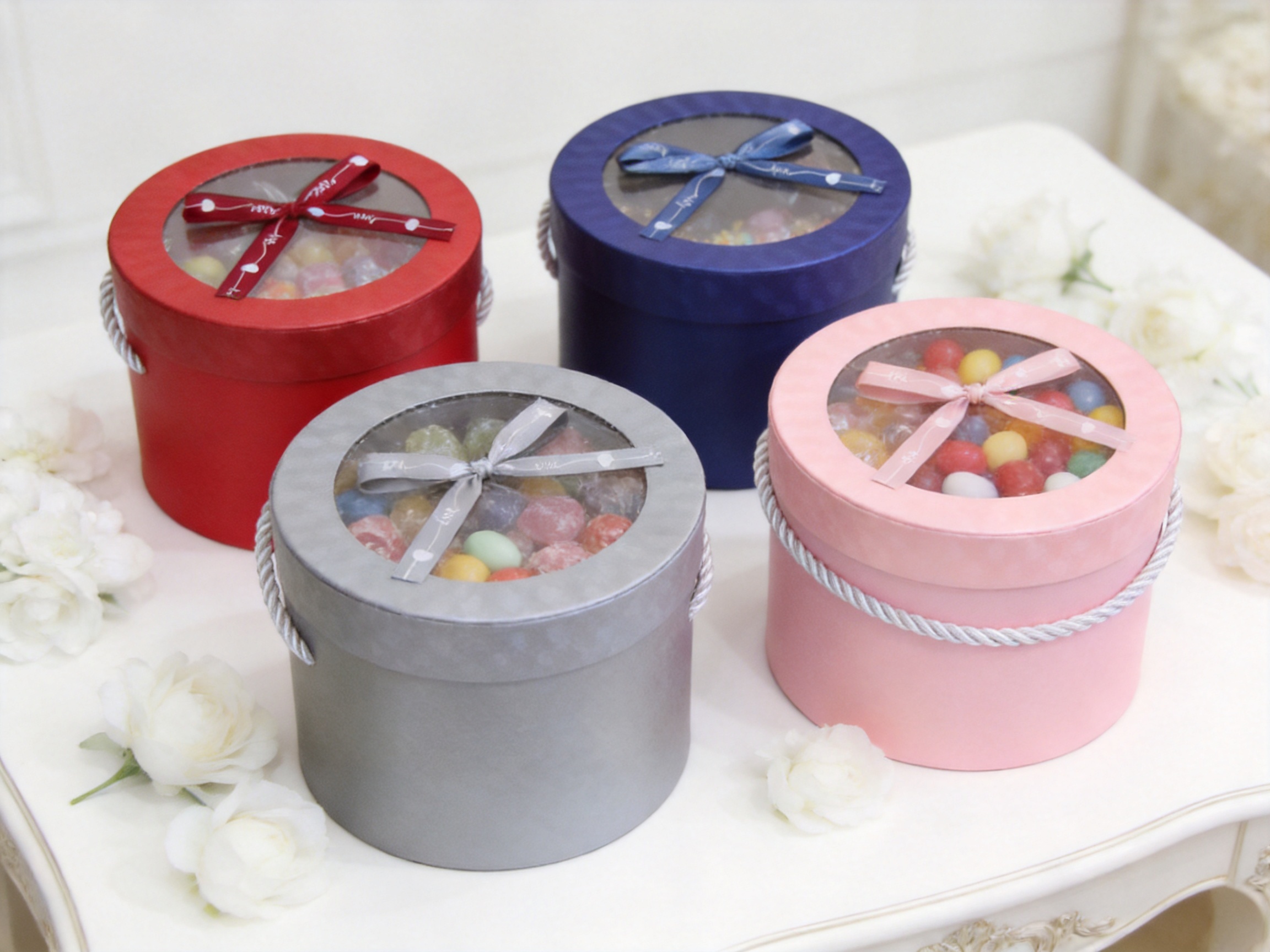
The 80101 model offers several advantages over basic closed cartons and undecorated paper boxes. The first is visible presentation. The transparent window allows the contents to participate in the visual design, which can improve product appeal and simplify selection.
The second is decorative integration. The ribbon bow gives the package a finished appearance without requiring customers or retailers to add separate gift wrapping. This can save time during busy sales periods and provide greater consistency across a large number of gift packages.
The third is portability. Rope handles make the box easier to carry than a handle-free carton. This can improve the customer experience, particularly for gifts that are purchased in person and transported immediately.
The fourth is product differentiation. The round form stands apart from common rectangular packaging. A distinctive shape can increase shelf visibility and create a stronger visual association with a product or campaign.
The fifth is application flexibility. Although designed for candy gifts, the box can be used for flowers, cosmetics, jewelry, party favors, and general storage. This flexibility can help buyers apply the same packaging concept to several product categories.
The sixth is customization potential. Available colors and custom sizing allow businesses to adapt the package to different markets and product requirements. Customization can be particularly valuable for companies seeking packaging that supports a specific brand identity rather than relying on generic stock designs.
| Comparison Point | Basic Closed Carton | 80101 Round Window Gift Box |
|---|---|---|
| Content visibility | Contents remain concealed | Transparent window provides a preview |
| Shape | Usually rectangular or square | Distinctive round structure |
| Decoration | May require separate wrapping | Ribbon bow included as part of the design |
| Carrying convenience | Often requires bottom support or an outer bag | Rope handles provide a practical grip |
| Application range | Often designed for one general use | Suitable for candy, flowers, cosmetics, jewelry, and storage |
| Color choices | May be limited to standard stock colors | Multiple colors and customization options |
| Retail impact | Functional but visually familiar | Decorative design supports stronger shelf presence |
This comparison does not mean that every application requires a decorated window box. Simple cartons may be appropriate for transportation-focused packaging or low-cost commodity products. However, where presentation, gifting, and customer experience are important, the 80101 design provides a broader combination of benefits.
Product performance depends not only on design but also on the manufacturer’s ability to execute that design consistently. Zhejiang Shihao Gift Packaging Co., Ltd. is an export-oriented manufacturer specializing in the production, research and development, and sales of paper gift packaging boxes. Its product range includes kits, storage boxes, folding boxes, jewelry boxes, and various gift boxes.
The company has operated for more than 15 years. This length of experience can support practical knowledge in material selection, structural development, production planning, quality control, packaging assembly, and international shipment preparation. Experience is particularly valuable for decorative packaging because several components must work together: the paperboard structure, window placement, ribbon, rope handles, color appearance, and final packing arrangement.
The company’s approximately 20,000-square-meter facility provides space for production operations, material handling, assembly, quality inspection, and finished-goods preparation. Its workforce of around 300 employees supports the company’s ability to manage product development and volume orders. An average daily production capacity of about 5,000 sets of gift boxes indicates that the manufacturer is equipped to support commercial-scale supply rather than only small artisanal batches.
Advanced equipment and strong research and development capabilities are also identified as company strengths. In the context of the 80101 box, equipment and process organization are important for achieving accurate cutting, consistent folding, reliable assembly, clean window installation, and stable decorative attachment. A round design may require careful control because irregularities can be more noticeable on curved or circular components than on a conventional straight-edged carton.
The manufacturing process begins with product design and structural planning. Engineers and designers must consider the intended contents, external dimensions, folding or forming requirements, lid construction, window placement, handle attachment, ribbon position, and packing method. For a standard model, these elements can be developed into a repeatable production specification. For a custom project, the process may include additional sampling and approval stages.
Structural development helps ensure that the package is attractive while remaining practical. The lid must align with the base, the window must remain properly positioned, and the box must retain its shape during handling. The selected cardboard must be appropriate for the intended size and use. If the contents are heavier than typical candy or decorative items, the buyer should discuss the required material thickness and internal support with the manufacturer.
Paperboard sheets are prepared according to the approved design. Cutting and creasing must be controlled carefully so that the components can be folded and assembled accurately. For a round box, consistent circular geometry is essential to the appearance of the finished package. Clean edges and accurate scoring also contribute to a more professional result.
Efficient material preparation can help reduce waste and improve production consistency. A manufacturer with established equipment and production experience can evaluate how components are arranged on sheets, how materials are handled, and how the product is prepared for repeat manufacturing. For custom orders, these considerations can influence both cost and lead time.
The transparent window is a central product feature and requires accurate positioning. It must be securely integrated into the lid while maintaining clear visibility. A well-controlled window installation process helps prevent misalignment, loose edges, wrinkles, or visual defects that could reduce the perceived quality of the package.
The window also needs to be compatible with the overall lid structure. Its size must provide sufficient visibility without weakening the surrounding paperboard. The design team and production team must therefore balance appearance and structural integrity. Buyers with special requirements should communicate whether the window will display delicate products, colorful candy arrangements, flowers, or branded inserts.
Color is one of the product’s customization strengths. Red, blue, gray, pink, and other colors can be selected for different markets and occasions. Consistent color control is important when an order includes a large number of boxes or when packaging must match other printed materials.
Color selection may be influenced by the target audience, product type, season, retail environment, and brand guidelines. A manufacturer with established research and production resources can help buyers evaluate suitable combinations of paper color, ribbon color, rope color, and window presentation. Final color results can vary according to material, lighting, printing, and finishing conditions, so production samples or approved color references are recommended for customized projects.
The ribbon bow is installed as a decorative component that completes the gift presentation. Its position, size, material, and color can affect the overall appearance. Proper attachment is important because the bow must remain secure during handling and transportation while retaining its shape.
Ribbon choices can be coordinated with seasonal campaigns or event themes. A manufacturer offering different ribbon materials and colors provides buyers with more flexibility than a single fixed design. The bow can be understated for a modern presentation or more expressive for festive and celebratory packaging.
Rope handles are added during the assembly stage. Their attachment points must be positioned for convenient carrying and a balanced appearance. The relationship between the handles, lid, bow, and round structure should be checked so that the completed box looks symmetrical and functions as intended.
Final assembly may include folding, forming, window inspection, bow attachment, handle installation, and visual review. Each stage contributes to the finished product. A small defect in one component may affect the appearance of the entire box, which is why organized inspection is important for decorative packaging.
Quality inspection may address dimensions, shape, color, window clarity, bow placement, handle security, surface condition, and assembly consistency. The finished boxes are then packed into cartons for storage and shipment. The stated carton quantity of 96 pieces and measurement of 87 x 59 x 49 centimeters provide a reference for logistics planning.
For international buyers, carton packing is especially important. Packaging must be arranged to reduce movement and protect decorative components during transportation. Buyers should discuss export packing requirements, stacking conditions, container loading, and any special labeling or documentation needs before production begins.
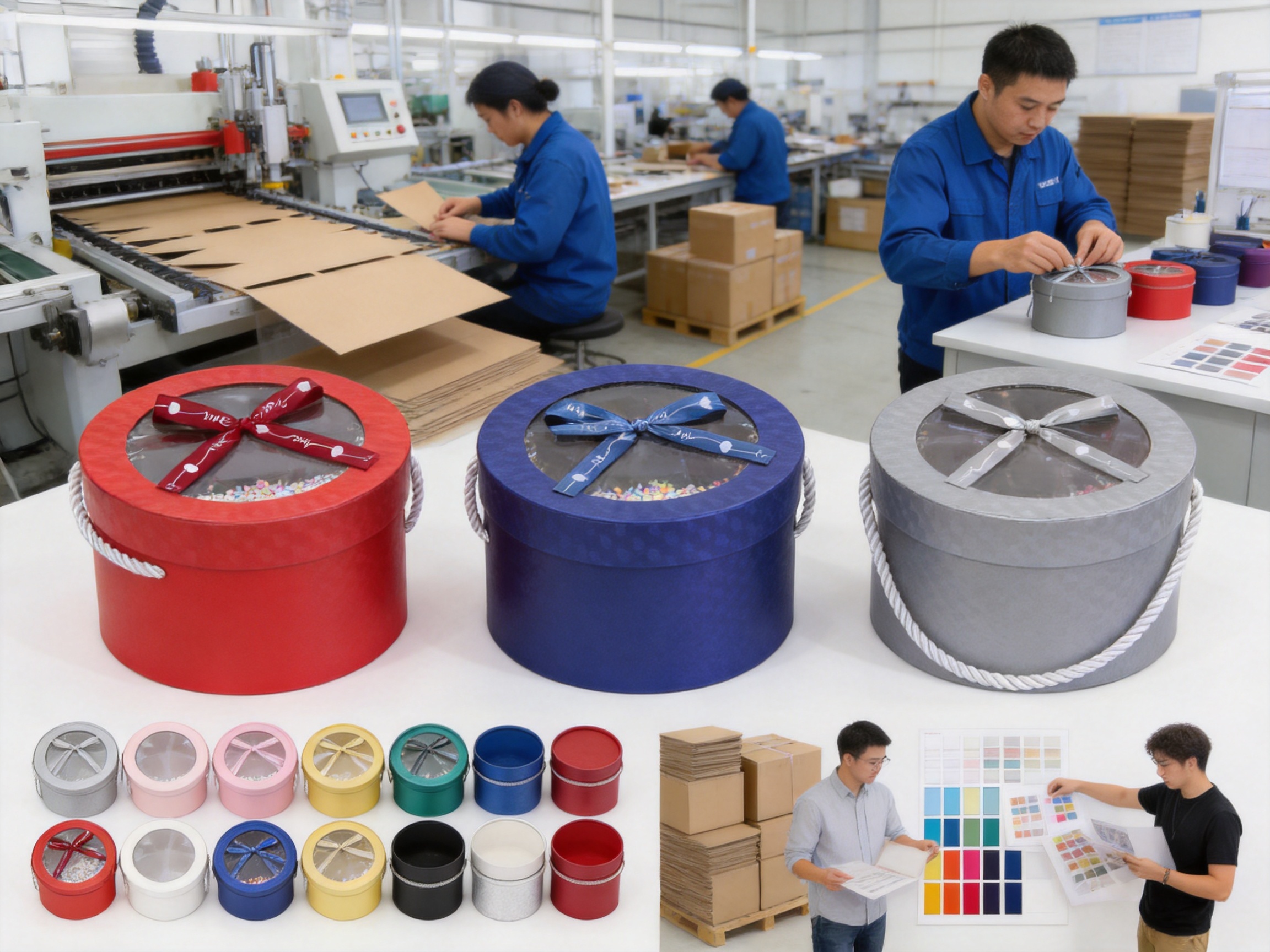
Research and development is a significant part of modern packaging manufacturing. It allows a company to improve existing products, create new structures, evaluate materials, and respond to changing customer preferences. Shihao reports having its own design team and updating dozens of products weekly. This indicates an active approach to product development and market responsiveness.
For buyers, an active design team can be valuable when a standard product requires modification. The buyer may need a different size, color, ribbon treatment, internal layout, or decorative direction. Rather than starting from an entirely blank design, the manufacturer may be able to adapt an existing structure or propose a related solution based on previous experience.
Research and development also support product variety. The company’s broader range includes folding boxes, storage boxes, jewelry boxes, kits, and other gift packaging. Experience across these categories can help the manufacturer understand different requirements, including compact storage, product visibility, premium presentation, portability, and shipment efficiency.
The 80101 box demonstrates how several design trends can be integrated into one product: visible contents, decorative finishing, a distinctive shape, convenient carrying, reusable storage, color variety, and customization. R&D capability helps ensure that these features are developed as a coordinated packaging system rather than as isolated additions.
The company exports products to Europe, the United States, the Middle East, and other regions. International experience can support communication across different markets, packaging expectations, quality requirements, and logistics systems. It may also help the manufacturer understand how gift packaging styles vary according to cultural preferences, seasonal events, retail formats, and product categories.
For importers and distributors, an experienced export supplier can provide practical assistance during order preparation. This may include product confirmation, specification review, sample coordination, carton information, production scheduling, and shipment planning. Clear communication remains essential, especially when a product includes multiple visual components such as a window, bow, rope handles, and color variations.
International buyers should provide detailed information about the intended use, required quantity, destination market, preferred color, contents, packaging environment, and any regulatory or sustainability expectations. These details help the manufacturer assess whether the standard product is appropriate or whether modifications are needed.
Shihao has passed BSCI and FSC certifications. These certifications are relevant to buyers evaluating manufacturing responsibility, social compliance, and paper-based material sourcing. BSCI is associated with social compliance assessment, while FSC certification relates to responsible forest management and controlled sourcing within the applicable certification system.
Certification is not a substitute for project-specific verification, but it can provide useful evidence of a manufacturer’s commitment to recognized standards. Buyers may request current certification documentation and confirm which factory, materials, and production activities are covered. They may also discuss the use of certified paperboard, recycled content, water-based finishes, packaging reduction, and recycling instructions where appropriate.
The paper-based structure of the gift box supports sustainability discussions because cardboard is widely recognized as a practical packaging material with established recycling pathways in many markets. Nevertheless, the complete product may include additional components such as the transparent window, ribbon, rope, adhesives, and coatings. Buyers seeking recyclability should evaluate the full material combination rather than considering the cardboard alone.
Responsible manufacturing also involves efficient production, reduced material waste, worker welfare, consistent quality, and reliable order management. A manufacturer that combines production scale with R&D resources and social and material certifications can offer a stronger foundation for customers seeking long-term packaging partnerships.
Customization is important for brands that want packaging to support recognition and differentiation. The 80101 box offers custom size services, allowing buyers to consider dimensions that better suit their products. Custom sizing can help reduce excessive empty space, improve the appearance of the contents through the window, and create a more appropriate fit for specific gift sets.
Color customization is another important opportunity. Buyers can select from the available red, blue, gray, and pink options or discuss other color directions. Color may be used to separate product collections, distinguish seasonal editions, match an event theme, or reinforce a brand palette.
Ribbon and rope details can also be coordinated. A consistent combination of exterior color, bow, and handle can create a more unified appearance. Buyers may request different decorative materials or styles depending on the desired market position, although all modifications should be reviewed for production feasibility and cost.
Depending on the project, buyers may also discuss branding elements such as printed artwork, labels, inserts, or other presentation details. Any custom printing or finishing should be confirmed through a formal sample approval process. Artwork files, color references, dimensions, packaging requirements, and order quantities should be clearly documented before mass production.
Customization should be approached as a complete packaging solution. Changing the size may affect the structure, material requirements, window proportion, handle position, bow placement, carton quantity, and shipping cost. The manufacturer’s design and engineering teams can help evaluate these relationships before production begins.
Wholesale buyers need packaging that is attractive to end customers and practical to manage in inventory. The 80101 model offers a standardized product number, defined carton quantity, known carton measurement, and stated gross and net weights. This information assists with purchasing plans, warehouse organization, freight estimates, and retail distribution.
The 96-piece carton quantity can support several commercial uses. A retailer may distribute the units across multiple stores. An event supplier may allocate boxes to different customer orders. A confectionery brand may use the product for a seasonal campaign or premium gift collection. A florist may combine the boxes with different arrangements while maintaining a consistent packaging identity.
The product’s versatility may also help buyers simplify their packaging range. Instead of purchasing one type of box for candy, another for small beauty gifts, and a third for event favors, a buyer may be able to use one adaptable design across several related applications. This can make purchasing and visual merchandising more consistent.
For private-label and customized projects, the manufacturer’s production scale can support larger programs. The company’s reported daily capacity of approximately 5,000 sets provides an indication of its ability to handle volume, although actual capacity for a specific product depends on the production schedule, customization level, order quantity, and component availability.
Packaging can influence purchasing decisions in both physical and digital retail. In a store, the round silhouette and transparent window can create shelf appeal. In product photography, the visible contents and ribbon bow can make the item look complete and gift-ready. Online sellers can show the box from several angles to communicate both presentation and function.
A visually distinctive package may also encourage customers to share photographs of gifts or event displays. While no packaging design can guarantee social engagement, decorative details create more opportunities for attractive presentation. This is particularly relevant to wedding favors, holiday gifts, influencer packages, boutique products, and premium confectionery.
The box can support storytelling as well. A brand may present the package as a reusable keepsake, a celebration container, a floral display package, or a carefully assembled gift experience. The transparent window helps communicate what is inside, while the bow and color choice communicate the mood of the gift.
Retailers can also use color variations to organize product collections. Red may identify holiday or romantic products, blue may represent calm or seasonal themes, gray may support minimalist collections, and pink may suit soft or feminine presentations. Such color organization can improve the visual structure of a display.
Before ordering, buyers should determine the exact contents that will be placed in the box. Candy, flowers, cosmetics, and jewelry have different requirements for weight, moisture protection, internal organization, and handling. The standard product may be suitable for many small items, but product-specific testing is recommended.
Buyers should also review the fit of the contents. A transparent window is most effective when the arrangement inside is visually appealing and does not appear crowded or excessively empty. Custom sizing may be appropriate if the standard dimensions do not provide the desired presentation.
Color and decorative components should be confirmed through samples where possible. The bow, rope handles, window, and exterior color all contribute to the final appearance. A sample review allows the buyer to evaluate proportion, assembly, surface finish, and overall quality before mass production.
Logistics should be considered at the beginning of the project. The stated carton size is 87 x 59 x 49 centimeters, with 96 pieces per carton and gross/net weights of 11.5 and 10 kilograms. These details can be used for preliminary freight calculations, but buyers should confirm final carton data after any customization.
For export orders, the buyer should clarify delivery terms, production lead time, payment arrangements, inspection procedures, carton markings, documentation, and shipping method. Early confirmation helps reduce delays and ensures that the product is manufactured according to a common specification.
An unboxing experience begins before the lid is removed. The recipient notices the shape, the bow, the color, and the visible contents. The 80101 box creates a sequence of small visual discoveries: first the decorative exterior, then the window, then the opening of the lid, and finally the contents themselves.
This layered experience can make ordinary products feel more special. A selection of candies becomes a prepared gift assortment. A small flower arrangement becomes a presentation piece. A group of cosmetics becomes a coordinated set. The box helps establish the idea that the contents were selected and arranged with intention.
The reuse potential adds another stage to the experience. After the original contents are removed, the recipient can use the box to store small objects. This continued function may increase the perceived value of the package and extend the time during which the box remains visible in the home or office.
For brands, an effective unboxing experience can encourage repeat purchases and positive word-of-mouth. The product itself remains central, but thoughtful packaging can help customers remember the occasion and associate the brand with quality and care.
The box is made primarily from cardboard and paper-based packaging materials. It also includes a transparent window, ribbon bow, rope handles, and the necessary assembly components. Buyers should confirm the exact material composition and finishing specifications for customized orders.
The listed product size is 14 x 14 x 11.5 centimeters. These dimensions are suitable for many small gift applications, but buyers should compare them with the size and weight of their intended contents before ordering.
The listed carton quantity is 96 pieces. The carton measurement is 87 x 59 x 49 centimeters, and the gross and net weights are listed as 11.5 and 10 kilograms respectively. Final packing information should be confirmed for customized versions.
Yes. Flower packaging is one of the suggested applications. The transparent window can showcase a small floral arrangement, while the round shape and ribbon bow create a decorative presentation. Internal protection and moisture considerations should be reviewed according to the type of flowers being used.
Yes. It can be used for small cosmetics, beauty accessories, jewelry, and other compact items. Additional inserts or protective materials may be required for delicate products, and the contents should be tested for fit and stability.
Available colors include passionate red, serene blue, understated gray, and soft pink. Other colors may be discussed as part of a customized packaging project, subject to material availability and production requirements.
Yes. Custom sizing services are available. A size change may affect the structure, material selection, window proportion, bow placement, handle position, carton quantity, and shipping calculations, so all details should be reviewed during the design stage.
The window allows the recipient or shopper to see the contents without opening the box. It improves product visibility, supports attractive retail presentation, and helps communicate the quality and arrangement of candy, flowers, or other small gifts.
Yes. The design includes rope handles. They make the box easier to carry and can be coordinated with the ribbon bow and exterior color.
The main differences are the round structure, transparent window, decorative ribbon bow, and rope handles. Together, these features provide a more complete presentation and carrying solution than a plain, closed, handle-free carton.
Customized packaging solutions can be discussed with the manufacturer. Buyers should provide artwork, dimensions, color references, and intended use so that the design and production teams can evaluate the project. A pre-production sample or approval process is recommended for branded orders.
The company operates a large production facility, employs around 300 people, and reports an average daily capacity of approximately 5,000 sets of gift boxes. These capabilities indicate support for commercial-scale orders, although capacity and lead time depend on product specifications and the current production schedule.
The company exports to Europe, the United States, the Middle East, and other regions. International buyers should discuss destination-specific requirements, shipping arrangements, documentation, and packaging standards before placing an order.
The company reports passing BSCI and FSC certifications. Buyers should request current documentation and confirm the scope of certification relevant to their order and material requirements.
The 80101 Round Transparent Window Candy Gift Box is designed for businesses that want packaging to do more than contain a product. Its round structure creates visual distinction, the transparent window displays the contents, the ribbon bow adds a ready-to-gift finish, and the rope handles improve portability. Together, these features provide a practical and decorative alternative to ordinary closed cartons.
Its application range extends from candy and confectionery to flowers, cosmetics, jewelry, party favors, promotional sets, and small-item organization. Color options and custom sizing give buyers room to adapt the product to different markets and occasions. The cardboard structure supports a lightweight, attractive, and paper-based packaging approach, while reported FSC and BSCI certifications provide additional points for responsible sourcing and manufacturing discussions.
The product is supported by a manufacturer with more than 15 years of industry experience, a 20,000-square-meter facility, approximately 300 employees, advanced equipment, an internal design team, and an average daily production capacity of about 5,000 gift box sets. Its export experience and broad packaging range make it suitable for buyers seeking both a specific product and a longer-term packaging partner.
For retailers and brands, the box can strengthen shelf appeal and create a more memorable customer experience. For event planners and florists, it combines decoration and convenience. For confectionery companies, it presents the contents while supporting premium positioning. For importers and distributors, its standard specifications, carton packing information, and customization potential offer a practical basis for wholesale planning.
When selected with the correct contents, dimensions, colors, and internal protection, the 80101 gift box can transform a simple package into a complete presentation. It demonstrates how thoughtful structure, decorative details, manufacturing expertise, and customization services can work together to create packaging that is attractive, functional, and commercially useful.
1. Product specification and description for the 80101 Round Transparent Window Candy Gift Box, including dimensions, carton quantity, materials, colors, features, and applications.
2. Company information supplied for Zhejiang Shihao Gift Packaging Co., Ltd., including manufacturing experience, facility size, workforce, production capacity, product range, export markets, and R&D capabilities.
3. Forest Stewardship Council. General principles relating to responsible forest management and certified paper-based materials.
4. Business Social Compliance Initiative. General principles relating to social compliance and responsible supply-chain practices.
5. General packaging design principles concerning product visibility, structural integrity, portability, reusable packaging, and retail presentation.
Recommended Products

Contact Us

No. 15, Xiayang Road, Huangzhai Town, Jinhua, Zhejiang, China

(+86) 579-84230069

(+86) 13085675766


Products

Gift Box Packaging Manufacturer
 English
 Français
 Español
 عربى