2026-09-14
Jewelry packaging does much more than protect a product. It introduces the item, establishes an emotional tone, and influences how the recipient remembers the moment of opening it. A well-designed jewelry box can make a modest gift feel thoughtful, a premium product feel more valuable, and a special occasion feel even more meaningful. The HY-1 square top-and-bottom-cover glitter paper jewelry gift box with ribbon bow is designed around this complete experience. It combines a structured paperboard form, decorative glitter paper, a handmade-style ribbon bow, and a practical separate-lid construction to create packaging that is attractive, functional, and suitable for customized production.
Unlike ordinary plain jewelry cartons, this gift box is intended to serve as part of the gift itself. Its reflective glitter-paper surface catches light from different angles, while the bow adds a ceremonial detail associated with birthdays, weddings, anniversaries, holidays, and other celebrations. At the same time, the square shape provides a stable structure and an organized interior suitable for many types of jewelry. The design is simple enough for efficient manufacturing but distinctive enough to help jewelry brands, retailers, gift companies, and promotional businesses present their products more effectively.
Produced by Zhejiang Shihao Gift Packaging Co., Ltd., the box reflects the capabilities of an export-oriented paper packaging manufacturer with experience in design, research and development, production, and customized packaging solutions. The manufacturer operates a large production facility, maintains a dedicated design team, and supplies packaging to multiple international markets. Its production resources support a balance between visual quality, dependable manufacturing, customization, and commercial scalability.
The HY-1 jewelry gift box uses a classic top-and-bottom construction. The lid and base are made as separate components, allowing the lid to be removed and replaced without damaging the box. This format is familiar to consumers, easy to understand, and appropriate for a wide range of jewelry presentations. It can be used for rings, earrings, bracelets, pendants, necklaces, small accessories, keepsakes, and selected gift items that require a compact protective package.
The square profile gives the box a balanced appearance. Unlike irregular packaging shapes that may require special display arrangements, a square box can be stacked, aligned, stored, and transported efficiently. It also creates a symmetrical visual platform for the ribbon bow. The shape is suitable for jewelry brands that want a classic presentation rather than an overly complicated structure.
The exterior is covered with glitter paper. Its fine reflective particles create a shimmering effect that changes according to lighting, viewing angle, and surrounding colors. This surface treatment gives the product more visual depth than standard matte paper. It can attract attention on a retail display, support photography for e-commerce listings, and create a sense of celebration when the box is presented as a gift.
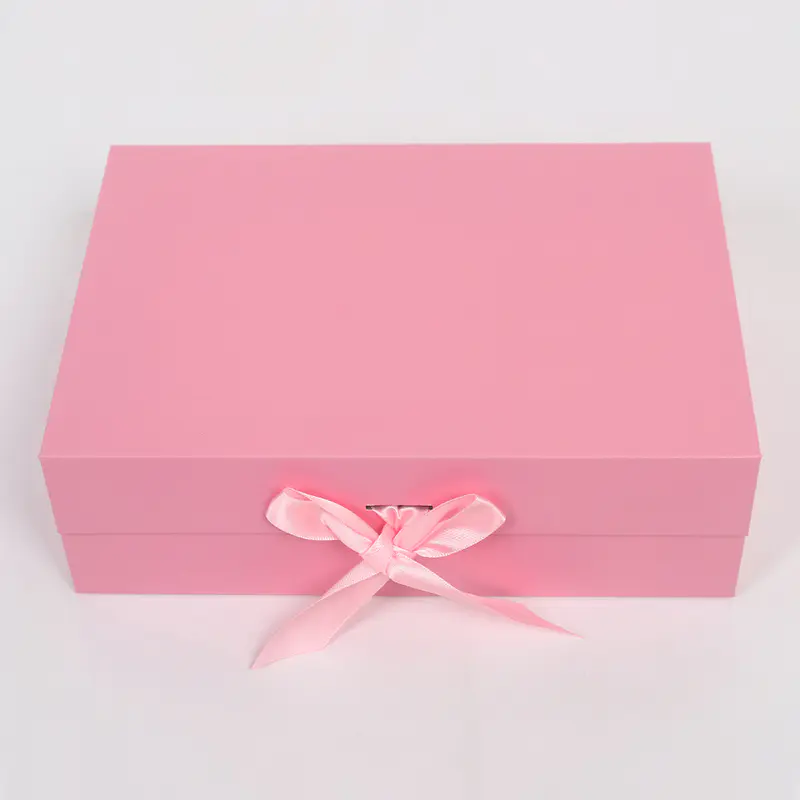
A ribbon bow is positioned on the center of the lid. This decorative element provides an immediate visual signal that the box contains something special. The bow also makes the package resemble a wrapped present without requiring additional wrapping paper. Ribbon material, color, and styling may be adjusted to coordinate with a brand identity, event theme, seasonal collection, or specific jewelry design.
The product can be used as a standalone jewelry gift box or as part of a larger packaging system. For example, it may be placed inside a paper shopping bag, a shipping carton, a presentation sleeve, or a gift set. Its decorative appearance allows it to move from storage to presentation with minimal additional preparation.
The separate-lid format is one of the most practical features of the design. The top and base can be opened and closed repeatedly, making the package suitable not only for one-time gifting but also for storage. A recipient may continue using the box to store jewelry, keepsakes, small accessories, or personal items after the original gift has been removed.
This reusability gives the packaging a longer functional life than disposable wrapping materials. The box remains part of the customer’s environment and may continue to remind the recipient of the brand or occasion. For jewelry retailers, this can support a more durable relationship between the product and the customer because the package is not immediately discarded.
The lid-and-base construction also provides a clean, structured appearance. Hinged or folding cartons can be efficient and convenient, but they often communicate a lighter or more temporary feeling. A rigid-feeling top-and-bottom box offers a more substantial presentation. Even when produced with paper-based materials, its assembled form can suggest care, order, and quality.
Another advantage is production flexibility. The lid and base can be covered, finished, inspected, and assembled using organized manufacturing steps. This makes it easier to manage color consistency, surface quality, edge alignment, and component matching. When multiple sizes are required, the same basic construction can be adapted to different internal dimensions while preserving a consistent product family.
The removable lid allows the recipient to open the box without tearing, cutting, or permanently damaging the package. This is important for jewelry because the unboxing action should feel deliberate rather than forced. A smooth opening sequence can create anticipation and help the recipient focus on the product inside.
The structure also makes it possible to place a fitted insert in the base. Depending on the jewelry type, the interior may accommodate a ring cushion, earring support, necklace pad, bracelet support, or a custom paperboard insert. An insert can prevent movement during handling and can help the product remain visually centered when the lid is removed.
For wholesale and retail applications, the separate-lid structure may simplify visual inspection. Buyers can open the box to check the jewelry or insert without unfolding a complicated package. It can also make replenishment and merchandising more straightforward in stores and warehouses.
Glitter paper is a major differentiating feature of the HY-1 design. A plain paper surface can look clean and professional, but glitter paper introduces a more celebratory and decorative character. Its reflective effect can make the box stand out among standard jewelry cartons, especially when displayed under retail lighting or photographed against a simple background.
The shimmer is not merely a decorative addition. It changes how the box is perceived. Metallic or reflective details are often associated with celebration, luxury, evening occasions, and premium presentation. A glitter surface can therefore support product positioning for fashion jewelry, bridal accessories, holiday collections, birthday gifts, and limited-edition promotional products.
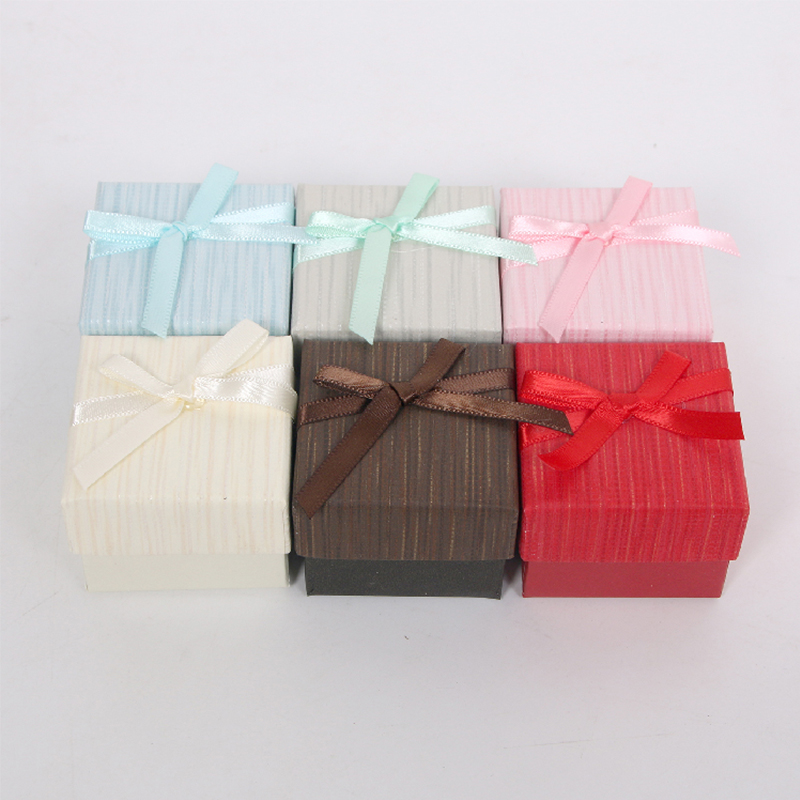
Glitter paper may also be coordinated with different ribbon colors and jewelry styles. A silver-toned surface with a soft-colored bow can create a delicate appearance. A darker glitter finish with a contrasting ribbon can look more dramatic. Light-colored glitter paper may support bridal or seasonal packaging, while brighter shades can be used for youth-oriented or festive collections.
Compared with adding separate foil labels, loose decorative particles, or complex surface embellishments after box production, glitter paper provides a more integrated exterior treatment. The decorative effect is part of the paper covering, which can help maintain a consistent appearance across the lid and base. This supports a cleaner overall design and reduces the need for multiple separate decorative operations.
For e-commerce sellers, the glitter surface can also contribute to stronger product imagery. It creates highlights and texture that can be captured in close-up photographs. Professional product photography should still control reflections carefully, but the visual material can help convey a richer appearance than an untextured paper box.
A successful glitter-paper box depends on more than the presence of shimmer. The covering should be applied evenly, with clean corners, controlled edges, and a consistent visual effect across the main visible areas. Uneven application, excessive creasing, or misaligned covering can reduce the premium impression. This is why manufacturing experience and inspection procedures are important when producing decorative paper packaging at commercial volumes.
The manufacturing process must account for how the paper behaves during cutting, folding, wrapping, gluing, and assembly. Glitter surfaces may reflect light differently at the edges, so accurate alignment is essential. The visual center of the lid must also be coordinated with the bow position. These details are particularly important because the product has a relatively simple form; small defects are more noticeable on a clean, symmetrical design.
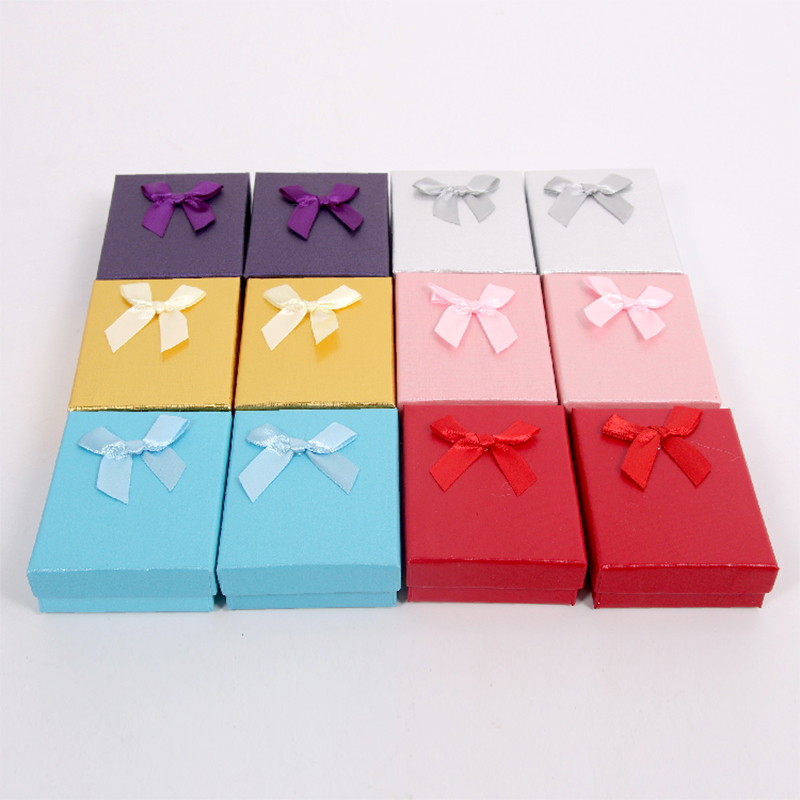
HY-1 Square Top and Bottom Cover Glitter Paper Jewelry Gift Box with Ribbon Bow
The ribbon bow is positioned at the center of the lid to create a clear focal point. It gives the package the immediate appearance of a finished present and adds an element of ceremony to the unboxing process. When the recipient sees the bow, the box communicates that the item inside has been selected and prepared for a meaningful occasion.
Many competing jewelry boxes rely on printing, embossing, or metallic logos to create a premium appearance. Those techniques can be effective, but a physical bow creates a different kind of visual and tactile experience. It adds dimension above the lid, introduces a soft material against the structured paper surface, and makes the package resemble a gift before it is opened.
The ribbon can be customized in terms of color, width, texture, and overall styling. This gives buyers an opportunity to match the packaging with corporate colors, wedding themes, seasonal campaigns, or the visual language of a jewelry collection. A neutral ribbon can support a timeless design, while a vivid ribbon can create a stronger retail presence.
The bow also improves the unboxing sequence. The recipient may touch or adjust the ribbon before lifting the lid, creating a brief moment of anticipation. This small interaction can make the opening process feel more personal. For social media content and product demonstrations, the bow gives the hands a natural visual point of interaction, making the opening action easier to understand on camera.
Because the ribbon is visible before the box is opened, it can communicate the intended use of the package from a distance. On a store shelf, in a gift display, or inside a shipping parcel, the bow helps distinguish the box from plain packaging. This can be particularly useful for seasonal products that need to look gift-ready without additional wrapping.
The HY-1 design offers several advantages when compared with ordinary paper jewelry boxes that use plain surfaces, minimal decoration, or less substantial structures. Its primary advantage is the integration of practical construction and decorative presentation. The box is not designed only to hold jewelry; it is designed to help present the jewelry as a complete gift.
First, the glitter-paper exterior creates more shelf and display visibility. Plain boxes may blend into a retail environment, especially when many products use similar neutral colors. The reflective surface can catch the eye and establish a more festive presentation without requiring a complicated box shape.
Second, the ribbon bow adds a three-dimensional decorative feature. Printed ribbon illustrations or flat patterns can suggest a gift, but a physical bow gives the package a more immediate and tactile identity. This can make the product more appealing for direct gifting.
Third, the separate lid and base offer a reusable format. Some low-cost cartons are intended primarily for transport and may not provide a satisfying long-term storage solution. A well-made top-and-bottom box can be retained by the recipient and used for future organization.
Fourth, the square form creates a reliable visual foundation for a variety of jewelry categories. The design can be adapted with different internal inserts instead of requiring a completely different exterior format for each jewelry type. This can support product-line consistency for brands that sell rings, earrings, pendants, bracelets, or small accessory collections.
Fifth, the design is suitable for customization. The outer paper, ribbon, internal support, dimensions, and possibly printing or finishing details can be coordinated according to the buyer’s needs. Customized production allows businesses to obtain packaging that is more closely aligned with their target market than generic stock packaging.
Finally, the box supports a higher perceived value without depending entirely on expensive structural complexity. The visual impact comes from the combination of shape, glitter paper, bow, and careful finishing. This can be an efficient approach for businesses seeking a decorative presentation at scalable manufacturing volumes.
Folding cartons are useful because they are lightweight, economical, and easy to store before assembly. However, they may provide less dimensional presence and may not create the same sense of occasion as a structured lid-and-base box. The HY-1 format offers a more substantial opening experience and can remain useful after the gift has been received.
A folding carton may also require extra wrapping, a printed sleeve, or additional decoration to achieve a gift-ready appearance. The glitter paper and ribbon bow of the HY-1 design provide decorative impact as part of the box itself. This can reduce the number of separate presentation materials required for many gifting applications.
Some premium boxes use multiple layers, magnets, hinges, windows, metal accessories, or complex inserts. These features can be appropriate for luxury collections, but they may increase material use, production complexity, shipping weight, and overall cost. The HY-1 box takes a more focused approach by emphasizing the visible lid, glitter surface, bow, and organized interior.
This balance can make the design attractive to businesses that want a premium-looking package without the cost or operational demands of a highly engineered presentation box. It provides a recognizable gift experience while maintaining a straightforward format that can be produced in volume.
The box is suitable for jewelry brands, independent designers, department stores, online retailers, wedding suppliers, gift shops, promotional companies, and manufacturers that need customized jewelry packaging. Its decorative character makes it especially appropriate for products sold as gifts rather than purely functional accessories.
For jewelry retailers, the box can be used for customer purchases, seasonal collections, loyalty programs, and premium upgrades. A retailer may offer the glitter-paper box as an enhanced packaging option for anniversaries, birthdays, or proposal-related purchases. The ribbon bow allows the product to be presented immediately without requiring a separate gift-wrapping station.
For wedding businesses, the package may be used for bridesmaid gifts, wedding favors, ring-related accessories, anniversary jewelry, or small keepsakes. Ribbon color customization makes it possible to coordinate the packaging with a wedding palette. The square format can also be arranged neatly on reception tables, gift tables, or retail displays.
For holiday promotions, the box can support collections for Christmas, Valentine’s Day, Mother’s Day, New Year celebrations, and other gifting periods. Seasonal ribbons and coordinated glitter-paper colors can create limited-edition visual identities while preserving the same core box structure.
For online sellers, attractive packaging can contribute to customer satisfaction after delivery. The product arrives in a presentation format that feels intentional rather than merely protected. This can help support positive reviews, unboxing content, repeat purchases, and social media sharing, although the final customer experience also depends on shipping protection and product quality.
For corporate and promotional gifting, the box can be customized to present small commemorative jewelry items, branded accessories, award-related gifts, or event souvenirs. A suitable logo, ribbon color, or printed message can help connect the packaging with a campaign or organization.
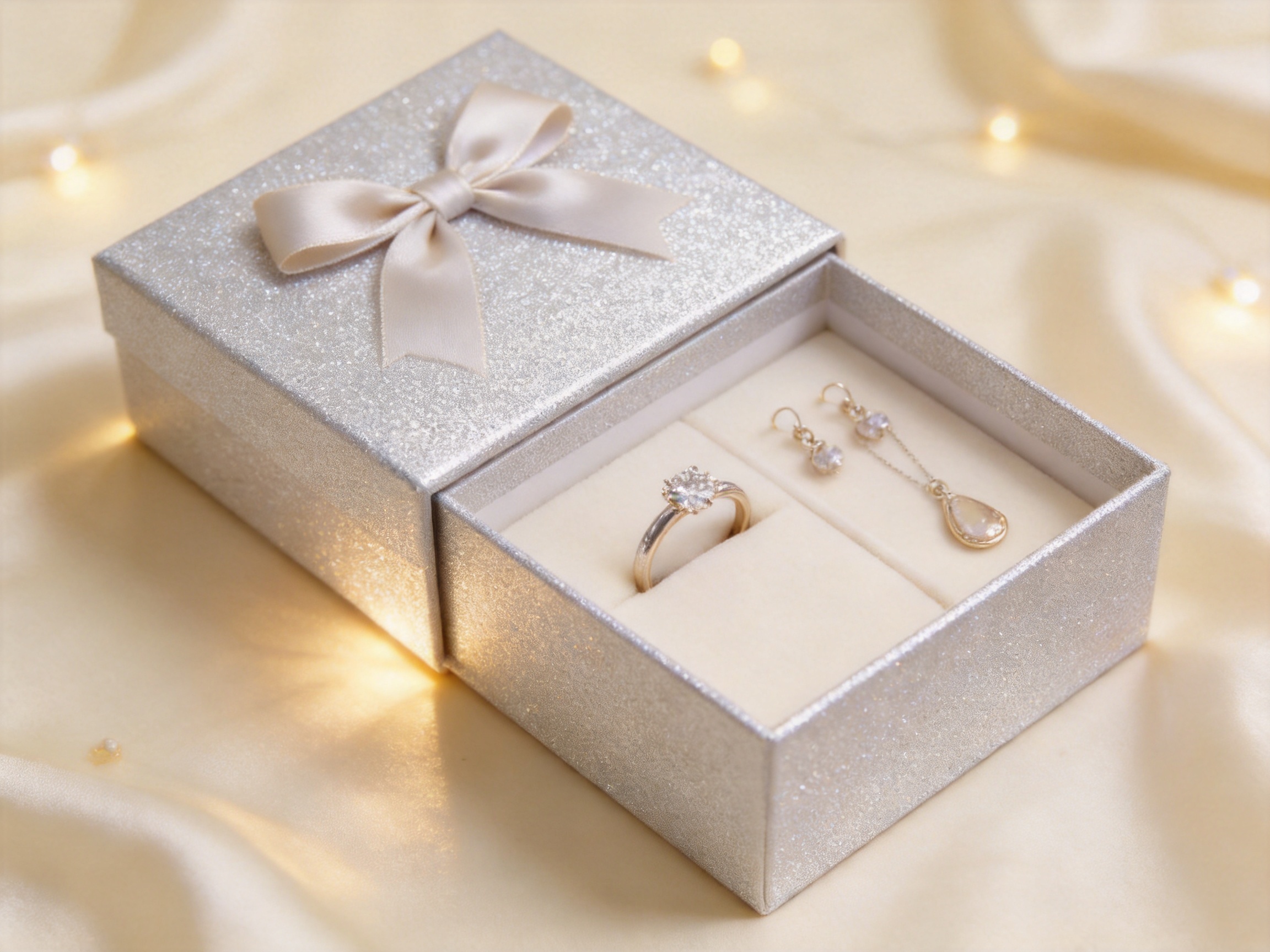
Customization is important because jewelry businesses differ in product size, brand identity, price position, customer demographics, and sales channel. A standard box can provide a starting point, but customized packaging can improve product fit and strengthen brand consistency.
The square external shape can be developed in different dimensions to accommodate various jewelry products. Smaller versions may be suitable for rings, earrings, or charms. Larger versions may be appropriate for bracelets, necklaces, gift sets, or multiple-piece combinations. The internal depth should be selected according to the product and insert requirements so that the jewelry is protected without appearing lost inside the box.
Internal supports may include cushions, slots, pads, trays, or paperboard compartments. A ring insert can hold the jewelry upright, while a necklace insert may include a central support or securing points. Earrings may require a pair of holes or a soft backing. The correct insert improves product visibility and limits movement during transport.
The glitter paper and ribbon can be selected to create a unified palette. Brands may choose colors that reflect their logo, collection themes, or target market. Soft shades can communicate delicacy and romance, while deep or metallic shades can create a more formal impression. Bright colors may be suitable for youth collections, celebration gifts, or seasonal promotions.
Color matching should be evaluated under the lighting conditions where the box will be sold and photographed. Glitter surfaces can appear different under warm, cool, direct, and diffused light. Sample approval is therefore an important step before mass production.
Depending on project requirements, branding elements may be added to the lid, interior, insert, or accompanying packaging. A restrained logo can preserve the elegant appearance of the bow and glitter surface. Additional printing, foil details, embossing, or labels may be considered when the brand requires stronger identification.
The most effective branding approach depends on the desired market position. A luxury jewelry label may prefer a small, discreet mark, while a promotional campaign may require a more visible logo. The manufacturer’s design team can help evaluate how branding elements interact with the glitter paper and ribbon rather than treating each component separately.
The quality of a decorative gift box depends on the consistency of many individual operations. These may include material preparation, paper cutting, board forming, surface covering, edge wrapping, adhesive application, bow preparation, component assembly, and final inspection. A defect in any one stage can affect the appearance or function of the completed package.
A professional manufacturing process begins with material and specification confirmation. The paper type, board strength, glitter effect, ribbon material, dimensions, insert design, and finishing requirements should be documented before production. This helps reduce misunderstandings between the buyer and factory and provides a reference for sample approval and later quality checks.
During material preparation, paper and board should be stored in conditions that help minimize moisture-related deformation. Paper-based components can change dimensionally when exposed to unstable humidity. Proper storage and handling support better cutting accuracy, cleaner folding, and more consistent edge wrapping.
Cutting and forming operations establish the dimensions of the lid and base. Accuracy is important because the lid must fit the base securely while remaining easy to remove. If the fit is too tight, the recipient may struggle to open the box. If it is too loose, the lid may shift during handling or transport. Consistent forming helps maintain the intended balance.
The glitter paper is then applied to the relevant surfaces. During this stage, the paper must be aligned so that the glitter effect appears even and the corners remain neat. Edges may be wrapped or finished according to the selected construction. Clean edge work is especially important because the box is viewed from multiple angles.
The ribbon bow requires separate preparation and placement. The bow should be centered on the lid and secured in a way that supports its appearance during handling. Ribbon tension, symmetry, position, and color consistency all influence the finished result. Since the bow is a major visual feature, it should receive specific inspection rather than being treated as a minor accessory.
After the components are assembled, finished boxes should be inspected for surface marks, loose paper, adhesive residue, poor alignment, damaged corners, uneven bows, color variation, and incorrect dimensions. Packaging intended for export should also be checked for appropriate packing methods so that the decorative surface is protected during transportation.
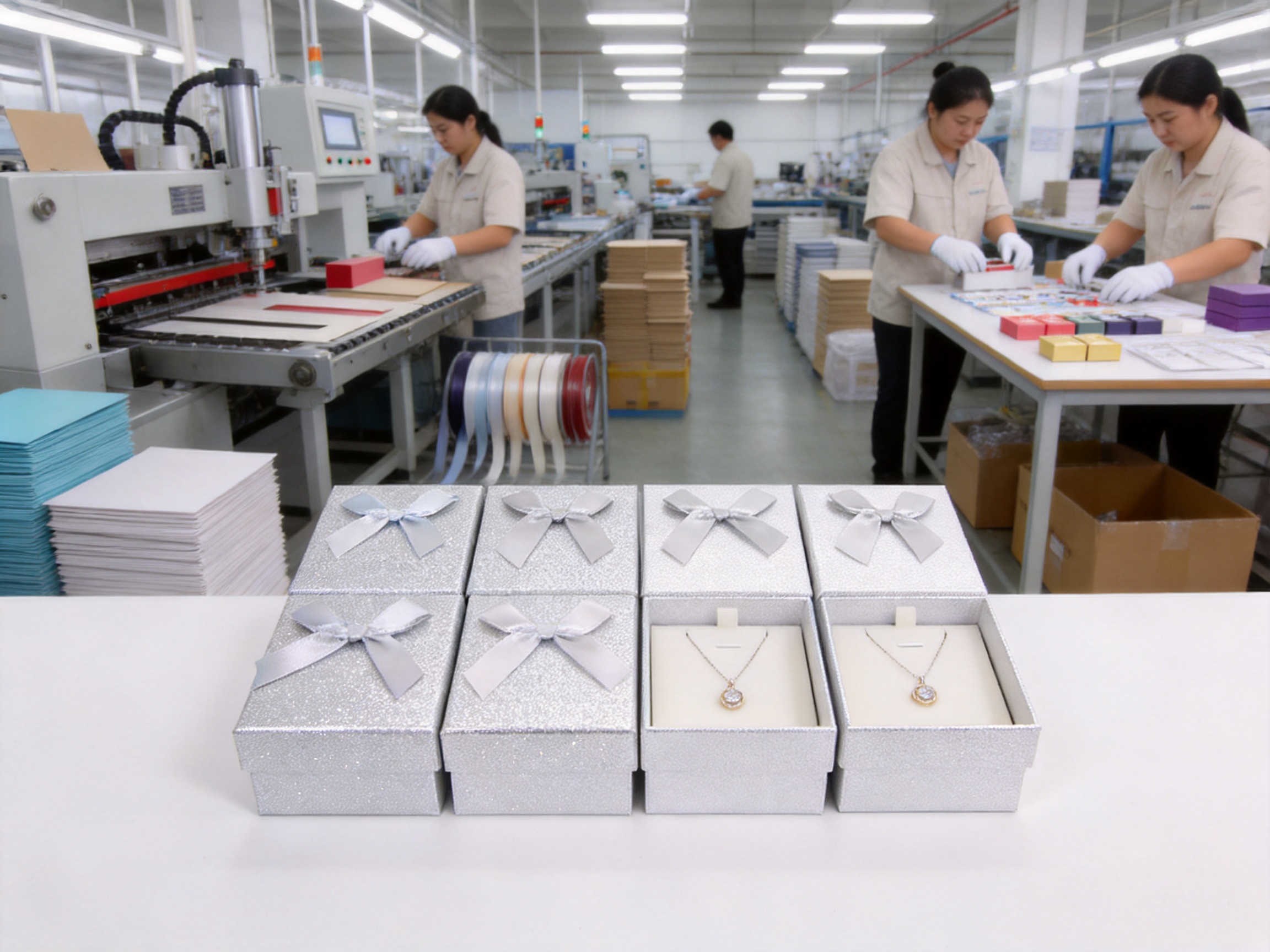
Zhejiang Shihao Gift Packaging Co., Ltd. has more than 15 years of experience in paper gift packaging production, research and development, and sales. The company operates a facility covering approximately 20,000 square meters and employs around 300 people. These resources provide a foundation for managing design development, production coordination, quality control, and export orders.
The company reports an average daily production capacity of approximately 5,000 sets of gift boxes. Capacity at this scale can be valuable for businesses that need repeat orders, seasonal inventory, or coordinated packaging for multiple product lines. It may also help reduce the risk of relying on a small workshop that cannot maintain consistent output during peak periods.
Advanced equipment supports the production of paper gift packaging through repeatable cutting, forming, covering, printing, and assembly operations. Equipment alone does not guarantee quality, but it can improve process stability when combined with trained workers, clear specifications, inspection procedures, and appropriate production planning.
The company also maintains its own design team and updates dozens of products weekly. This product development activity can help buyers explore new structures, decorative methods, and market-specific packaging concepts. For customers who have a general idea but need assistance converting it into a manufacturable box, a dedicated design team can provide practical support during development.
Shihao has passed BSCI and FSC certifications. BSCI relates to social compliance assessment, while FSC certification is associated with responsible forest-based material sourcing under applicable chain-of-custody requirements. Buyers should confirm the specific certification scope, certificate validity, and material documentation for each project, but these credentials provide useful indicators for businesses that evaluate supplier responsibility and sourcing standards.
International buyers often need more than a visually attractive sample. They require reliable communication, repeatable specifications, export experience, manageable lead times, and packaging that can withstand distribution. A manufacturer serving Europe, the United States, the Middle East, and other regions may be familiar with the practical requirements of different markets, although each order should still be reviewed according to the buyer’s destination and regulations.
Shihao’s export-oriented background supports the development of packaging for international customers. Experience with overseas orders can help a supplier understand the importance of carton packing, labeling, order documentation, sample confirmation, and production scheduling. These operational details are important because a successful packaging project includes delivery and repeatability, not just the first sample.
The company’s product range includes kits, storage boxes, folding boxes, jewelry boxes, and other gift boxes. This breadth can be advantageous for buyers who need several related packaging formats from one supplier. A brand may begin with the HY-1 jewelry box and later develop matching shopping bags, storage boxes, gift sets, or folding packages using coordinated materials and colors.
A broad product range can also support more efficient supplier management. Instead of communicating with separate factories for every packaging category, a buyer may be able to consolidate development and purchasing with a manufacturer that has experience across multiple paper-box structures. This does not eliminate the need for project-specific quality checks, but it can simplify coordination.
Paper-based gift packaging can support sustainability goals when it is designed, sourced, manufactured, and disposed of responsibly. The use of paper materials may make recycling more accessible than packaging that combines large amounts of plastic, although actual recyclability depends on coatings, adhesives, glitter materials, ribbons, inserts, local recycling systems, and contamination.
FSC-related sourcing can be relevant for businesses that want forest-based paper materials connected with responsible supply chains. Buyers should specify whether FSC-certified materials are required and request the appropriate documentation. They should also evaluate whether the glitter surface, ribbon, and other components are compatible with their sustainability objectives.
The reusable nature of the top-and-bottom box is another consideration. A recipient may use the box for jewelry storage or small-item organization after the original purchase. Longer use can reduce the need for an immediate replacement storage container. The box’s second life depends on its durability, appearance, and the customer’s habits, so manufacturers and brands should communicate realistic reuse benefits rather than making unsupported environmental claims.
Packaging optimization can also reduce unnecessary material and shipping volume. Selecting an appropriate box size, designing an efficient insert, and using protective outer cartons can help balance product safety with material consumption. A buyer should review the entire packaging system rather than evaluating only the decorative gift box.
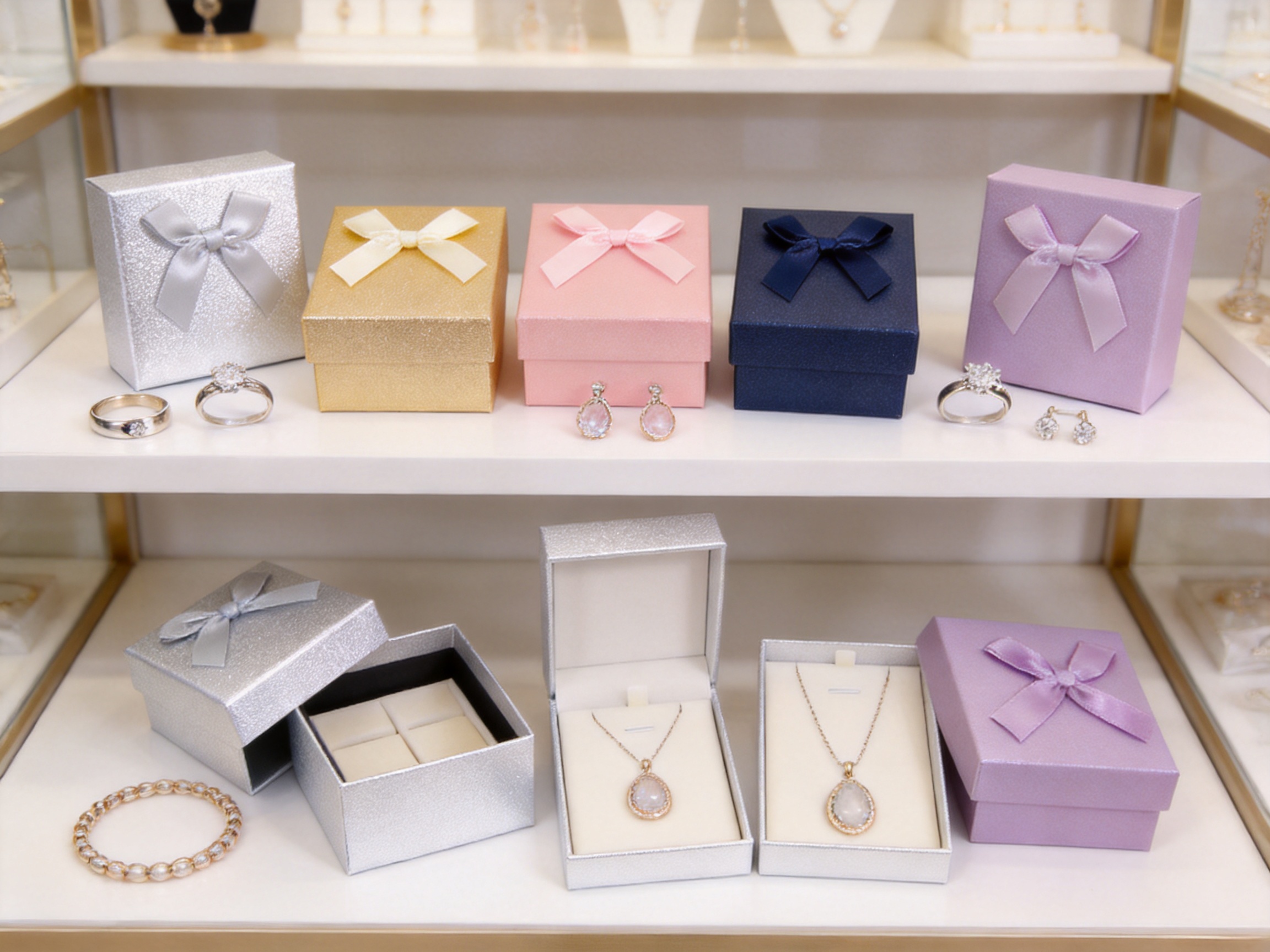
The HY-1 box can be displayed in several ways. On a jewelry counter, it may be placed beside the product to show the complete gift presentation. In an online store, photographs can show the closed box, the ribbon detail, and the open interior. In a gift shop, multiple colors can be arranged together to create a festive visual display.
For a jewelry salesperson, the box provides a natural point at which to discuss gifting. The customer can see that the purchase is ready for presentation, which may simplify the decision to buy for an occasion. Retailers can also use the box as part of a premium packaging upgrade or loyalty benefit.
In e-commerce fulfillment, the decorative box should be placed inside suitable protective shipping packaging. Glitter paper and ribbon can be damaged by compression, abrasion, moisture, or careless handling. A well-designed shipping carton, cushioning material, and appropriate packing arrangement help preserve the box’s appearance until it reaches the consumer.
The unboxing sequence can be incorporated into marketing content. A short video can show the ribbon, the lifting of the lid, and the presentation of the jewelry. Because the box has a clear focal point and a recognizable opening action, it can work well in product demonstrations, event content, and seasonal campaigns.
Customer experience also depends on proportion. The jewelry should fit the interior properly, and the insert should make the product easy to see. A beautiful outer box cannot compensate for an interior that allows the item to move, disappear, or become difficult to remove. The outer design and inner presentation should therefore be developed as one packaging system.
Before placing an order, buyers should prepare accurate information about the jewelry product and intended use. This includes the product dimensions, weight, shape, insert requirements, number of pieces per box, preferred box colors, ribbon preferences, branding needs, order quantity, target market, and expected delivery schedule.
Samples should be evaluated for lid fit, corner quality, surface consistency, bow position, color, interior dimensions, and protection during handling. Buyers should open and close the sample repeatedly to confirm that the structure feels smooth and stable. Jewelry should also be placed inside the sample to verify that the insert provides the intended support.
Color approval is particularly important for glitter paper and ribbon. Digital images may not accurately represent reflective materials. Physical samples viewed under relevant lighting conditions provide a more reliable basis for approval. If exact color consistency is important, the buyer and manufacturer should establish an approved reference sample or color standard.
Packaging tests should reflect the intended supply chain. A retail-only box may require different protection from a box shipped directly to consumers. Buyers should consider stacking, vibration, compression, humidity, and handling conditions. The final packing method should protect both the box structure and the decorative bow.
| Specification Area | Key Questions | Why It Matters |
|---|---|---|
| Box dimensions | What are the jewelry dimensions and required internal clearance? | Ensures the product fits securely without excessive empty space. |
| Construction | Should the lid and base have a firm, standard, or easier-opening fit? | Balances presentation, usability, and storage performance. |
| Surface | Which glitter-paper color, texture, and visual intensity are required? | Defines the visual position of the packaging and supports brand consistency. |
| Ribbon | What ribbon color, width, material, and bow style should be used? | Creates coordination with the jewelry, campaign, or event theme. |
| Interior | Is a ring, earring, necklace, bracelet, or multi-item insert needed? | Protects the product and improves the opening presentation. |
| Branding | Should a logo or message appear on the lid, insert, or accompanying package? | Improves brand recognition without overwhelming the decorative design. |
| Quality control | Which defects must be rejected during inspection? | Creates a clear standard for mass production and repeat orders. |
| Shipping | How will the boxes be packed and protected for the destination market? | Reduces damage to corners, surfaces, ribbons, and finished assemblies. |
Packaging is one of the most visible expressions of a jewelry brand. A business that sells affordable fashion jewelry may use the glitter box to create an exciting gift experience. A boutique brand may select restrained colors and a small logo to emphasize elegance. A wedding supplier may coordinate the ribbon with event colors. The same basic product can therefore support different market positions through carefully selected customization.
The box can also help create consistency across collections. If a brand uses the same square shape and bow concept for different jewelry categories, customers may recognize the packaging before reading the label. Consistent packaging can make a product line look more organized and professional across stores, websites, trade events, and social media channels.
At the same time, variation can be introduced through color, ribbon, insert, and seasonal finishing. This allows the brand to maintain a recognizable structure while producing special editions. Such an approach may be more efficient than creating an entirely new package for every campaign.
The box’s gift-ready appearance can be particularly valuable for brands that sell through channels where the packaging is seen by the final recipient. When the purchaser sends jewelry directly to another person, the box becomes part of the message. It should communicate care and occasion even when the buyer is not physically present.
Decorative packaging must remain functional. The glitter paper should not interfere with opening, the bow should not prevent stacking, and the interior should protect rather than conceal the jewelry. The HY-1 design is effective because its decorative elements are concentrated on a clear structural foundation.
The square shape supports stable placement. The separate lid provides access. The glitter paper supplies visual interest. The bow creates a gift signal. Each feature has a distinct role, and together they form a cohesive package. The design does not depend on excessive structural mechanisms to create impact.
This balance can be important for businesses that need packaging to work across retail, storage, shipping, and gifting. A box that looks attractive but is difficult to open or expensive to transport may create operational problems. Conversely, a box that is highly efficient but visually plain may fail to meet customer expectations for premium presentation. The HY-1 format aims to occupy a practical middle ground.
Repeat orders should be compared with the approved sample and documented specifications. Important checkpoints include paper color, glitter density or visual effect, lid fit, base dimensions, ribbon color, bow placement, insert construction, logo position, and outer-carton packing. A consistent inspection checklist helps identify deviations before products are shipped.
Production samples may be approved before mass production begins. This allows the buyer to review how the selected materials and finishing methods work together. If changes are required, they can be addressed before the full order is completed. For large or recurring programs, a retained reference sample can provide a useful comparison for later batches.
Factory communication should include clear drawings, measurements, color references, approved artwork, packing instructions, and quality standards. Photographs and written descriptions are helpful, but physical samples may be necessary for reflective surfaces and tactile materials. Clear documentation reduces the risk of different interpretations between design and production teams.
Shihao’s combination of manufacturing space, production staff, design resources, equipment, and export experience provides a foundation for managing these processes. The buyer remains responsible for confirming the exact specifications and approval procedures for each project, but a capable supplier can make the process more organized and responsive.
The box can be used for rings, earrings, pendants, necklaces, bracelets, charms, small accessories, and selected jewelry gift sets. The most suitable interior depends on the dimensions and shape of the product. A fitted insert should be selected when the jewelry needs extra support or a specific display position.
Yes. The separate lid and base allow the recipient to open and close the box after the original gift has been removed. It may be reused for jewelry, keepsakes, accessories, or other small items, provided it is kept in suitable conditions and handled carefully.
Ribbon color and other ribbon details can be discussed according to the project requirements. Buyers should provide a preferred color reference and approve a physical sample when precise coordination is important.
The square format can be adapted to different dimensions for different jewelry products. Final sizing should be based on the product measurements, insert design, required clearance, and intended presentation.
Interior configuration should be confirmed for each order. Inserts can be developed according to the jewelry category, such as ring, earring, necklace, bracelet, or multi-item support. The insert should be tested with the actual product before mass production.
Glitter paper has a reflective surface that creates a shimmering visual effect under different lighting conditions. It gives the box more decorative impact and can support festive, premium, romantic, or celebratory product positioning.
The bow is designed as part of the finished lid presentation. The exact attachment method should be confirmed with the manufacturer because it may depend on the ribbon type, box material, handling requirements, and production specifications.
Branding options can be discussed during product development. A logo may be placed on the lid, interior, insert, label, or accompanying packaging, depending on the desired appearance and selected finishing method. Artwork and placement should be approved before production.
Finished boxes should be packed in protective outer cartons with an arrangement that limits crushing, abrasion, moisture exposure, and bow deformation. The exact packing method should reflect the shipping route, handling conditions, order quantity, and destination requirements.
The manufacturer reports BSCI and FSC certifications. Buyers should request current documentation and confirm the scope of the relevant certification for the specific materials and production program.
Yes. The design is suitable for jewelry retailers, brands, gift companies, wedding suppliers, and promotional businesses requiring repeatable packaging. Order quantity, customization level, lead time, and final specifications should be confirmed before production.
A physical sample is recommended because reflective materials can appear different in photographs and under different lighting. Buyers should evaluate the sample under conditions similar to the intended retail or photography environment.
It can support premium positioning when the glitter paper, ribbon, insert, branding, and finishing quality are carefully coordinated. The final market position will also depend on the jewelry, product photography, retail environment, and overall brand presentation.
Useful information includes the jewelry type and dimensions, desired box size, quantity, paper and ribbon preferences, insert requirements, logo or artwork, destination market, packaging requirements, and desired delivery schedule. More complete information generally supports a more accurate quotation and development plan.
The HY-1 square top-and-bottom-cover glitter paper jewelry gift box with ribbon bow combines decorative appeal with practical packaging performance. Its square structure is stable and easy to organize, its separate lid supports a satisfying opening experience, and its glitter-paper exterior gives the package a visible shimmer that can distinguish it from ordinary jewelry cartons. The centered ribbon bow adds a tactile and emotional detail, turning the package into a ready-to-present gift.
Its strongest advantage is the balance between visual impact and manufacturing practicality. Instead of relying on a complicated structure, the design uses a clear shape, a decorative surface, and a customizable bow to create a memorable presentation. This makes it suitable for jewelry retailers, online sellers, wedding businesses, gift companies, seasonal promotions, and brands seeking a more refined customer experience.
The product is supported by the manufacturing capabilities of Zhejiang Shihao Gift Packaging Co., Ltd., including more than 15 years of industry experience, a large production facility, a workforce of approximately 300 employees, advanced equipment, an in-house design team, substantial production capacity, and export experience. The company’s reported BSCI and FSC certifications also provide useful reference points for buyers evaluating supplier responsibility and sourcing standards.
For the best result, buyers should treat the box as a complete packaging system. Dimensions, insert design, glitter-paper color, ribbon style, branding, packing method, and quality standards should be confirmed together. With appropriate customization and careful production control, this jewelry gift box can protect the product, strengthen brand presentation, and make the act of giving more memorable.
1. Zhejiang Shihao Gift Packaging Co., Ltd. Product information for the HY-1 square top-and-bottom-cover glitter paper jewelry gift box with ribbon bow.
2. Zhejiang Shihao Gift Packaging Co., Ltd. Company profile and manufacturing capability information.
3. Forest Stewardship Council. General principles for responsible forest-based material sourcing and chain-of-custody certification.
4. amfori Business Social Compliance Initiative. General principles concerning social compliance assessment in international supply chains.
5. Packaging Institute. General principles of paperboard packaging design, structural performance, and quality inspection.
6. International Organization for Standardization. General quality management principles for manufacturing and supplier evaluation.
Recommended Products

Contact Us

No. 15, Xiayang Road, Huangzhai Town, Jinhua, Zhejiang, China

(+86) 579-84230069

(+86) 13085675766


Products

Gift Box Packaging Manufacturer
 English
 Français
 Español
 عربى