2026-07-24
The perfume industry relies heavily on presentation, but behind every elegant fragrance lies a critical engineering challenge: protecting a fragile glass bottle through transport, retail handling, and gifting moments. The Lid And Base Perfume Gift Box has become one of the most widely adopted structures for this purpose, combining simplicity in form with surprisingly strong protective performance.
Perfume packaging studies consistently highlight that glass bottles are highly sensitive to vibration, pressure imbalance, and impact during shipping, especially around neck and shoulder areas where structural stress tends to concentrate. Proper box structure and insert design significantly reduce breakage risk across the supply chain.
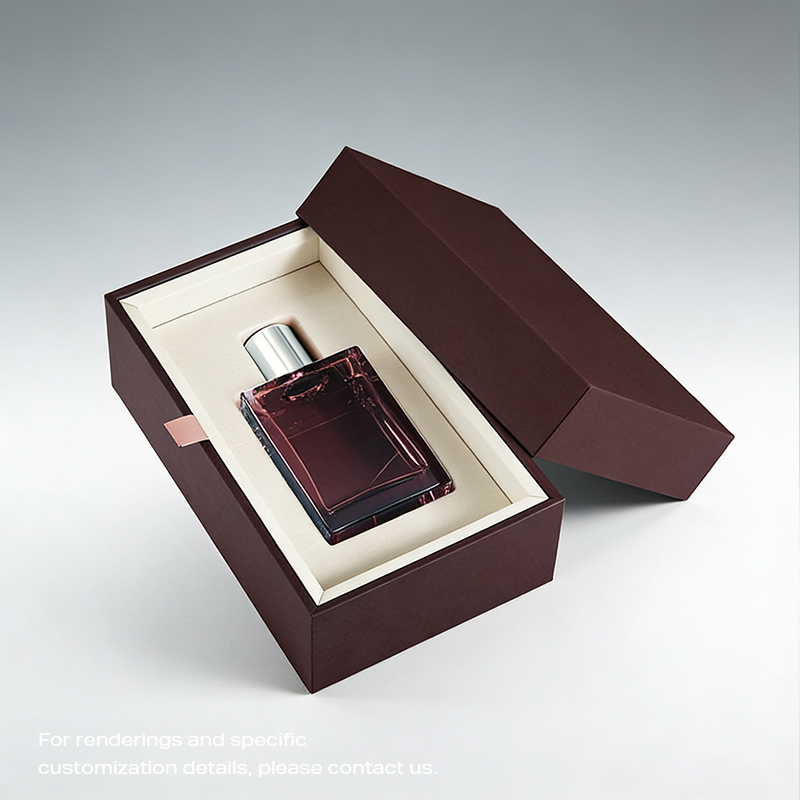
Perfume bottles are not uniform objects. Even within the same product line, variations in height, cap weight, and glass thickness change how forces travel through the packaging system.
Industry packaging engineering emphasizes three key risk factors that directly influence damage rates:
Without structural control, even short-distance handling can create micro-movements that gradually weaken the bottle or lead to sudden breakage during impact.
The lid-and-base format is built on a simple concept: a separate lid covers a rigid base that holds the product in a fixed position. This separation allows engineers to optimize both protection and presentation independently.
The base section carries the weight of the bottle and insert system. Rigid greyboard structures typically range between 1000–1800 gsm, providing sufficient compression resistance to maintain shape during stacking and transport.
Inside the base, inserts such as EVA foam, molded pulp, or die-cut cardboard trays are used to immobilize the bottle. This reduces lateral movement, which is one of the primary causes of glass fracture during transit.
The lid creates a controlled reveal sequence. Rather than exposing the bottle immediately, the lifting motion slows down the unboxing process, reducing accidental impact and enhancing perceived luxury.
Not all lid and base perfume boxes behave the same way. Structural variations significantly affect both durability and user experience.
| Structure Type | Design Feature | Functional Benefit |
| Standard lid and base | Simple two-piece fit | Cost-efficient protection and easy assembly |
| Shoulder lid and base | Inner shoulder frame | Improved alignment and reduced lid shift |
| Magnetic-enhanced base | Hidden magnetic closure | Stronger sealing during handling |
| Drawer hybrid system | Sliding inner tray | Extra motion control and premium reveal |
Each structure adjusts how force is distributed when the box is dropped, tilted, or compressed during transport.
Despite newer packaging innovations, lid and base boxes remain widely used because they balance protection, cost, and brand presentation flexibility.
Manufacturing data shows that rigid lid-and-base formats are particularly effective for glass bottles due to their ability to combine structural rigidity with customizable insert systems.
Perfume packaging is not evaluated purely on safety. Emotional response plays an equally important role in shaping user perception.
The unboxing experience created by lid and base boxes often becomes part of brand storytelling. The gradual lift of the lid, the reveal of the bottle, and the structured interior layout all contribute to perceived value.
User feedback patterns in fragrance communities also show that damaged or poorly fitted packaging can negatively affect the overall impression of a perfume, even when the fragrance itself remains intact. This reinforces the importance of combining protection with presentation consistency.
Although widely used, lid and base structures are not without challenges.
These limitations are typically managed through precision die-cutting, controlled fitting tolerances, and reinforced insert engineering.
The Lid And Base Perfume Gift Box remains a foundational structure in fragrance packaging because it addresses both physical protection and sensory presentation at the same time. Its value is not derived from complexity, but from balance—between rigidity and elegance, between safety and storytelling.
Fragile perfume bottles require more than decorative packaging. They require controlled environments that minimize movement, absorb impact, and maintain visual harmony from production line to end user. Lid and base structures continue to meet that requirement with consistent reliability, making them a quiet standard in modern perfume design.
Recommended Products

Contact Us

No. 15, Xiayang Road, Huangzhai Town, Jinhua, Zhejiang, China

(+86) 579-84230069

(+86) 13085675766


Products

Gift Box Packaging Manufacturer
 English
 Français
 Español
 عربى
عربى